
Think about the last time you watched a YouTube video, travel vlog, or Instagram Reel. Chances are, a tripod was somewhere behind the scenes.
As content creation explodes, Ulanzi and Peak Design are taking very different routes to win creators. One focuses on accessibility and variety, while the other bets on premium design and engineering.
In the Ulanzi tripod vs Peak Design Tripod battle, which brand is winning? Let’s uncover.
Company Profile Comparison: Ulanzi vs Peak Design
Both Ulanzi and Peak Design have built strong identities in the camera accessories market, but their company profiles reveal very different origins, customer bases and business positioning.
Take a look at the table below to understand how the two brands compare in terms of their history, leadership, core business, and target customers-
| Company Profile | Ulanzi | Peak Design |
| Founded | 2016 | 2011 |
| Founder(s) & CEO | William Zou | Peter Dering |
| Headquarters | Shenzhen, China | San Francisco, USA |
| Core Business | Creator and camera accessories | Premium camera and travel gear |
| Primary Customers | Creators, vloggers, photographers, videographers | Photographers, creators, travelers, professionals |
Ulanzi vs Peak Design: Two Very Different Business Strategies
Ulanzi describes itself as a one-stop photography and videography provider. Its range includes tripods, lights, microphones, quick-release systems and other accessories, allowing it to serve creators across multiple budgets.
Peak Design takes a premium route. Founder Peter Dering launched the company after designing a better way to carry a camera and taking the idea to Kickstarter. The company emphasizes thoughtful features, durability and design, creating a clear premium position.
Ulanzi Tripod vs Peak Design Tripod: The Product Battle
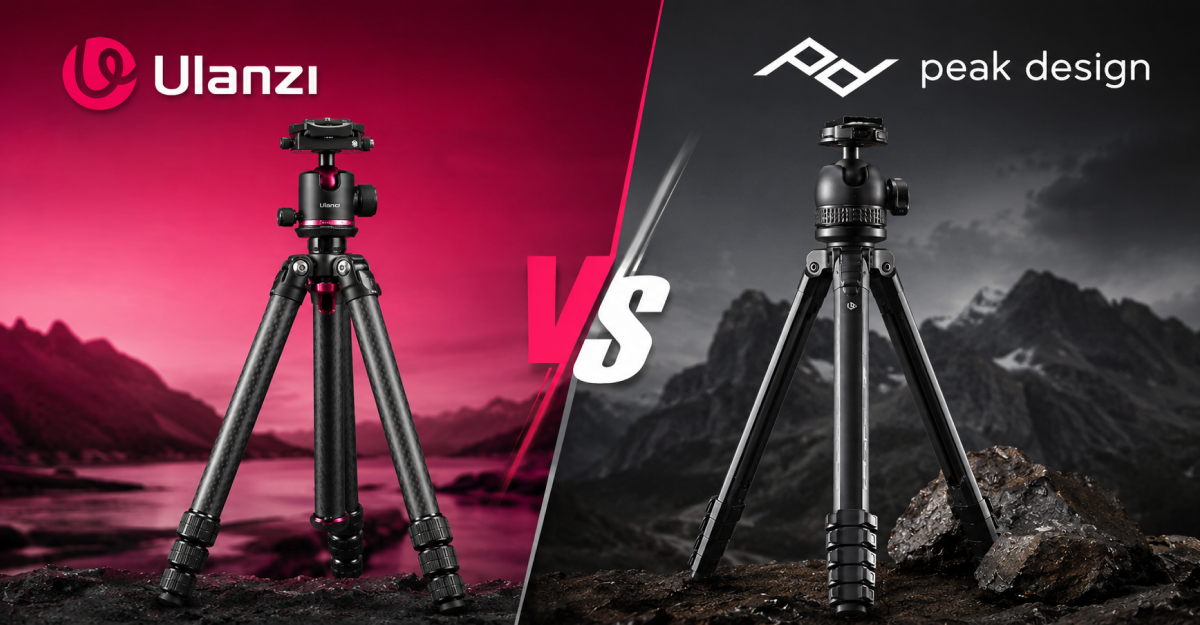
The Ulanzi Zero Y and Peak Design Travel Tripod show the contrast. Both target travelers wanting full-size capability without a bulky tripod. The Zero Y uses carbon fiber, weighs about 1.1 kg and folds to roughly the size of a water bottle. It uses an Arca-Swiss-compatible head and lever locks.
Peak Design’s Travel Tripod similarly folds to about the diameter of a water bottle. Its integrated ball head and compact architecture reduce bulk while retaining full-height usability.
Portability attracts travelers and creators, while clever design can justify premium pricing. Ulanzi offers strong functionality at a lower entry price. Peak Design makes design part of the product’s value.
| Product | Approx. Price | Positioning | Target Customer |
| Ulanzi Zero Y Carbon Fiber | $279.95 | Value-focused | Creators and travelers |
| Peak Design Travel Tripod Aluminum | $399.95 | Premium | Photographers and creators |
| Peak Design Travel Tripod Carbon Fiber | $599.95 | High-end | Professionals and enthusiasts |
Prices are current US list prices from official product pages and may vary by country, retailer, sale and configuration.
Pricing: Where Ulanzi Has a Major Advantage
Price is one of Ulanzi’s strongest business weapons. Its Zero Y starts at $279.95, compared with $399.95 for Peak Design’s aluminum Travel Tripod and $599.95 for its carbon-fiber version.
That gap can attract beginners, students, amateur photographers, YouTubers, influencers and budget-conscious professionals.
Peak Design is not simply selling materials and specifications. Its premium price reflects design, engineering, durability, and brand experience.
Business Strategy Comparison: Ulanzi vs Peak Design
The competition between Ulanzi and Peak Design goes far beyond their tripods, with both brands taking very different paths to capture the growing creator and photography market.
Go through the comparison below to see how their product ranges, pricing strategies, competitive strengths, and market opportunities stack up.
| Business Factor | Ulanzi | Peak Design |
| Product Range | Tripods, lighting, microphones, mounts, cages, mobile gear | Tripods, camera bags, travel gear, straps, clips |
| Key Tripod | Zero Y, Zero F38 | Travel Tripod |
| Positioning | Affordable, creator-focused | Premium, design-led |
| Pricing Strategy | Value and broad price range | Premium pricing |
| Competitive Edge | Variety, accessibility, creator ecosystem | Design, innovation, brand loyalty |
| Major Competitors | SmallRig, DJI, Manfrotto, Joby | Manfrotto, Gitzo, Ulanzi |
| Sales Model | E-commerce and direct-to-consumer | Direct-to-consumer and global retail |
| Market Opportunity | Mass creator and emerging creator market | Premium creator, photography and travel market |
Who Is Dominating the Creator Economy?
The customer base has expanded beyond traditional photographers. YouTubers, TikTok creators, Instagram influencers, travel bloggers, vloggers, small businesses and mobile creators all need stable images and video.
This expansion potentially favors Ulanzi. Lower prices and a broader portfolio make it easier to reach emerging creators. A customer may start with a tripod and later buy a light, microphone, cage or mounting system.
Peak Design is positioned toward customers with stronger purchasing power and established preferences. Its brand material describes customers as generally higher-earning early adopters who value thoughtful features and durability.
Brand Power vs Price Advantage
Peak Design’s advantage is brand equity. Its products are associated with travel and photography, and crowdfunding has helped build a community around launches.
Ulanzi’s advantage is accessibility. It competes across more price points and categories, creating a potentially larger addressable market. Its approach is closer to building a broad creator equipment ecosystem.
Distribution and Market Reach
Distribution can determine which strategy scales faster. Ulanzi’s online availability and competitive pricing make its products easy to discover for emerging creators. Peak Design combines direct sales with retail and dealer distribution while maintaining direct customer relationships.
Exact global market share is difficult to establish. Both companies are private, and comparable tripod-specific sales figures are not publicly available. They also compete across broader camera-accessory categories, making a clean market-share comparison unreliable.
Ulanzi Tripod vs Peak Design Tripod: Which Business Model Is Stronger?
| Business Factor | Ulanzi | Peak Design |
| Pricing | Strong value | Premium |
| Target Audience | Broad creator base | Premium photographers and creators |
| Product Range | Broad | Focused ecosystem |
| Premium Positioning | Growing | Strong |
| Creator Economy Reach | Potentially broader | More selective |
| Brand Loyalty | Expanding | Established |
| Innovation | Fast expansion | Design-led |
| Global Opportunity | High volume potential | Premium growth |
The Bigger Camera Accessories Market
Creator-led video, travel content, mirrorless cameras, smartphones and compact cameras are expanding demand across the photography accessories market.
Buyers increasingly want connected product families covering tripods, microphones, lights, cages, mounts and bags. Ulanzi has an advantage in breadth, while Peak Design has built an ecosystem around camera carry, travel and lifestyle.
Note: Did you know that YouTubers Are Beating Hollywood At Filmmaking? We have covered this article here- Top 10 Strategies of YouTubers to Beat Hollywood. Give it a read for more info.
So, Who Is Winning?
There is no reliable public evidence to declare an outright market-share winner.
Ulanzi appears to be winning on accessibility and potential volume. Its pricing and broad creator portfolio position it well as more people enter content creation. Peak Design appears to be winning on premium brand value. It has made design and engineering central to the buying decision, allowing it to command higher prices.
So, in the Ulanzi tripod vs Peak Design Tripod battle, Ulanzi may have the stronger market-expansion strategy, while Peak Design has the stronger premium-brand strategy. If winning means reaching the largest possible creator audience, Ulanzi has the edge. If it means building a differentiated brand with pricing power and lasting loyalty, Peak Design remains difficult to beat.
The real contest is not simply about which tripod is better. It is about whether the future of camera accessories belongs to affordable creator gear sold at scale, or premium products that turn functionality into brand value. Both brands are winning on different scoreboards globally.
