
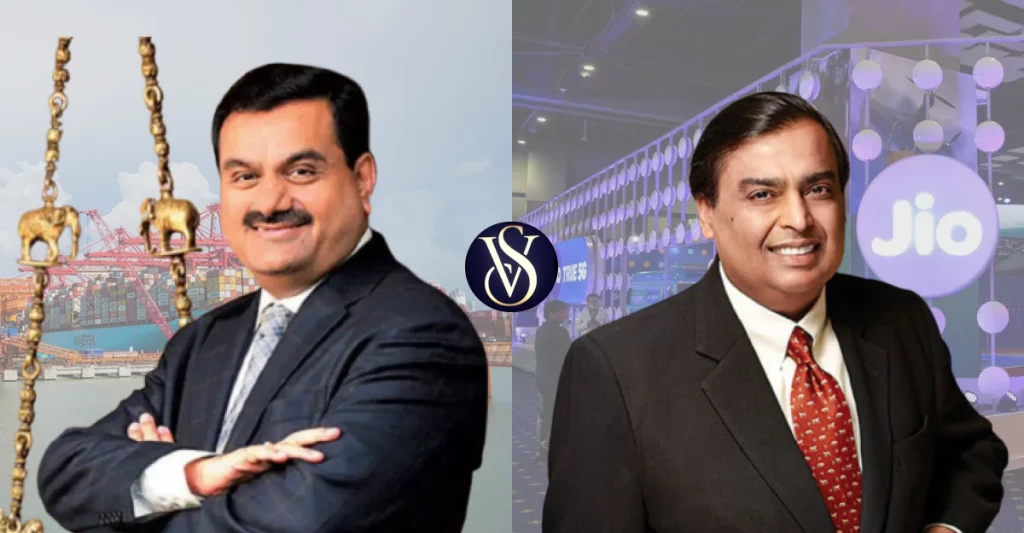
If you’ve been even a little curious about India’s business world, the names Adani and Ambani have surely caught your attention. These two tycoons—Gautam Adani and Mukesh Ambani—have become the face of modern Indian capitalism. Their success stories are not just about money; they’re about ambition, risk, politics, and power.
In this article, we’ll take you through the full picture of Adani vs Ambani—how they built their empires, how they compete, and what their rivalry means for India and the world. Whether you’re a curious student, a market enthusiast, or someone just trying to understand India’s economic landscape, this battle of billionaires is worth exploring.
Let’s begin!
A Brief Overview of Adani vs Ambani
First of all, let me give you a brief overview of both the billionaires-
| Category | Gutam Adani | Mukesh Ambani |
| Background | First-generation entrepreneur from Gujarat, started with a small trading company. | Son of Dhirubhai Ambani, inherited and expanded Reliance Industries. |
| Net Worth (As of mid-2024) | $84 billion (approx.) | $113 billion (approx.) |
| Business Focus | Old Economy (Ports, Power Generation, Special Economic Zones, Petroleum) | New Economy (5G, Virtual Reality, IoT, Communications, Information Technology) |
| Debt Strategy | Debt-fuelled expansion, with significant debt obligations | Net-debt free strategy, using equity sales and bonds for funding |
| Recent Developments | Faced significant wealth decline due to Hindenburg allegations and market volatility | Maintained position as Asia’s richest person after surpassing Adani in 2024 |
| Company Revenue | Adani Group: $32 billion | Reliance Industries: $110 billion |
| Global Ranking (2024) | 20th on Forbes’ real-time list | 11th on Forbes’ real-time list |
The Rise of Two Titans in India: Adani vs Ambani
Let’s start with where it all began-
| Particulars | Gautam Adani | Mukesh Ambani |
| Early Life | Born in 1962 in Ahmedabad, Gujarat; college dropout; started as a diamond sorter in Mumbai. | Born in 1957 in Aden, Yemen; studied Chemical Engineering at IIT Bombay and MBA at Stanford (dropped out). |
| Career Start | Began career in 1981 as a diamond sorter in Mumbai, then moved to trading commodities. | Joined Reliance Industries in 1981, working closely with his father Dhirubhai Ambani. |
| Breakthrough Moment | Secured Mundra Port contract in 1995, marking a significant turning point. | Took over Reliance Industries after his father’s death in 2002, expanding the company aggressively. |
| Personal Challenges | Survived a kidnapping attempt in 1998 and the Mumbai terror attacks in 2008. | Faced a public feud with his younger brother Anil Ambani over the family business. |
| Rise to Prominence | Rapidly expanded his business in the 2000s, becoming one of India’s richest individuals by the 2020s. | Became one of Asia’s richest men by the 2000s, leveraging Reliance’s growth in petrochemicals and telecom. |
| Leadership Style | Known for aggressive expansion and strategic risk-taking. | Recognized for strategic vision and ability to adapt to new technologies and markets. |
| Personal Achievements | Built a business empire from scratch, becoming a first-generation entrepreneur success story. | Successfully transformed Reliance Industries into a global conglomerate, expanding beyond traditional sectors. |
In other words, both of them had very different journeys. Yet they became billionaires.
Mukesh Ambani, the chairman of Reliance Industries, was born into one of India’s most famous business families. His father, Dhirubhai Ambani, was a visionary who started Reliance from scratch. Mukesh took over the reins in the early 2000s and expanded the company into energy, petrochemicals, retail, and telecom.
On the other hand, Gautam Adani, the founder and chairman of the Adani Group, is a self-made billionaire. Born in a middle-class family in Gujarat, he started as a diamond sorter and later moved into trading and ports. Over the years, he built a vast empire across infrastructure, energy, and logistics.
So, in the debate of Adani vs Ambani, one comes from legacy and the other from grit. But both are symbols of Indian ambition!
Business Empires Comparison of Adani vs Ambani
When you compare Adani vs Ambani, you’re looking at two very different business strategies.
Mukesh Ambani’s Reliance started with oil and petrochemicals but made a big shift towards consumer-facing sectors. Today, Reliance is known for:-
- Jio (India’s largest telecom company)
- Reliance Retail (India’s biggest retail chain)
- Petrochemicals and Oil Refining
Ambani’s strategy is clear- dominate sectors that touch every Indian’s life—data, fuel, shopping, and more.
Gautam Adani, in contrast, has focused more on infrastructure and nation-building sectors. His empire includes:-
- Adani Ports (India’s largest private port operator)
- Adani Green Energy (one of the biggest renewable energy companies in the world)
- Adani Power, Adani Transmission, and more
So while Ambani looks toward technology and consumers, Adani is building the backbone—ports, power, logistics, and now even airports.
You’ll get a clear picture of Adani vs Ambani business in the following table-
| Business Aspects | Gautam Adani (Adani Group) | Mukesh Ambani (Reliance Industries) |
| Market Capital (2025) | ₹14 lakh crore (~$170 billion) | ₹16.3 lakh crore (~$200 billion) |
| Revenue (2024) | ₹2.32 lakh crore (~$28 billion) | ₹8.99 lakh crore (~$100 billion) |
| Global Rankings by Market Cap | Among the top 100 globally | 68th globally |
| Key Sectors | Ports, Power, Renewable Energy, Coal Mining, Logistics, Airports | Petrochemicals, Oil Refining, Retail, Telecommunications, Media & Entertainment |
| Number of Listed Companies | 7 | 9 |
| Subsidiaries | Adani Enterprises, Adani Green Energy, Adani Ports, Adani Power, Adani Transmission | Jio Platforms, Reliance Retail, Jio Financial Services, Viacom18, Network18 Group |
| Global Presence | Operations in Australia, Indonesia, and other countries | Global operations with significant presence in the U.S., Europe, and Asia |
| Employee Base | Approx. 23,000 employees | 347,362 employees (2024) |
| Net Worth (2024) | Approx. $84 billion | Approx. $113 billion |
| Growth in Market Cap (2021–2025) | Doubled from ₹9.62 trillion to ₹19.44 trillion by 2022; current value ~₹14 trillion | Grew from ₹16.33 trillion to ₹16.3 trillion by 2025 |
Both paths are essential for India’s growth. That’s what makes the Adani vs Ambani story so interesting—they’re not just business rivals; they’re shaping different parts of the same nation.
Net Worth War: Who’s Richer?
Now let’s talk money—because no comparison of Adani vs Ambani is complete without discussing who’s richer.
As of early 2025, here’s how things stood:-
- Mukesh Ambani’s net worth: Around $91 billion (according to Forbes)
- Gautam Adani’s net worth: Around $58.7 billion (as per Forbes, after recovering from a major dip in 2023)
In 2022, Adani actually overtook Ambani and became Asia’s richest man. But after a critical report by Hindenburg Research in January 2023, Adani’s companies lost billions in market value. He bounced back impressively by mid-2024, but Ambani is once again leading in the wealth race.
That said, in Adani vs Ambani, the net worth battle is dynamic, and can change in a matter of months based on stock prices, investments, and public perception.
Stock Market Performance
If you’re into investing, you might be wondering:- whose companies perform better in the stock market?
- Reliance Industries has been a stable blue-chip stock. It’s a favorite for long-term investors.
- Adani Group stocks are more volatile, often swinging sharply with news and market trends. But they’ve given some massive returns in the past.
In 2022, Adani Enterprises saw a massive surge. But after the Hindenburg report, stocks across the group fell by over $100 billion in total market cap. By late 2023 and into 2024, the group slowly recovered after repaying debts, securing investments, and restoring investor confidence.
But the year 2025 changed it all! Here’s how-
| Category | Gautam Adam (Adani Group) | Mukesh Ambani (Reliance Industries) |
| Wealth Loss in 2025 | Over $10 billion; 20% decline in some reports | Around $3.13 billion in some reports; total loss varies by source |
| Market Cap Change (2024-2025) | 21% decline in Adani Group’s market cap, eroding ₹3.4 trillion | Reliance Industries’ market cap relatively stable, with some fluctuations |
| Stock Performance (2025) | Adani Green Energy down 48.3%, Adani Total Gas down 35.1% | Reliance Industries up 2.54% year-to-date; Jio Financial Services down 28.7% |
| Key Challenges | Hindenburg allegations, market volatility, and foreign investors selling | Market volatility, global economic uncertainties |
| Recent Market Activity | Recent rebound in Adani stocks, adding ₹400 billion in market cap | Reliance Industries’ stock performance stable despite market fluctuations |
So, if you’re comparing Adani vs Ambani from an investor’s perspective, Ambani’s companies offer stability, while Adani’s could offer high risk, high reward.
Note: We have also covered “6 biggest green hydrogen stocks in India.” Go through the article for more details.
Political Links and Controversies
The Adani vs Ambani rivalry doesn’t just play out in boardrooms—it’s also closely tied to politics.
| Categories | Gautam Adani (Adani Group) | Mukesh Ambani (Reliance Industries) |
| Political Links | Close ties with Prime Minister Narendra Modi; both hail from Gujarat. | No direct political controversies; generally seen as a business leader. |
| Controversies | Criticized for monopolistic practices, but no major political scandals. | Criticized for monopolistic practices but no major political scandals. |
| Recent Allegations | US indictment for bribery in securing solar contracts in India. | No recent major allegations related to political interference. |
| Government Contracts | Received lucrative contracts, including Dharavi redevelopment. | Major contracts in telecom and retail sectors, but less controversy. |
| Opposition Criticism | Rahul Gandhi and others have demanded investigations and arrests. | Generally not targeted by opposition for political favoritism. |
| International Scrutiny | US fraud charges impacting global reputation. | No significant international controversies related to political links. |
| Impact on Political Lanscape | Complicates political dynamics for BJP and opposition parties. | Not directly involved in political controversies affecting government policies. |
Ambani has always maintained a more low-profile political image, although Reliance has had close ties with successive governments over the decades. His Jio launch was seen as a bold move that transformed India’s telecom sector and got attention at the highest levels.
Adani, on the other hand, is often seen as being closer to Prime Minister Narendra Modi. Critics say his rise has been helped by political connections, especially in sectors like airports, energy, and ports. The Hindenburg report even accused Adani of stock manipulation and accounting fraud, though Adani Group strongly denied these claims.
In India’s polarized political environment, some see Adani as a symbol of crony capitalism, while others view him as a homegrown success story that reflects India’s infrastructure dreams.
So yes, Adani vs Ambani is not just corporate—it’s also deeply political!
Vision for the Future: Who’s Thinking Bigger?
Looking ahead, both Adani and Ambani are betting big—but on different futures.
Ambani is moving fast into 5G, digital platforms, and green energy. He’s already pledged to invest over $10 billion in renewable energy. His vision is to turn Reliance into a tech and clean energy giant.
Adani, meanwhile, is focused on infrastructure, logistics, and green power on a massive global scale. Adani Green Energy plans to become the world’s largest renewable energy company. He’s also expanding into data centers, defense, and even media.
So if you ask, “In the battle of Adani vs Ambani, who’s thinking bigger?” — the answer depends on your perspective. Ambani wants to digitize India; Adani wants to build it.
Public Image: The Billionaire Brands
Public perception matters, especially when you’re that rich.
Ambani is known for luxury. Think about the Antilia mansion, lavish weddings, and Bollywood connections. His brand is about power, class, and tradition. He rarely speaks to the media but is always in the news.
Adani, in contrast, keeps a low profile. He rarely appears in public interviews, and his image is more “businessman’s businessman.” He doesn’t flash wealth but instead emphasizes India-first messaging and quiet efficiency.
In terms of branding, Ambani appeals to aspiration, while Adani appeals to ambition. And both understand how to shape narratives in their favor.
Final Thoughts: What Does This Rivalry Mean for India?
At the end of the day, Adani vs Ambani is more than a rivalry. It’s a reflection of the new India—bold, global, and complex.
- One represents legacy and diversification (Ambani).
- The other represents rapid expansion and infrastructure power (Adani).
They are not always in direct competition, but their paths do cross—especially in energy, telecom, and media. And their actions influence everything from stock markets to policy discussions.
If you’re watching India’s economy, you can’t ignore the impact of this clash. It’s shaping the country’s next decade.
FAQs About Adani vs Ambani
Q1: Who is richer—Adani or Ambani in 2025?
Ans: As of early 2025, Mukesh Ambani is richer with a net worth of about $84 billion.
Q2: Are Adani and Ambani rivals in the same sectors?
Ans: Some sectors overlap (energy, media), but their core businesses differ: Adani focuses on infrastructure, Ambani on consumer tech and retail.
Q3: What was the Hindenburg report about Adani?
Ans: In 2023, Hindenburg Research accused Adani Group of stock manipulation and fraud. The group denied the allegations, but the report triggered major stock drops.
Q4: Who is better for investors—Adani or Ambani?
Ans: Ambani’s stocks are more stable; Adani’s offer more growth potential but carry higher risk.
So, Who’s Winning in Adani vs Ambani battle?
If you’ve read this far, you’re probably wondering: who’s actually ahead in the Adani vs Ambani face-off?
In terms of net worth, Ambani is ahead—for now.
In terms of growth speed, Adani has shown incredible momentum—even after setbacks.
In terms of diversification and global partnerships, both are expanding fast.
But maybe it’s not about who’s winning. Maybe the real story is how both are driving India forward—one building its digital future, the other its physical one.
So keep watching this space, because the battle of Adani vs Ambani is far from over—and you’re living through a key chapter in India’s business history. By the way, who do you support more in Adani vs Ambani battle?
Share your thoughts in the comment section below 🙂
