
When it comes to your favorite salty snacks, two names always come to mind — Lays and Kurkure. You might grab a pack of Lays potato chips when you’re in the mood for something light and crisp, or reach for Kurkure snacks when you crave that spicy, masala crunch.
The debate of Lays vs Kurkure has been going on for years in India’s snack world — one representing smooth Western-style comfort, and the other bringing fiery Indian flavors to life.
But what makes each of them so popular? And when you compare Lays vs Kurkure, which one really wins the taste, texture, and business battle? Let’s look into this crunchy face-off!
Profile Comparison of Lays vs Kurkure
Before you decide your winner in Lays vs Kurkure, it helps to know where each brand comes from and how they position themselves in the snack market. Both are owned by PepsiCo, but their stories are worlds apart.
Lays was born in the United States back in 1932, created by Herman W. Lay, and has since become one of the most recognized potato chip brands globally. It’s produced by Frito-Lay, the same company behind other global snack icons like Cheetos and Doritos. Over time, Lays became synonymous with fun, light, and flavorful potato chips that fit every mood.
On the other hand, Kurkure was introduced in India in 1999 as a crunchy, spicy, and “tedha medha” (twisted) snack designed especially for the Indian palate. It’s also produced by Frito-Lay India, a subsidiary of PepsiCo, but unlike Lays, Kurkure proudly represents the Indian masala snack culture — a blend of cornmeal, rice, and gram flour, loaded with bold spices and unique regional flavors.
In short, when you think of Lays vs Kurkure, you’re really comparing Western potato chips versus Indian-style extruded snacks — both delicious, but with completely different personalities.
Before going deeper, let’s briefly look at the profiles-
| Particulars | Lays | Kurkure |
| Operating Industry | Salty Snacks | Salty Snacks |
| Product Type | Potato Chips | Puffed Snack made from corn, lentil, and rice flour |
| Owner | PepsiCo | PepsiCo |
| Produced by | Frito-Lay | Frito-Lay India |
| Country | United States | India |
| Introduced | 1932 | 1999 |
| Positioning | Western Snacks | Traditional Indian Snacks |
| Markets | Worldwide | South Asia |
| Previous Owners | Herman W. Lay | No previous owners |
| Registered as a trademark in | United States and Canada | India, UK, US, and Canada |
| Competitors | Pringles, Doritos, Cheetos, Ultz, Uncle Chips, Bingo, Kurkure | Lays, Bingo, Balaji Wafers, Haldiram’s, Pratap Snacks, and Bikaji Foods. |
What’s interesting here is that both Lays and Kurkure rule different segments of the salty snacks market. Lays enjoys a global presence, while Kurkure dominates in South Asia, especially India, where spicy, tangy, masala-filled snacks are a staple. PepsiCo cleverly manages both, allowing each brand to thrive in its niche.
Features Comparison: Lays vs Kurkure Snack Experience
Now let’s crunch into what matters most — the taste, texture, and flavor of each snack. The Lays vs Kurkure flavor battle has been a topic of countless online discussions, taste tests, and snack reviews across India.
Lays potato chips are all about that delicate crispiness. Thin, light, and perfectly seasoned, each chip gives you a smooth, melt-in-the-mouth feel. The brand offers a wide variety of Lays flavors, from the evergreen Classic Salted to India’s favorite Magic Masala, and even baked and ridged versions like Lays Maxx and Lays Wavy. If you prefer something lighter or less oily, Lays even has baked potato chips and Poppables — airy 3D snacks that are lower in fat but high in crunch.
Kurkure snacks, on the other hand, are the complete opposite — loud, bold, and unapologetically crunchy. They come in unique extruded snack formats like sticks, rings, and puffs.
Each bite of Kurkure Masala Munch or Green Chutney Rajasthani Style gives you that spicy, tangy explosion of flavor that Indian consumers absolutely love. The Kurkure snack types aren’t baked, but they deliver that satisfying, hard crunch that keeps you reaching for more.
| Feature | Lays | Kurkure |
| Core Snack Format | Thin, sliced, and fried (or baked) potato chips | Extruded crunchy sticks, rings, puffs made from cornmeal, rice meal, and gram flour |
| Popular Product Lines | Classic (regular/fried chips), Baked, Maxx (deep ridges for extra crunch), Wavy (wavy potato chips), Stax (stacked crisps), Poppables (three-dimensional crisped snacks) | Solid Crunchy Sticks, Solid Rings, Solid Puffs |
| Notable Flavours (India) | Classic Salted, Magic Masala, Hot & Sweet Chili, Cream & Onion, Spanish Tomato, Masala (special Indian spice) | Masala Munch, Green Chutney, Chilli Chatka, Naughty Tomato, Solid Masti, Yummy Cheese, among others |
| Global Flavors Variety | Extensive—varies by country, featuring unique flavors such as BBQ, Sour Cream & Onion, Vinegar, international specials (e.g., Kimchi, Piri-Piri) | Focus on spicy, tangy profiles with regional Indian spice blends and masala-based flavors |
| Dietary Formats | Regular fried, baked (lower fat), Stax (stacked/potato crisps), ridged/crinkled, poppable 3D shapes | Fried crunchy shapes (sticks, puffs, rings); Not baked or low-fat |
| Main Ingredients | Potatoes, vegetable oil, seasoning, and some specialty variants | Rice meal, cornmeal, gram flour, various spices, and flavorings |
| Texture | Thin, crisp, varies by cut (classic, ridged, wavy, Stax, Poppables) | Harder crunch, robust mouthfeel (extruded), multi-shape (rings, sticks, puffs) |
When you think about Lays vs Kurkure texture difference, Lays is thin, crisp, and gentle, while Kurkure is rough, crunchy, and fiery. Lays feels like your comfort snack, while Kurkure feels like your guilty pleasure.
In terms of ingredients, Lays relies mainly on potatoes, oil, and seasoning, while Kurkure combines cornmeal, rice meal, gram flour, and spices. This gives Kurkure a unique “extruded” texture — the kind you can’t find in traditional chips.
If you love international snack flavors, Lays takes the lead with global variants like Barbecue, Sour Cream & Onion, and even local twists like Kimchi and Piri-Piri in other countries. Kurkure stays loyal to Indian taste buds — bold masalas, tangy chutneys, and regional flavors that remind you of local namkeen.
So, in the Lays vs Kurkure flavor variety race, it depends on your taste. Lays offers global subtlety; Kurkure delivers spicy desi energy.
Business Comparison: Lays vs Kurkure Market Dynamics
Beyond taste and texture, the Lays vs Kurkure business comparison tells another fascinating story. Though both belong to PepsiCo, they serve different audiences and markets.
Lays remains a global leader in potato chips, with a strong presence in over 200 countries. In India, Lays India sales for 2024–25 touched around ₹4,133 crore, translating to approximately USD 500 million, while Kurkure India sales reached ₹2,756 crore, or about USD 333 million.
When comparing Lays vs Kurkure market share India, Lays holds around 15.2%, while Kurkure follows closely with 14.3% — almost neck and neck. Both brands report steady CAGR growth between 12–15%, showing how fast India’s snack industry is expanding.
| Business Aspects | Lays | Kurkure |
| Market Valuation | $1.52 billion | $1.0 billion |
| Market Share | 15.2% | 14.3% |
| Revenue (India, 2024–25) | ₹4,133 crore (≈ USD 500 million) | ₹2,756 crore (≈ USD 333 million) |
| Expenses | ₹6,006 crore (includes manufacturing, marketing & logistics share of food division) | ₹4,133 crore (includes manufacturing, marketing & logistics share of food division) |
| Profit/Loss | ₹530 crore profit ($64 million) | ₹353 crore ($43 million) |
| CAGR Growth | 12%-15% | 12%-15% |
| Market Position | Leader in Western-style potato chips | Leader in extruded/spicy Indian snacks |
| Recent Investments | New plants in UP, Assam; expanding capacity | Focus on product innovation, expansion into namkeen categories |
| Per Capita Consumption | Low but growing rapidly in India | Low but expanding with regional penetration |
| Strategic Focus | Diversification with baked, Maxx, Stax | Expanding product range, new launch every 3-4 months |
In profitability terms, Lays edges slightly ahead with a profit of around ₹530 crore, while Kurkure records ₹353 crore. However, both spend heavily on marketing, innovation, and logistics. PepsiCo continues to invest in expanding manufacturing plants — Lays focusing on Uttar Pradesh and Assam, and Kurkure investing in new product innovation and diversifying into the namkeen segment.
When you look at Lays vs Kurkure advertising strategies, both are iconic. Lays often uses celebrity ambassadors like Ranbir Kapoor and Alia Bhatt to portray a fun, youthful vibe — “Smile with Lays.” Meanwhile, Kurkure’s ads, featuring stars like Juhi Chawla and Akshay Kumar, play on the quirky, Indian side of humor — emphasizing the “tedha medha” (twisted fun) character of the snack.
Another interesting business point is Lays vs Kurkure brand loyalty. Consumers of Lays tend to see it as an everyday comfort snack, while Kurkure’s audience treats it as a spicy indulgence — something that pairs perfectly with tea or long chats with friends.
From a market positioning view, Lays dominates the Western-style chips category, while Kurkure is the leader in extruded Indian snacks. Together, they help PepsiCo cover both ends of India’s fast-growing savory snacks industry.
Who Is the Winner? The Lays vs Kurkure Verdict
So, after crunching through facts, figures, and flavors, who really wins the Lays vs Kurkure battle? Well, it depends on what you want from your snack.
If you crave something light, globally inspired, and crispy, then Lays potato chips are your go-to. They’re available in multiple packaging sizes, from ₹10 pocket packs to larger family bags, offering options for every mood. Lays’ baked and Stax versions are slightly better if you’re watching calories, with fewer fats than the classic fried variants.
But if your heart beats for Indian masala, crunch, and spice, then Kurkure snacks are unbeatable. They’re flavorful, intense, and made for the desi palate. With constant flavor innovation and regional launches, Kurkure flavors like Masala Munch and Chilli Chatka never fail to deliver a punch.
In a Lays vs Kurkure taste test, most consumers find Lays milder and lighter, while Kurkure brings stronger spices and crunch. If you prefer potato chips vs extruded snacks, your pick will naturally depend on texture preference — smooth vs gritty.
In terms of Lays vs Kurkure nutritional comparison, both are indulgent rather than healthy. Lays has around 160 calories per serving, Kurkure about 150, but both are fried and high in sodium. Moderation is key for both. Neither is “healthy,” but both are fine as occasional treats.
If we look at Lays vs Kurkure market competition, both brands face challenges from Bingo, Balaji Wafers, Haldiram’s, Pratap Snacks, and Bikaji. Still, their branding power and PepsiCo’s strong distribution network keep them miles ahead of smaller competitors.
The real winner, though, is you, the consumer — because you get to enjoy two completely different snack experiences from the same company!
Conclusion
In the end, the Lays vs Kurkure rivalry isn’t just about two snack brands — it’s a reflection of India’s evolving food culture. Lays represents the modern, globalized India — people who love Western-style snacks but crave local twists like Magic Masala. Kurkure, on the other hand, embodies the spirit of Indian streets — bold, spicy, quirky, and proudly desi.
When it comes to Lays vs Kurkure price difference, both remain affordable mass-market snacks, but Kurkure often offers a slightly larger portion size for the same price point, giving it a value edge for budget-conscious snackers. However, Lays maintains a premium image with sleeker packaging and international appeal.
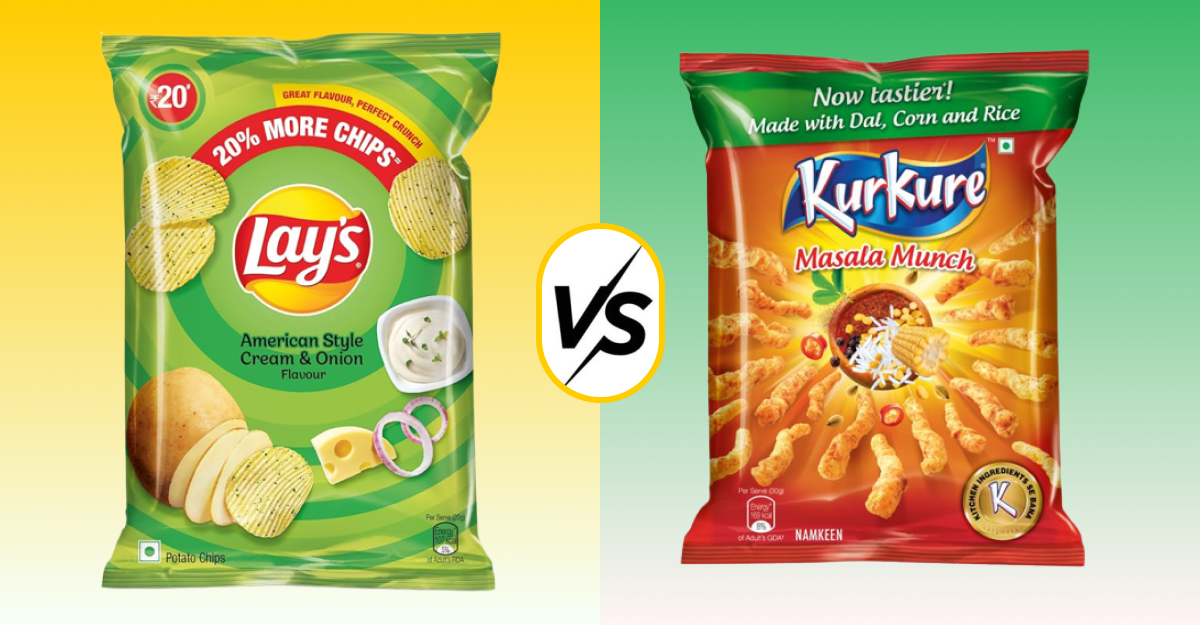
From a business perspective, Lays leads in global outreach and profit margins, while Kurkure excels in innovation and local market penetration. Together, they help PepsiCo dominate both Western and Indian snack segments, building a powerful snack portfolio that no rival brand has matched yet.
If we talk about Lays vs Kurkure snack health impact, both should be eaten occasionally, not daily. Their high fat and sodium levels make them guilty pleasures — tasty but not nutrient-rich. Yet, their emotional connection with consumers is undeniable. From movie nights to train journeys, from picnics to office breaks — these snacks have become a part of India’s shared food memories.
So, next time you’re at the store deciding between Lays and Kurkure, think about what you’re craving. Do you want something smooth and crispy, or bold and spicy? Either way, you’re reaching for a brand that has mastered the art of snacking.
And that’s the beauty of Lays vs Kurkure — two sides of the same crunchy coin, both irresistible in their own way.
FAQs
Q1. Is Kurkure healthy to eat?
Kurkure is made from rice meal, corn meal, and gram flour with added spices and palm oil. It’s high in fats and sodium, so enjoy it occasionally.
Q2. Is Lays healthy or not?
Lays are fried potato chips high in fats and calories. They’re not healthy for regular consumption but fine as a treat.
Q3. Is Kurkure owned by Lays?
No, both are owned by PepsiCo India, but they’re different product lines under the same company.
Q4. Who is Lays’ biggest competitor?
In India, Haldiram’s, Balaji, and Bingo are strong competitors.
Q5. Lays vs Kurkure calories count?
Lays: ~160 calories/serving; Kurkure: ~150 calories/serving.
Q6. What are the disadvantages of Lays?
High in fats and sodium, low in nutrients. Should be eaten moderately.
Q7. What are the disadvantages of Kurkure?
Contains fats, sodium, and additives. Regular consumption may affect health.
Q8. Is Kurkure made of plastic?
No, that’s a myth. Kurkure is made from edible ingredients — rice meal, cornmeal, gram flour, and spices.
Q9. Kurkure vs Lays, which is healthier?
Neither is very healthy; both are fried snacks high in calories. Healthier only in moderation.
Final Words
Whether you’re a loyal Lays potato chips fan or a die-hard Kurkure snacks lover, both brands have earned their place in India’s snacking heart. The Lays vs Kurkure rivalry may never end — and honestly, that’s what keeps it deliciously exciting.
Because in this battle of potato vs corn, smooth vs crunchy, and mild vs spicy, you don’t have to pick just one — you can enjoy both, depending on your mood!
