
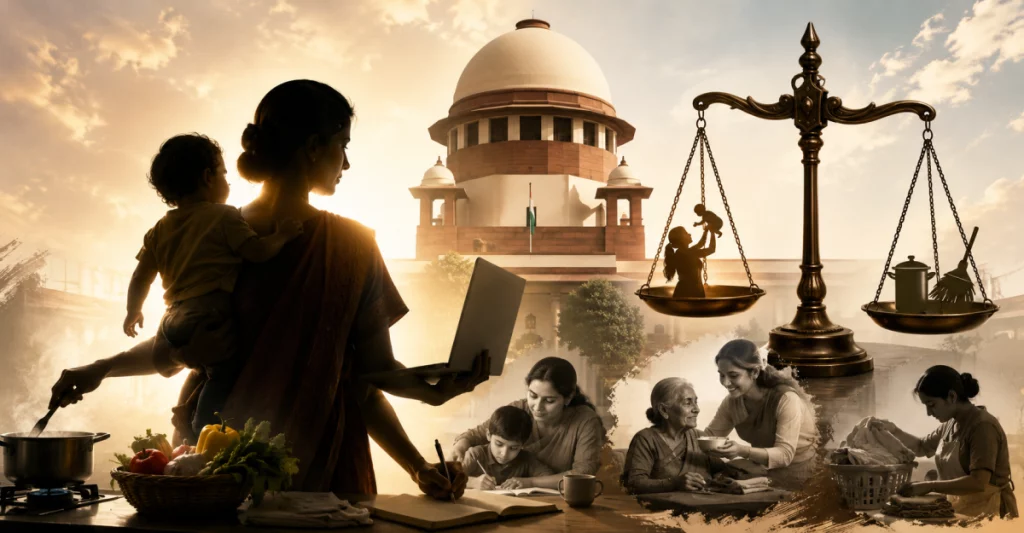
If your mother or wife suddenly stopped doing everything she does for the family, how much would it cost to replace her work? Who would cook, care for the children, manage the household, or hold everything together when life gets hectic?
For years, this enormous homemaker contribution has gone largely unrecognized in financial terms. But now, the Supreme Court has stepped in with a landmark ruling that could change the conversation forever.
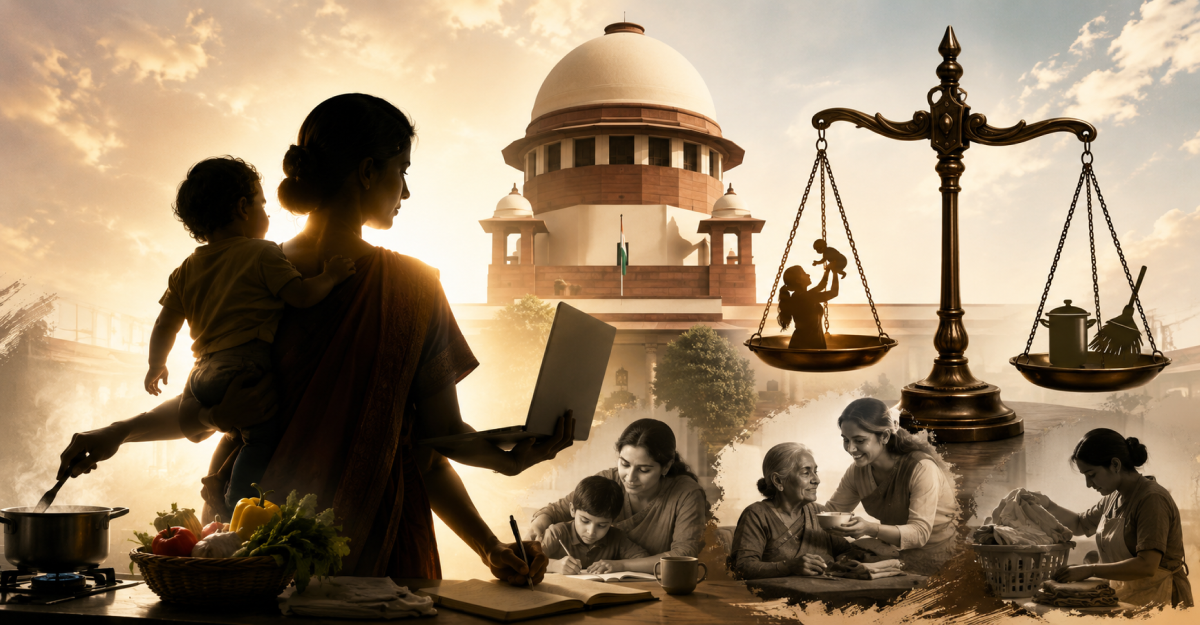
Calling homemakers “nation builders,” the Court has recognized the value of their unpaid work and said that, in eligible motor accident claims, their domestic services should be valued at a minimum of ₹30,000 per month.
Why has the Court taken this step now, and what does it mean for millions of Indian families? The details of this judgment may surprise you.
What Did the Supreme Court Say?
The Supreme Court judgment was delivered by Justice Sanjay Karol and Justice N.K. Singh, who emphasized that homemakers contribute far beyond routine household chores.
According to the Court, homemakers play a vital role in nurturing families, raising future generations, and creating the social foundation upon which society functions. Justice Karol described homemakers as “nation builders,” highlighting that their work has long remained undervalued despite its immense significance.
The ruling seeks to ensure that courts assessing motor accident claims properly account for the economic and social value of domestic care.
| Key Aspect | Supreme Court Observation |
| Status of Homemakers | Nation builders |
| Minimum Value of Domestic Care | ₹30,000 per month |
| Applicable Cases | Motor accident compensation claims |
| Additional Compensation Head | Loss of Domestic Care |
| Revision Mechanism | 10% increase every three years |
Why Is This Judgment Important?
Historically, homemakers were often treated as financial dependents when compensation was calculated after accidents. This approach overlooked the fact that entire families rely on their daily labour, caregiving, and emotional support.
The Supreme Court homemaker ruling challenges this long-standing assumption. The Court acknowledged that while homemakers may not receive a salary, their contribution is indispensable to household functioning and family well-being.
In one of the most striking observations in the judgment, the Court noted:
“It is ironic to describe a homemaker as dependent when the household itself depends on her.”
The ruling brings overdue recognition to unpaid domestic work that has traditionally remained invisible in economic calculations. It also strengthens the legal framework for homemaker compensation by acknowledging the real-world impact of domestic labour.
What Is ‘Loss of Domestic Care’?
One of the most significant aspects of the judgment is the recognition of loss of domestic care as an independent head of compensation in motor accident claims.
In simple terms, the Court recognized that a homemaker’s role extends beyond physical chores. It includes managing the household, caring for children, supporting spouses, and providing emotional stability to the family.
To account for these contributions, the Court fixed ₹30,000 per month as a baseline value for domestic care services. Importantly, if a homemaker was also earning an income through employment, this amount can be added to the proven income while calculating compensation.
| Component of Domestic Care | Examples |
| Household Management | Cooking, cleaning, budgeting |
| Childcare | Education, emotional support |
| Family Caregiving | Caring for spouse, parents, relatives |
| Social and Emotional Support | Maintaining family well-being |
The recognition of loss of domestic care expands the scope of compensation beyond financial earnings and reflects the broader reality of family life.
The Bigger Message Behind the Verdict
The Court’s observations extend far beyond motor accident claims.
According to the judgment, homemakers contribute significantly to India’s human capital by enabling other family members to pursue education, employment, and professional growth. They are often the first teachers children encounter and play a crucial role in shaping future citizens.
The Court also highlighted research suggesting that unpaid caregiving and domestic work may contribute between 15% and 17% of India’s GDP, despite not being formally reflected in traditional economic indicators.
| Contribution Area | Impact |
| Child Development | Builds future workforce |
| Household Stability | Supports earning members |
| Social Development | Strengthens communities |
| Economic Contribution | Estimated at 15–17% of GDP |
This broader perspective reinforces the idea that homemaker contribution is not confined to individual families—it has a measurable impact on society and the economy as a whole.
Note: Recently, divorce rates spiked in India. Do you know what people search the most while going through a divorce? It’s ALIMONY. Hence, we’ve covered Alimony Tax in India: What You Need to Know Before Paying or Receiving It! Give it a read and you’ll get to know sone surprising facts!!!
How the Law Has Evolved?

The latest ruling builds upon a series of important Supreme Court judgments that have gradually expanded recognition of unpaid domestic work.
Among the key decisions cited in this evolution are:
- Lata Wadhwa v State of Bihar
- Arun Kumar Agrawal v National Insurance Co.
- Kirti v Oriental Insurance Co.
- Arvind Kumar Pandey v Gyanesh Pandey
These decisions progressively recognized that the economic value of a homemaker’s work cannot be ignored simply because it is unpaid. The current Supreme Court judgment further strengthens that principle by providing a concrete framework for assessing homemaker income in compensation cases.
Supreme Court Also Addresses Delays in Compensation Cases
The judgment did not focus solely on compensation calculations. The Court also expressed concern over the prolonged delays affecting motor accident claims across the country.
While reviewing more than 100 appeals, the bench found that nearly half had remained pending for over four years. Such delays, the Court observed, defeat the purpose of providing timely relief to affected families.
To address this issue, High Courts and Motor Accident Claims Tribunals were urged to ensure faster and more efficient disposal of cases.
| Concern | Court’s Direction |
| Long pendency of claims | Faster disposal |
| Delays beyond four years | Require judicial monitoring |
| Motor Accident Claims Tribunals | Follow summary procedure effectively |
| High Courts | Monitor implementation |
Wrap-Up: A Recognition Long Overdue
At its core, this Supreme Court judgment is about far more than compensation figures. It represents a powerful acknowledgment of the economic and social value created inside Indian homes every day.
By recognizing loss of domestic care and assigning a baseline monetary value to homemaker services, the Court has moved closer to correcting a long-standing legal blind spot.
For millions of homemakers across India, the ruling sends an important message: unpaid domestic work is neither invisible nor insignificant. It sustains families, strengthens communities, and contributes to nation-building.
Through this landmark verdict, the Supreme Court has formally recognized that reality and given homemaker contribution the legal respect it deserves!
