
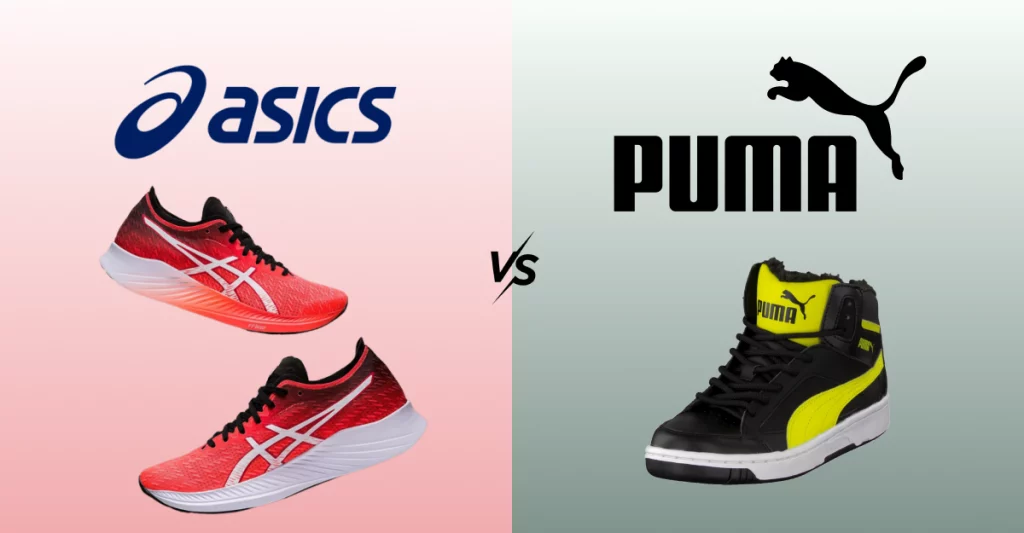
Asics vs Puma—it’s a choice every sneaker lover faces at some point. One brand is known for precision and performance, the other for bold style and everyday comfort.

Whether you’re hitting the pavement for a long run or just want something that turns heads on the street, both have something serious to offer. But when you can only pick one, how do you decide?
Let’s break it down and see which brand really fits your feet!
Profile Comparison of Asics vs Puma
When you’re choosing between Asics vs Puma, it’s like comparing two giants with very different origins and visions. Asics was born in Japan back in 1949 as Onitsuka Tiger, while Puma started a year earlier in 1948 in Germany.
Although Asics officially rebranded in 1977, it’s been shaping the running world for over seven decades.
Asics’ founder, Kihachiro Onitsuka, had one clear mission—improve the lives of youth through sports. On the other hand, Puma was created by Rudolf Dassler (yes, the brother of Adidas’ founder), and it’s always had a more fashion-forward, competitive edge.
Let’s briefly look at their profiles.
| Particulars | Asics | Puma |
| Operating Industry | Sports equipment, textile | Textile, Footwear |
| Founded | September 1, 1949; 75 years ago (as Onitsuka Tiger)1977; 48 years ago (renamed to Asics) | 1948 |
| Founders | Kihachiro Onitsuka | Rudolf Dassler |
| Headquarters | Kobe, Japan | Herzogenaurach (Bavaria, Germany) |
| Number of Locations | ≈ 1,900 outlet stores worldwide (2017) | More than 120 countries (582 stores in India) |
| Area Served | Worldwide | Worldwide |
| Key People | Motoi Oyama (Chairman and CEO) | Arne Freundt (CEO); Markus Neubrand (CFO); Maria Valdes (CPO); Héloïse Temple-Boyer (chair) |
| Products | Trainers, clothing | Sportswear; Footwear; Sports equipment, Apparel, Accessories |
| Launched in India | 2010 (through a 5-year partnership with Reliance Retail); 2015 (Launched first standalone store) | 2006 |
| Competitors | Nike, Adidas, New Balance, PUMA, Reebok, Under Armour | Nike, Adidas, Asics, Under Armour, Sketchers, New Balance, etc. |
Their headquarters reflect their culture—Asics in Kobe, Japan (precise and performance-oriented), Puma in Bavaria, Germany (stylish, bold, and global). With nearly 1,900 Asics stores and Puma’s presence in over 120 countries, both have massive global footprints.
If you’re in India, Puma has been around longer—since 2006—while Asics entered in 2010, later launching standalone stores in 2015. So, if you’re comparing Asics vs Puma for your next pair of sneakers, you’re dealing with two brands that have deep roots and global credibility.
Asics vs Puma: Features Comparison
Here’s where things get interesting. If you’re a runner, athlete, or someone who needs high-performance footwear, the Asics vs Puma debate will likely center around performance and comfort.
| Aspect | ASICS | Puma |
| Target Audience | Strong emphasis on runners, athletes, and sports enthusiasts; known for foot health and durability. | Broad appeal: runners, lifestyle, streetwear, and sports fashion. Appeals to casual and performance markets. |
| Technology & Innovation | Prominent technologies include GEL™ cushioning, FlyteFoam™, and MetaSpeed designs. Focus on stability, comfort, and leg protection | Nitro foam midsole (Velocity, Fast-R), PWRPlate; highlights responsiveness, efficiency, and aggressive ride |
| Performance (Running Shoes) | Metaspeed Sky Paris: Slightly firmer ride, marginally shorter ground contact time (194 ms), better leg spring stiffness (9.8 kN/m), more stable feel | Fast-R Nitro Elite 3: Softer, more bouncy; higher back kick, marginally longer ground contact time (195 ms); feels faster |
| Effort Efficiency | ASICS allows for good energy conservation, slightly better in fatigue reduction, especially for longer runs | Puma shoes often demonstrate greater efficiency at the same power output, enabling slightly faster paces for the same effort |
| Durability & Longevity | Highly regarded for lasting build and consistent performance over time | Good, but typically perceived as less durable than ASICS for high-mileage use |
| Fit & Comfort | Generally more secure, stable, and protective; strong focus on support for all foot types, especially overpronators | Tends to be roomier/toe-box, softer underfoot, suitable for those preferring plush comfort and bounce |
| Weight (Model Specific) | Metaspeed Sky Tokyo: ~210g (men’s 9, varies by model); focus on lightweight, race-ready shoes | Fast-R Nitro Elite 3: ~210g (men’s 9, varies by model); competitive weight for race-day performance |
| Responsiveness | Slightly firmer, offers direct ground feedback and a protective feel, lower bounce | More responsive and bouncy, emphasizing energetic toe-off and pronounced rocker geometry |
| Drop (Heel-to-Toe) | Typically in the 5–8 mm range (varies by model; e.g., GEL-Cumulus 26: 8mm) | Classic models are often 8–10 mm; Velocity Nitro 3 has a 10mm drop |
| Price Range (India) | INR 6,000–20,000+ for running shoes, premium for advanced models | INR 5,000–18,000 for performance running/lifestyle models, often competitive pricing |
| Style/Design Aesthetic | More conservative, performance-driven layouts, often seen as less “fashion-forward” | Sporty, youthful, fashion-centric; collaborations with musicians, designers, and athletes for limited editions |
| Sustainability Initiatives | Increasing focus on eco-friendly materials and processes (varies by collection) | Prominent use of recycled materials: “Forever Better” initiative, eco-friendly packaging |
| Availability (India) | Extensive: online (asics.co.in), retail partners, flagship stores, specialty run stores. | Extensive: online (in.puma.com), Puma stores, major retailers, high penetration in Indian urban markets. |
| Brand Perception | Viewed as highly technical, reliable, and optimal for serious runners | Perceived as trendy, versatile, popular in youth and streetwear scenes; strong athletic endorsements |
| Customer Feedback | Praised for comfort, stability, and injury prevention | Praised for fun aesthetics and value, but runners note less support and durability compared to ASICS |
Asics is all about science and foot health. Their shoes feature innovative tech like GEL™ cushioning, FlyteFoam™, and MetaSpeed designs. They focus on reducing fatigue and keeping your body protected over long distances. So if you’re serious about marathons or injury prevention, Asics could be your best friend.
Puma, however, doesn’t just play the performance game—it mixes it with fashion and energy. With their Nitro foam and PWRPlate, Puma offers more bounce, speed, and that “flying” sensation underfoot. They also win points in aesthetics with bold colors and limited-edition collabs with celebrities.
Asics tends to be firmer and more stable—ideal for overpronators and those needing structured support. Puma? It’s roomier, plush, and great if you love soft landings and street style.
Price-wise, there’s overlap. Asics ranges between INR 6,000 and 20,000+, while Puma starts around INR 5,000 and tops off near 18,000. In the Asics vs Puma battle, Puma gives you style and comfort for slightly less, but Asics delivers on performance and durability.
Business Comparison: Asics vs Puma
Let’s talk money—because numbers often reveal what marketing doesn’t. In the Asics vs Puma rivalry, Asics might surprise you.
| Business Aspect | Asics | Puma |
| Market Capitalization | ¥2.64 trillion ($17.77 billion) | €3.39 billion ($3.86 billion) |
| Market Share (India) | 5.38% (Q1 2025) | 9.74% (Q1 2025) |
| Revenue Earned | World: $4.41 billion India: ₹340.85 crore (about $41.06 million) | €8.82 billion (about $9.5 billion) |
| Expenses | $3.010 billion (FY25) | €3.58 billion ($4.12 billion) |
| Profits | ¥44.5 billion ($300.4 million) | €282 million ($320 million) |
| Employee Benefits | Professional development opportunities, generous parental leave, employee discounts, health insurance, soft skill training, etc. | Health insurance, retirement plans, product discounts, paid time-off |
| Cash Flow (2024) | $74 million (a 68.79% decline year-over-year) | €878.2 million ($995.3 million) |
As of 2025, Asics has a market capitalization of $17.77 billion, massively overshadowing Puma’s $3.86 billion. That’s a huge difference. In fact, Asics earns around $4.41 billion in global revenue and clocks in with profits of $300.4 million, while Puma brings in a heftier $9.5 billion in revenue but earns slightly more profit—$320 million.
What does that mean for you? It shows Asics is leaner and more efficient. They make more profit per dollar earned, and that often translates to higher product quality and smarter R&D investments.
In India, Puma leads with a 9.74% market share compared to Asics’ 5.38%. That’s because Puma is more aggressive with retail stores and lifestyle marketing, appealing to fashion-conscious youth.
But don’t overlook Asics’ solid customer perks—health insurance, parental leave, training programs—reflecting a brand that values long-term growth. Puma shines in cash flow, reporting nearly $995 million, which means it has more spending power for expansion, advertising, and product innovation.
So when you’re choosing Asics vs Puma, think about what matters more to you—technical excellence or a global style presence?
Conclusion: Who is the Winner?
Let’s not sugarcoat it—there’s no single “winner” in the Asics vs Puma showdown. It all depends on you—your lifestyle, your goals, and your preferences.
Choose Asics if-
- You’re a serious runner or athlete.
- You need supportive, injury-preventive shoes
- You prefer long-term durability
- You value foot science and innovation
Choose Puma if-
- You love fashion and streetwear.
- You want versatile shoes for casual and gym use.
- You prefer a cushioned, bouncy feel underfoot.
- You enjoy celebrity collabs and trendy designs.
In terms of value for money, both brands are competitive. Puma gives more variety for lifestyle wear, while Asics gives more consistency in performance wear. Many runners swear by Asics’ ability to prevent injuries and improve performance.
But if your daily activities involve walking, gym workouts, or even casual meetups, Puma is the more fun and flexible choice.
Note: We have also compared the following sports brands-
FAQs: Everything You Still Wonder About Asics vs Puma
1. Are ASICS shoes high quality?
Yes, ASICS shoes are known for their premium build, especially in running and stability models. They’re praised for durability and foot health support.
2. Who is ASICS’ biggest competitor?
Nike and Adidas are its primary global rivals, but in the running segment, brands like New Balance and Puma are strong contenders.
3. Is ASICS better than Adidas?
For runners and athletes, many prefer ASICS for performance and injury prevention. Adidas wins in lifestyle and casual segments.
4. Is ASICS a high-end brand?
Yes, ASICS is considered high-end in the sports category, especially due to its advanced tech and performance reliability.
5. Why is ASICS so popular?
ASICS gained popularity through consistent performance, foot support, and innovations like GEL™ and FlyteFoam™, especially among serious runners.
6. Is ASICS a Japanese brand?
Absolutely! ASICS is headquartered in Kobe, Japan, and embraces the precision and quality that Japanese engineering is known for.
7. What does “Asics” actually stand for?
It’s an acronym from the Latin phrase “Anima Sana In Corpore Sano,” meaning “A Sound Mind in a Sound Body.”
8. Did Virat Kohli buy Puma?

No, Virat Kohli did not buy Puma. He has a partnership with them and is one of their global brand ambassadors.
9. Why did Kohli reject Puma?
He didn’t reject Puma—in fact, he signed one of the biggest endorsement deals with them. There’s no public record of rejection.
Remember, the right shoe isn’t just about brand—it’s about how it fits your goals, your body, and your lifestyle. Take a walk in both and see which one feels like home.
