
Do you remember those days of 2016 when Reliance made a revolutionary announcement by launching Jio 4G for free? Reliance garnered a humongous user base for Jio, and today it is a monopoly along with Airtel in India’s telecom sector.
A similar outcome is predicted by experts in the Ice Cream industry as well!
Because Reliance has picked another everyday consumer category to test its low-price, high-distribution formula.
You read it right!
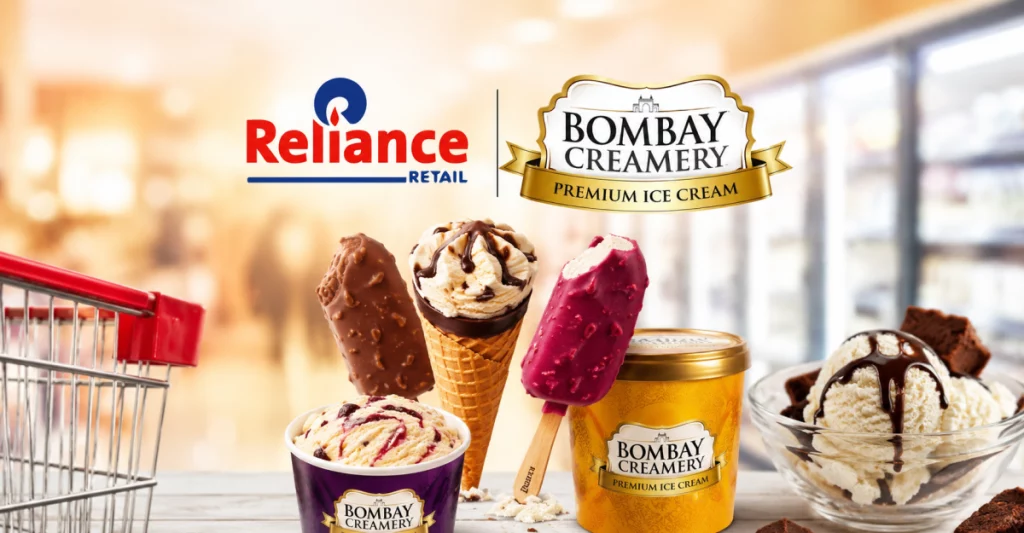
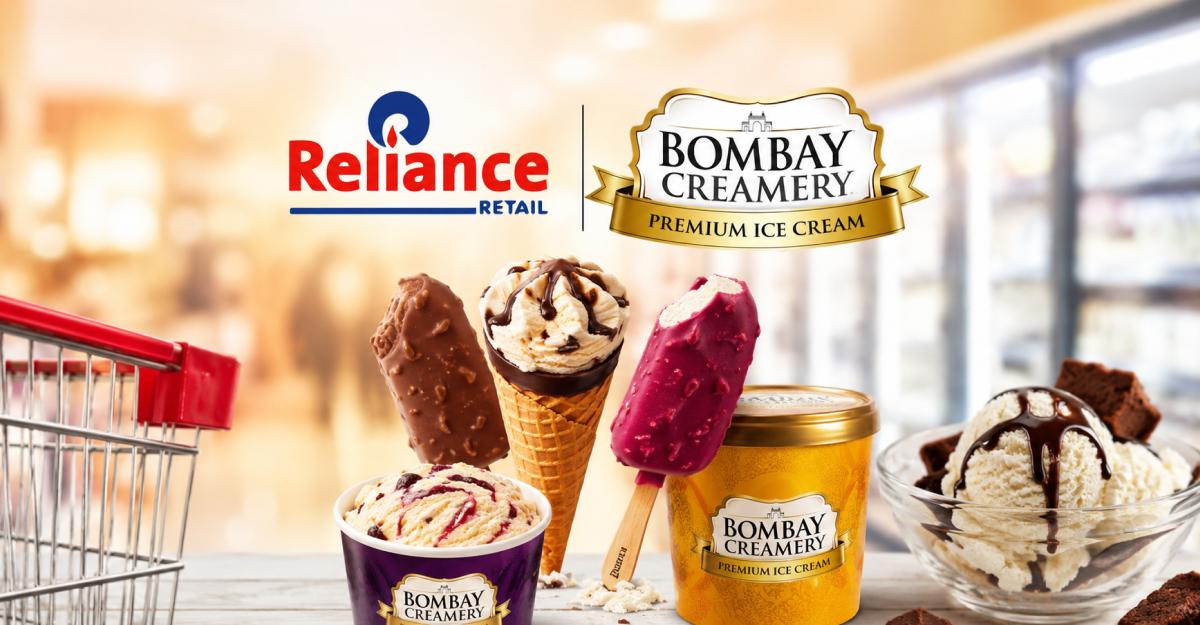
Reliance Consumer Products Ltd (RCPL), the FMCG arm of Reliance Industries, has entered India’s ice cream market with Bombay Creamery ice cream, with prices starting at ₹10.
The timing is significant. Ice cream is already a crowded market with Amul, Mother Dairy, Kwality Wall’s, Vadilal and several newer brands fighting for consumers. Reliance is now bringing one of its familiar weapons into the category: an affordable entry price backed by a huge distribution network.
The bigger question is whether ₹10, retail reach and scale can persuade consumers to switch from brands they already know.
Synopsis: Reliance Launches Bombay Creamery Ice Cream
RCPL announced the launch of Bombay Creamery on September 1, marking its formal entry into the ice cream category. The brand is being positioned as an accessible premium dairy offering, with the company saying its products are made with real dairy cream.
The range covers cones, cups, tubs, bars and sticks, with prices beginning at ₹10. The initial rollout is in western India, followed by a planned expansion across the country.
This is a new brand launched by RCPL rather than a revival of an old ice cream brand. It should also not be confused with Vantara Creamery, a separate luxury ice cream venture associated with the Reliance Foundation.
For Reliance, the launch adds another category to an FMCG portfolio that already spans beverages, staples, packaged foods and personal and home care.
Why Does The Bombay Creamery ₹10 Price Matter?
The most attention-grabbing part of the Bombay Creamery price is the ₹10 starting point.
That does not automatically make every Bombay Creamery product cheaper than its rivals because pack sizes and formats differ. But the entry price is low enough to make trial easier, particularly for price-sensitive consumers.
For perspective, a current Blinkit listing shows an Amul Gold Duetz Mango ice cream stick at ₹20 for 60 ml. Zepto also lists Amul Aamras Kulfi at ₹20 for 60 ml and Kwality Wall’s Twister Mango at ₹18 for 65 ml. Kwality Wall’s official promotional terms also identify its Twister Mango 65 ml and Mango Duet 45 ml products at ₹18 and ₹9 respectively, although the promotion itself ran earlier in 2026.
| Brand | Product/Format | Pack Size | Current/Reported Price |
| Bombay Creamery | Multiple formats | Varies | ₹10 onwards |
| Amul | Gold Duetz Mango Stick | 60 ml | ₹20 |
| Mother Dairy | Two-in-One Cup | Not independently verified | ₹10 listing |
| Kwality Wall’s | Twister Mango | 65 ml | ₹18 MRP |
Prices checked from retailer or company listings available in early September 2026. Ice cream prices vary by location and platform.
So while ₹10 is an aggressive starting point, consumers will ultimately compare quantity, taste and quality rather than the headline price alone.
India’s Ice Cream Market Is Heating Up
Reliance is entering a category that is expected to grow rapidly. Expert Market Research estimates that India’s ice cream market was worth about $3.98 billion in 2025 and projects it to reach $16.10 billion by 2035, implying a 15% CAGR between 2026 and 2035. That is a forecast, not a measure of the market’s current size.
Several forces are supporting the category, including rising disposable incomes, wider retail availability, quick-commerce and growing interest in both affordable and premium products.
Ten-minute delivery platforms are particularly relevant because ice cream is an impulse purchase. Quick-commerce has also made it easier for consumers to order frozen products without visiting a supermarket.
At the same time, brands such as Go Zero and NOTO are targeting consumers looking for lower-sugar or health-focused alternatives, adding another layer to the competition.
Bombay Creamery Enters A Crowded Market
Reliance will not be competing against weak incumbents.
Amul, Mother Dairy, Kwality Wall’s and Vadilal have years of brand recognition and distribution behind them. Naturals has built a strong premium identity, while newer players are trying to attract consumers through unusual flavours, health-focused products and modern branding.
That leaves consumers with several reasons to choose one brand over another. Price matters, but so do taste, ingredients, availability, convenience and trust.
Reliance’s challenge will therefore be bigger than getting consumers to try Bombay Creamery ice cream once. The real test will be getting them to buy it repeatedly.
Reliance’s Real Advantage May Be Distribution
This is where Bombay Creamery could become more interesting.
RCPL said its FMCG products now reach more than 3 million outlets through over 5,000 distributors. Reliance Retail also gives the group a vast physical retail footprint, while its wider ecosystem includes grocery, e-commerce and quick-commerce channels.
Ice cream, however, comes with a complication that packaged staples and many beverages do not: the cold chain.
Products have to remain frozen during transportation, storage and retail. Freezers also occupy valuable space at stores. Reuters reported that Reliance has already used branded refrigerators for Campa products, a model it could potentially extend to ice cream.
That means ₹10 pricing alone will not decide the outcome. Reliance will need consistent availability, adequate freezer infrastructure and a product good enough to generate repeat purchases.
The Campa Cola Connection: How Campa Cola Will Fuel Bombay Creamery Distribution?
The strongest parallel is Campa.
Reliance revived Campa as part of its FMCG push and used competitive pricing and distribution to take on established soft-drink companies. In FY26, Campa crossed ₹4,700 crore in gross sales and became India’s fourth-largest carbonated soft-drink brand, according to Reliance.
RCPL’s FY26 gross revenue reached ₹22,000 crore, double the previous year.
The company had also expanded its distribution to more than 3 million outlets through over 5,000 distributors.
However, Campa’s performance should be treated as a strategic precedent, not proof that Bombay Creamery will repeat the same trajectory.
There is another important correction to the original claims. RCPL’s June 2026 quarter gross revenue was reported at ₹8,600 crore, while its beverages business contributed ₹2,900 crore and daily essentials ₹3,200 crore.
RCPL did not disclose EBITDA or profit for that quarter. The ₹125 crore figure relates to a reported net loss for the four-month period following the December 2025 demerger, so it should not be presented as an EBITDA figure.
What Experts Say About Reliance Ice Cream?
Deven Choksey, managing director of DRChoksey FinServ, described the ice cream launch as part of Reliance’s longer-term strategy to capture more of consumers’ spending through an integrated ecosystem.
The point is important. Reliance does not need Bombay Creamery to succeed through pricing alone. Its larger advantage could come from putting the brand in front of consumers across multiple retail and distribution channels.
T. Krishnakumar, director at RCPL, has also emphasised the use of genuine dairy ingredients. That gives the brand a second proposition beyond affordability: offering a dairy-based product while keeping the price accessible.
Note: We have also covered- The Shocking Truth About Reliance Dominance in India: How it’s Hitting Your Wallet? Go through the article for more information.
Can Bombay Creamery Disrupt India’s Ice Cream Market?
| Factor | Bombay Creamery |
| Parent Company | Reliance Consumer Products Ltd |
| Category | Ice cream |
| Starting Price | ₹10 |
| Initial Market | Western India |
| Formats | Cones, cups, tubs, bars and sticks |
| Distribution Advantage | 3 million+ outlets and 5,000+ distributors across RCPL’s FMCG network |
| Core Strategy | Affordable pricing + distribution scale |
The opportunity is obvious. Reliance has money, retail reach, FMCG experience and an established distribution machine. A ₹10 entry point could also lower the barrier for first-time buyers.
But ice cream is not simply another shelf-stable FMCG product. Strong regional brands, consumer loyalty, cold-chain costs and the need to protect margins could all make the category harder to crack.
That is why the Bombay Creamery launch should be viewed as the beginning of a competitive battle rather than evidence of disruption.
Reliance has shown with Campa that an established category can be attacked through price and distribution. Bombay Creamery is now a test of whether that formula can work in frozen desserts too.
If the brand gains traction, established players may have to respond with sharper pricing, wider distribution, new products or stronger premium positioning. For now, the ₹10 price has started the conversation.
The real battle will be won in freezers, stores and repeat purchases!
