
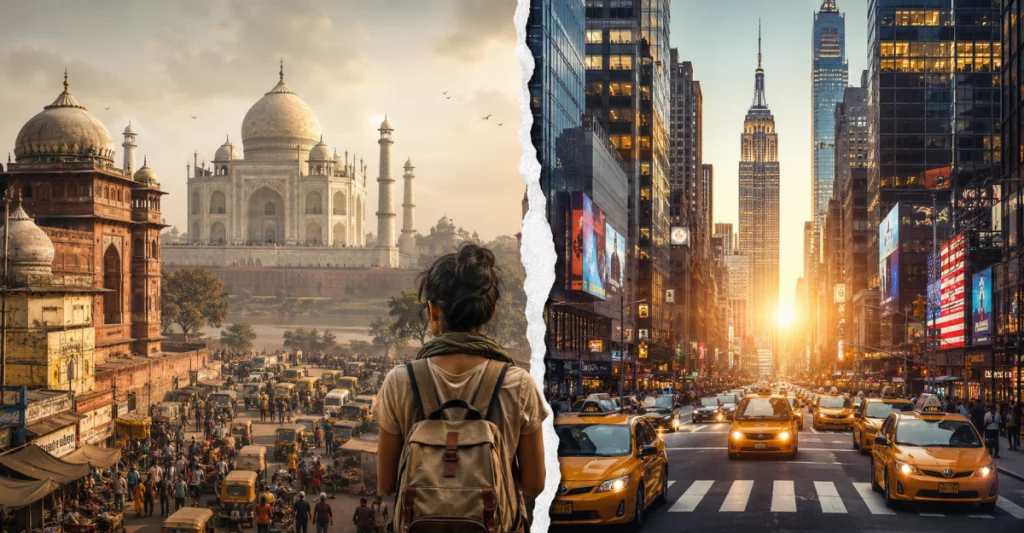
New York City welcomed 64.3 million visitors in 2024… India, a country spanning mountains, deserts, beaches, jungles, ancient temples, royal palaces, and one of the Seven Wonders of the World, attracted 9.52 million foreign tourist arrivals in 2023.
One city versus an entire nation of 1.4 billion people…
That comparison sounds almost unbelievable.
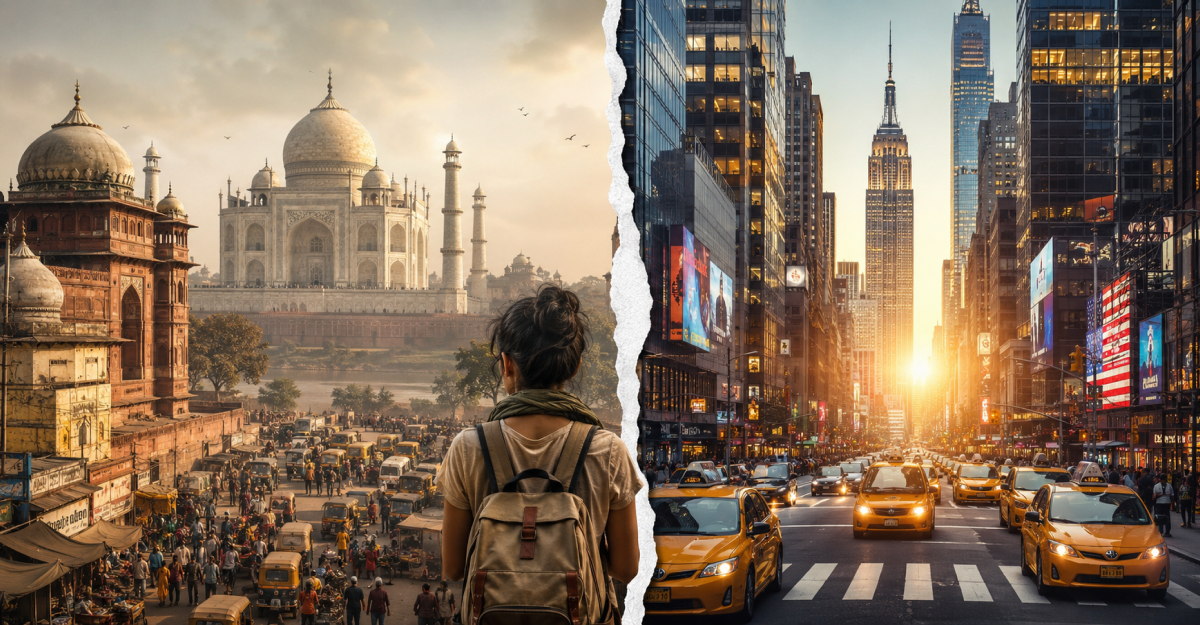
How can a single metropolitan area attract more visitors than a country that offers the Himalayas, Goa, Kerala, Rajasthan, yoga retreats, tiger safaris, and centuries of history?
So, is Indian Tourism declining?
Or is India simply failing to convert its enormous tourism potential into international visitor numbers?
The answer is more complicated than most headlines suggest.
The Numbers Don’t Add Up
Let’s start with the data.
India vs New York Tourism: A Tale of Two Destinations
| Tourism Metric | India | New York City |
| Annual Visitors | 9.52 million foreign tourist arrivals (2023) | 64.3 million visitors (2024) |
| Economic Impact | Tourism contributes roughly 5% of GDP | $79 billion economic impact |
| Jobs Supported | Millions across tourism ecosystem | 388,000+ jobs |
| Global Position | One of the world’s largest tourism markets by potential | Most visited city in the United States |
Sources: Ministry of Tourism (India), NYC Tourism
The comparison isn’t perfectly apples-to-apples. NYC’s figure includes both domestic and international visitors, while India’s 9.52 million figure refers only to foreign tourist arrivals.
But that’s precisely the point.
Even after adjusting for methodology, the gap remains striking.
India has world-class attractions. Yet the scale of international tourism remains surprisingly modest.
Is Indian Tourism Declining?
The short answer: not exactly.
The longer answer: India’s foreign tourism recovery remains incomplete.
Foreign Tourist Arrivals in India
| Year | Foreign Tourist Arrivals |
| 2019 | 10.93 million |
| 2020 | 2.74 million |
| 2021 | 1.52 million |
| 2022 | 6.19 million |
| 2023 | 9.52 million |
| Recovery vs 2019 | 87.1% |
The data shows that India has recovered significantly since the pandemic.
Foreign tourist arrivals jumped nearly 48% in 2023 compared with 2022. However, India still remains below its pre-pandemic peak of 10.93 million visitors recorded in 2019. (tourism.gov.in)
So when people ask, Is Indian Tourism Declining?, the evidence suggests a different story.
India isn’t collapsing as a tourism destination.
It’s growing.
The bigger question is why growth remains relatively modest compared with India’s potential.
Why Does NYC Attract More Tourists Than India?
This is where the discussion becomes interesting.
Reason 1: Ease of Travel
Tourists don’t buy destinations.
They buy convenience.
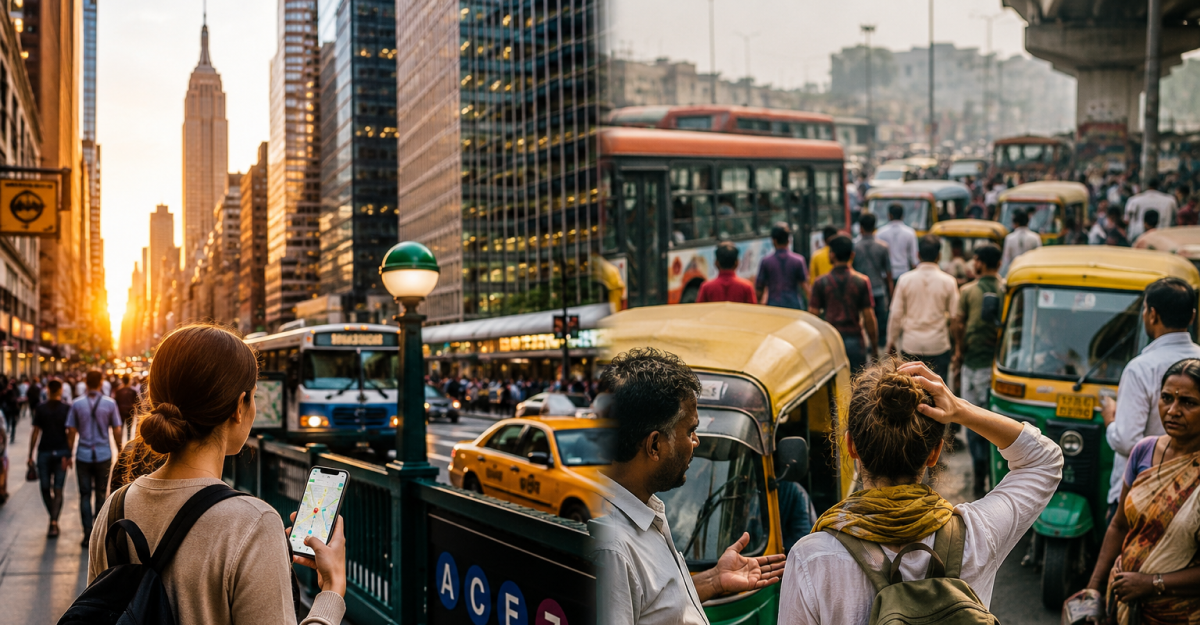
A visitor landing in New York can navigate the city through subways, buses, taxis, ride-sharing apps, walking routes, and clear signage.
The experience feels predictable.
India has improved dramatically over the last decade, especially with new airports, highways, metro systems, and digital payments. But many international tourists still face challenges involving transportation, language barriers, inconsistent infrastructure, and last-mile connectivity.
For many travelers, convenience matters as much as attractions.
Reason 2: Tourism Is NYC’s Product
New York sells itself relentlessly.
Broadway.
Times Square.
The US Open.
Fashion Week.
Christmas in Manhattan.
The city has become a global brand.
People often visit New York not because they researched every attraction but because they already know the story.
India’s branding remains fragmented.
The Taj Mahal is famous.
Goa is famous.
Kerala is famous.
But India itself is not marketed internationally as a seamless tourism experience.
Reason 3: India Sells Destinations, Not Experiences
Modern tourists increasingly prioritize experiences.
They want:
- Safety
- Clean streets
- Walkability
- Easy bookings
- Reliable transport
- Predictable service standards
A monument alone isn’t enough.
The entire journey matters.
And that’s where many international visitors feel friction.
The Problems India Still Hasn’t Solved
To understand why tourists avoid India, we have to look beyond attractions.
Safety Concerns
India continues to battle international perception issues, especially regarding women’s safety.
Whether those perceptions are always accurate is a separate debate.
In tourism, perception often matters as much as reality.
Infrastructure Gaps
Major cities have improved significantly.
However, many tourist destinations still struggle with:
- Last-mile transportation
- Tourist information systems
- Public amenities
- Consistent service quality
Cleanliness
India has made progress through cleanliness campaigns.
Yet global traveler surveys and media coverage frequently highlight concerns around litter management and sanitation in popular tourist zones.
Tourist Scams
Overcharging, unofficial guides, transportation disputes, and pricing inconsistencies can damage trust.
One bad experience often generates dozens of negative reviews online.
Air Pollution
This is perhaps the most underestimated challenge.
Cities such as Delhi frequently dominate global pollution rankings during certain seasons, creating concerns for international travelers planning long stays.
The Hidden Problem Nobody Talks About
Here’s the twist.
India’s tourism ecosystem isn’t actually weak.
Its foreign tourism ecosystem may be.
India is a domestic tourism giant.
Consider this: destinations such as Mathura-Vrindavan alone attracted approximately 79 million visitors in 2023, mostly domestic travelers. Many Indian destinations generate visitor numbers that would rival entire countries.
This reveals something important.
The tourism industry in India already works at scale.
Hotels are full.
Pilgrimage routes are busy.
Hill stations are crowded.
Beaches are packed.
The challenge is not attracting Indians.
The challenge is attracting more foreigners.
What Countries Like Thailand, Dubai, and Singapore Got Right?
Let’s compare them side by side-
Tourism Comparison
| Factor | India | Thailand | Dubai | Singapore |
| Visa Ease | Improving | Strong | Strong | Strong |
| Infrastructure | Uneven | Tourist-focused | World-class | World-class |
| Global Branding | Fragmented | Clear tourism identity | Aggressive marketing | Strong global image |
| Tourist Experience | Varies widely | Consistent | Highly curated | Highly predictable |
Thailand turned tourism into a national strategy.
Dubai built infrastructure before demand fully arrived.
Singapore obsessed over efficiency.
All three focused heavily on reducing visitor friction.
India often focuses on attractions.
These countries focus on experience.
Can India Become a Tourism Superpower?
Absolutely.
In fact, India may possess more tourism assets than almost any country on Earth.
Untapped Opportunities
| Tourism Segment | India’s Strength |
| Medical Tourism | Affordable world-class healthcare |
| Spiritual Tourism | Yoga, meditation, and pilgrimages |
| Wellness Tourism | Ayurveda and holistic wellness |
| Adventure Tourism | Himalayas, trekking, rafting |
| Luxury Tourism | Palace hotels and heritage experiences |
| Cultural Tourism | Thousands of years of history |
The government has already expanded initiatives around medical, wellness, adventure, and niche tourism categories.
The raw ingredients exist.
The opportunity exists.
The global demand exists.
What’s missing is execution at scale.
Conclusion: Is Indian Tourism Declining?
Not really.
The data shows that foreign tourist arrivals in India are recovering and moving closer to pre-pandemic levels. The country’s tourism economy remains massive, supported by hundreds of millions of domestic travelers every year.
The real story isn’t decline.
It’s underperformance relative to potential.
The India vs New York tourism comparison feels shocking because India should arguably be one of the world’s most visited destinations.
It has the history.
It has the culture.
It has the landscapes.
It has the experiences.
What it often lacks is the frictionless visitor journey that today’s international traveler expects.
India doesn’t suffer from a shortage of attractions.
It suffers from a shortage of tourist-friendly systems.
Until that changes, a single city like New York may continue attracting more visitors than an entire nation packed with wonders!
Thanks for reading 🙂
