
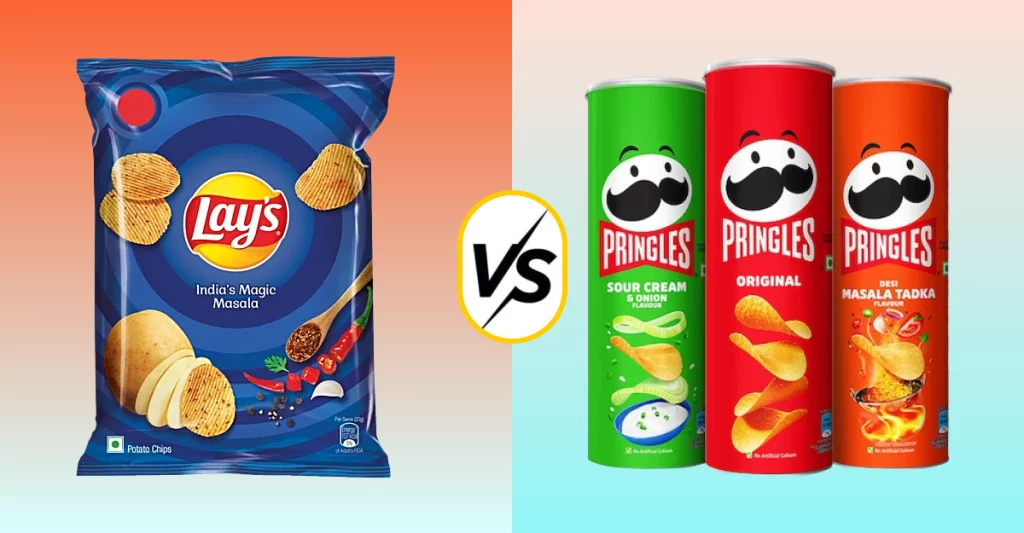
In the world of chips, Lays vs Pringles is like Pepsi vs Coca Cola – both iconic, but with entirely different personalities.
Whether it’s the light, salty crisp of Lay’s or the perfectly stacked, uniform chips of Pringles, each bite sparks nostalgia, satisfaction, and sometimes, confusion—because choosing one over the other isn’t easy.
In 2026, the global chips market is growing faster than ever, and the battle of Lays vs Pringles is crunchier than before.
So, who’s really winning hearts, shelves, and sales this year? Let’s find out!
Profile Comparison
When you think of Lays vs Pringles, it’s really a story of two giants built on different philosophies of snacking.
Lay’s, owned by PepsiCo, was founded in 1932 by Herman W. Lay. Over the years, it became a global household name with a presence in more than 200 countries, selling billions of packets every year. You’ll find Lay’s in every corner shop, airport, and vending machine, from India to the U.S. to the Middle East.
Pringles, on the other hand, was born in 1968 under Procter & Gamble and later acquired by Kellogg’s (now Kellanova) in 2012. Known for its iconic cylindrical can and its mascot “Mr. P,” Pringles revolutionized snack packaging and consistency. Today, Pringles operates in over 140 countries, maintaining a sleek, premium image.
| Particulars | Lay’s | Pringles |
| Operating Industry | Salty Snacks | Salty Snacks |
| Product Type | Potato Chips | Potato and Wheat-based Stackable Chips |
| Owner | PepsiCo | Kellanova (formerly Kellogg Company) |
| Produced by | Frito-Lay (subsidiary of PepsiCo) | Kellanova Snacks Division |
| Country | United States | United States |
| Introduced | 1932 | 1968 |
| Positioning | Western Snacks (Volume Leader) | Premium Global Stackable Snack (Niche Leader) |
| Brand Type | Mass-market, regional flavors | Premium, uniform global taste |
| Markets | Worldwide (over 200 countries) | Worldwide (over 140 countries) |
| Previous Owners | Herman W. Lay | Procter & Gamble (1968–2012) |
| Registered as a Trademark in | United States and Canada | United States (trademarked as “Pringles”) |
| Competitors | Pringles, Doritos, Cheetos, Ultz, Uncle Chips, Bingo, Kurkure | Lay’s, Doritos, Cheetos, Stax, Popchips, REAL, Barcel USA |
In short, Lay’s plays the quantity game, dominating in every geography, while Pringles plays the quality game, offering a consistent and sleek global snack experience.
Features Comparison: Lays vs Pringles
When it comes to Lays vs Pringles, your choice depends on what you expect from your chip: authenticity or precision.
| Feature | Lay’s | Pringles |
| Core Snack Format | Thin, sliced, and fried (or baked) potato chips | Stackable potato crisps made from reconstituted potato dough (flakes + starch) |
| Popular Product Lines | Classic, Baked, Maxx (deep ridges), Wavy, Stax (stacked crisps), Poppables (3D snacks), Kettle Cooked Series | Original, Sour Cream & Onion, Barbecue, Cheddar Cheese, Pringles Light, Pringles Scorchin’, and Mingles (bowtie-shaped chips introduced in 2025) |
| Notable Flavours (India) | Classic Salted, Hot & Sweet Chili, Magic Masala, Spanish Tomato Tango, Cream & Onion, West Indies Hot ‘n Sweet | Original, Sour Cream & Onion, Hot & Spicy BBQ, Cheesy Jalapeño, Salt & Vinegar, Tangy Tomato, Paprika |
| Global Flavors Variety | Extensive — Over 200 variants globally; includes Kimchi (Korea), Piri-Piri (Portugal), Sweet Basil (Thailand), Dill Pickle (USA) | Moderate — Around 70 global variants; 2025 lineup includes Cinnamon & Sugar, Smoky Bacon, Sharp White Cheddar, Jalapeño & Queso (Mingles range) |
| Dietary Formats | Regular fried, baked (50% reduced fat), kettle-cooked, air-popped, and Stax (stacked crisp format) | Regular, Light (reduced fat), Scorchin’ (extra spicy), Vegan-certified SKUs in select markets, and Mingles (air-light shape, 2025 launch) |
| Main Ingredients | Whole potatoes, vegetable oil (sunflower/palm blend), salt, natural and artificial flavoring (depending on variant) | Dehydrated potato flakes, corn flour, wheat starch, vegetable oil, emulsifiers, flavoring, and seasoning mixes |
| Texture | Thin, crisp, airy texture; varies across Classic, Wavy, Maxx (extra crunch), and Poppables (3D lightness) | Uniformly curved, dense, and layered crisp with consistent crunch; new Mingles series are lighter and airier |
Ingredients and Texture
Lay’s are made from real sliced potatoes fried or baked with sunflower or palm oil. That’s why each chip looks slightly different—some folded, some bubbly—but that’s part of its charm. You get that natural, airy crunch with a burst of flavor.
Pringles, however, are not sliced potatoes. They’re made from a blend of dehydrated potato flakes, wheat starch, and corn flour that’s pressed into uniform curved crisps. That means every chip looks identical—neat, stackable, and travel-friendly.
So, while Lay’s gives you the “farm-to-fry” feeling, Pringles gives you “factory perfection.”
Flavor Variety
Lay’s is famous for regional flavor innovation. India has Magic Masala, West Indies Hot & Sweet, and Spanish Tomato Tango, while the U.S. enjoys Flamin’ Hot, Barbecue, and Cheddar Jalapeño. Globally, there are over 200 variants.
Pringles keeps things more consistent—around 70 global variants—with favorites like Sour Cream & Onion, Original, Hot & Spicy BBQ, and newer experiments like Pringles Mingles (a bow-tie–shaped crisp launched in 2025).
Lay’s thrives on local adaptation; Pringles thrives on global uniformity.
Nutrition
Here’s how both stack up nutritionally (per 100g):
| Nutritional Metric | Lay’s Classic | Pringles Original |
| Calories | 536 kcal | 541 kcal |
| Total Fat | 34g | 36g |
| Sodium | 525mg | 575mg |
| Protein | 6.4g | 5.8g |
While neither is a healthy food, Lay’s baked range (11% of total SKUs in North America and India) offers 50% less fat, giving Lay’s an advantage among health-conscious consumers.
Packaging and Shelf Life
This is where Pringles shines. Its iconic resealable can keeps chips fresh longer and prevents breakage, making it ideal for travel. Lay’s bags are lightweight but prone to crushing and air leakage.
So, if you’re buying for freshness and portability, Pringles wins. But if you want that rustic, hand-cut potato feel, Lay’s takes the bite.
Business Comparison on Lays vs Pringles: Who is dominating the market?
When it comes to the business battle of Lays vs Pringles, PepsiCo and Kellanova are playing on very different chessboards.
| Business Aspects | Lay’s | Pringles |
| Market Valuation | USD 1.52 billion (Indian potato chips market share approx) | Smaller share within Indian premium chips segment [~5-8% estimated] |
| Indian Market Share | ~30% (leader in Indian potato chips) | Estimated 5–8% premium segment, niche positioning |
| Global Market Share | 23.5% | 12.1% |
| Global Revenue | $9.4 billion | ~$4.8 billion |
| Revenue (India, 2024–25) | ₹4,133 crore (~USD 500 million) [based on company reports and market estimates] | Estimated ₹400–600 crore (USD 50–75 million) (smaller scale in India) |
| Expenses | ₹6,006 crore (manufacturing, marketing, logistics) [approximate division expenses] | Proportionally lower, focused on premium segment investments |
| Profit/Loss | ₹530 crore profit (~USD 64 million) | Smaller profit margin, due to premium positioning and import/supply costs |
| CAGR Growth | 12–15% (robust growth in India, driven by volume and new launches) | Lower CAGR (~8–10%), focused on urban, affluent consumers |
| Market Position | Leader in Western-style potato chips, dominant mass market player | Premium, aspirational niche player with global brand recall |
| Recent Investments | New plants in Uttar Pradesh and Assam expanding capacity for baked and new variants | Focus on premium product diversification, innovative packaging |
| Per Capita Consumption | Low but rapidly growing with rising urbanization & middle-class income | Low due to niche premium positioning, urban metro-focused |
| Strategic Focus | Diversification into baked, Maxx, Stax, and regional flavors; strong offline & online penetration | Focus on premium formats, longer shelf life, export potential, and advertising innovation |
Global Market Share
According to the Global Best-Selling Chips Report 2025, Lay’s controls 23.5% of the global potato chips market, while Pringles holds 12.1%. PepsiCo’s entire snack empire—including Doritos, Ruffles, and Cheetos—owns nearly 41% of the global chip segment.
That’s a significant lead, proving that Lay’s remains the dominant force worldwide.
Revenue & Profitability
In 2024:
- Lay’s generated $9.4 billion in global revenue.
- Pringles earned approximately $4.8 billion, based on Kellogg’s reports.
In India, Lay’s annual revenue stands at around ₹4,100 crore (USD 500 million), while Pringles, a premium import brand, makes roughly ₹400–600 crore annually.
Market Position
Lay’s positions itself as the affordable, emotional, and local favorite. You’ll find it in every retail format—from ₹10 packs in small towns to premium multi-flavor bundles in supermarkets.
Pringles, meanwhile, appeals to the urban, aspirational consumer. It’s more expensive—₹115 for a 107g can compared to ₹35 for a 52g Lay’s pack—but the can’s prestige makes it a lifestyle product.
Growth & Investments
Lay’s is rapidly expanding into baked and air-popped segments and setting up new manufacturing facilities in Assam and Uttar Pradesh to meet regional demand.
Pringles is innovating with plant-based proteins and eco-friendly cans made with 50% recycled material.
Marketing & Brand Strategy
Marketing is where the Lays vs Pringles rivalry truly becomes artful.
Lay’s Approach: Emotional and Local
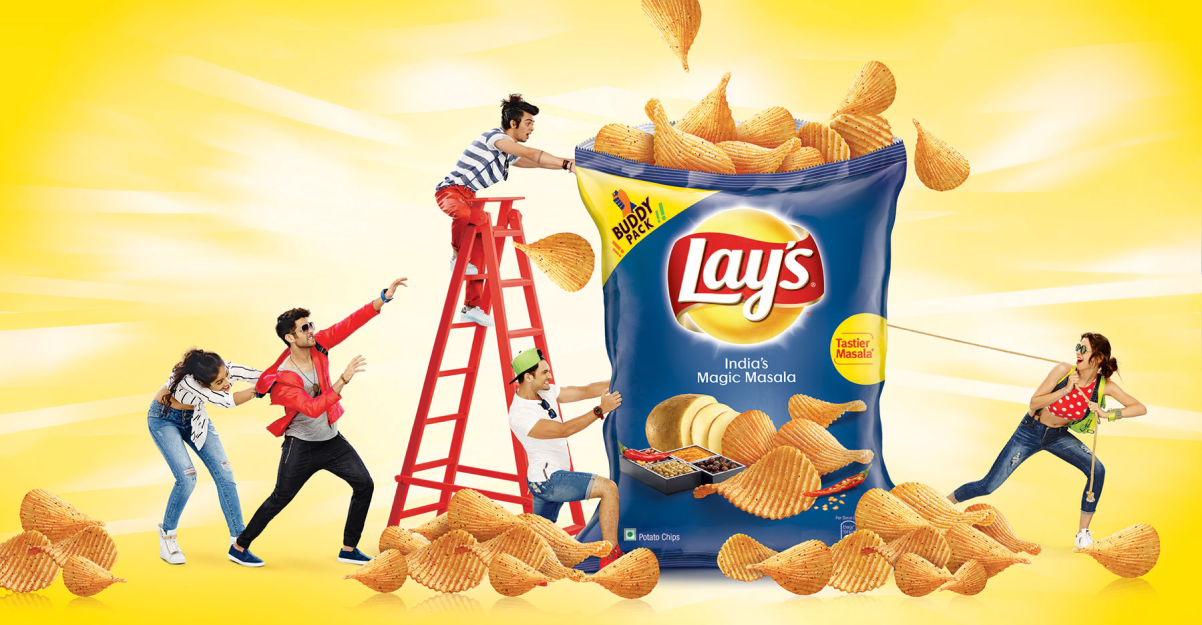
Lay’s focuses on emotions. Its “Smile Deke Dekho” campaign in India made waves, encouraging people to share joy with every bite. Globally, PepsiCo aligns Lay’s with local culture — from cricket in India to Super Bowl ads in the U.S. It’s about making you feel something every time you open a pack.
Lay’s tagline evolution — from “Betcha Can’t Eat Just One” to “Smile with Lay’s” — emphasizes community, happiness, and connection.
Pringles’ Approach: Consistent and Global
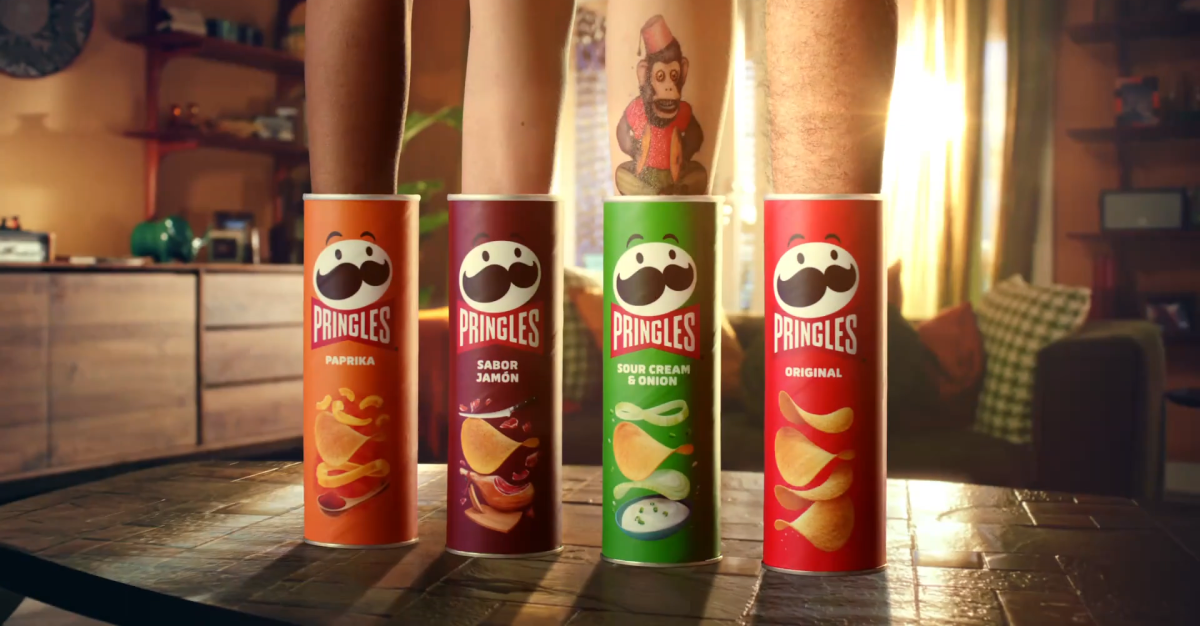
Pringles banks on wit and relatability. Its tagline, “Once You Pop, You Can’t Stop,” remains iconic since 1998. In 2025, Pringles expanded into music and e-sports collaborations, capturing Gen Z’s attention. It dominates 68% of vending machine chip sales globally thanks to its practical can design.
Where Lay’s wins your heart, Pringles wins your curiosity.
Note: We have also explained the following comparisons-
Lays vs Pringles: Who is the Winner?
It’s time for the crunch question – in Lays vs Pringles, who really wins?
Let’s break it down category by category-
| Category | Winner | Reason behind |
| Global Market Share | Lay’s | Controls 23.5% of global chips sales |
| Flavor Variety | Lay’s | Over 200 flavors tailored to regions |
| Packaging Innovation | Pringles | Iconic, resealable can with minimal waste |
| Healthier Range | Lay’s | Baked series with 50% less fat |
| Premium Image | Pringles | Sleek, consistent, aspirational |
| Price Accessibility | Lay’s | Affordable across income groups |
| Shelf Lift & Portability | Pringles | Longer-lasting, travel-friendly |
| Brand Emotion & Local Connect | Lay’s | Cultural relevance and emotional marketing |
| Urban Coolness Factor | Pringles | Popular among youth and global travelers |
So, who’s the overall winner? It depends on what you value more.
If you crave affordability, emotional connection, and flavor diversity, Lay’s takes the trophy. But if you love neat packaging, global taste consistency, and premium style, Pringles is your pick.
In 2025, analysts agree: Lay’s rules the masses, while Pringles rules the margins.
Conclusion
The battle of Lays vs Pringles isn’t just about chips—it’s about two global philosophies of snacking.
Lay’s stands for emotion, diversity, and reach. It thrives on being the chip next door—accessible, adaptable, and emotionally warm. Every packet connects you with a story, a smile, or a shared laugh with friends. It’s the snack of the people.
Pringles, in contrast, stands for innovation, precision, and style. It’s engineered to be sleek, consistent, and aspirational. It’s the go-to for modern, travel-ready, trend-aware consumers who want their crunch as polished as their playlists.
From a business perspective, Lay’s dominates—bigger market share, more flavors, and unmatched availability. But Pringles innovates, continually redefining what a “premium chip” means in the global market.
In the end, it’s not Lays vs Pringles, it’s Lays and Pringles — two different textures, two different emotions, one shared love for that perfect crunch.
So next time you’re torn between the two, remember — if you want comfort, reach for Lay’s; if you want class, pop open a can of Pringles. Either way, your taste buds win.
