

When flights get grounded, like the recent IndiGo aircraft shutdown that left thousands of passengers stranded, frustrated, and anxious, you start questioning which airlines can truly handle pressure. You wonder if any carrier has faced real chaos and still managed to stand tall. This is where the Malaysia Airlines success story becomes impossible to ignore!
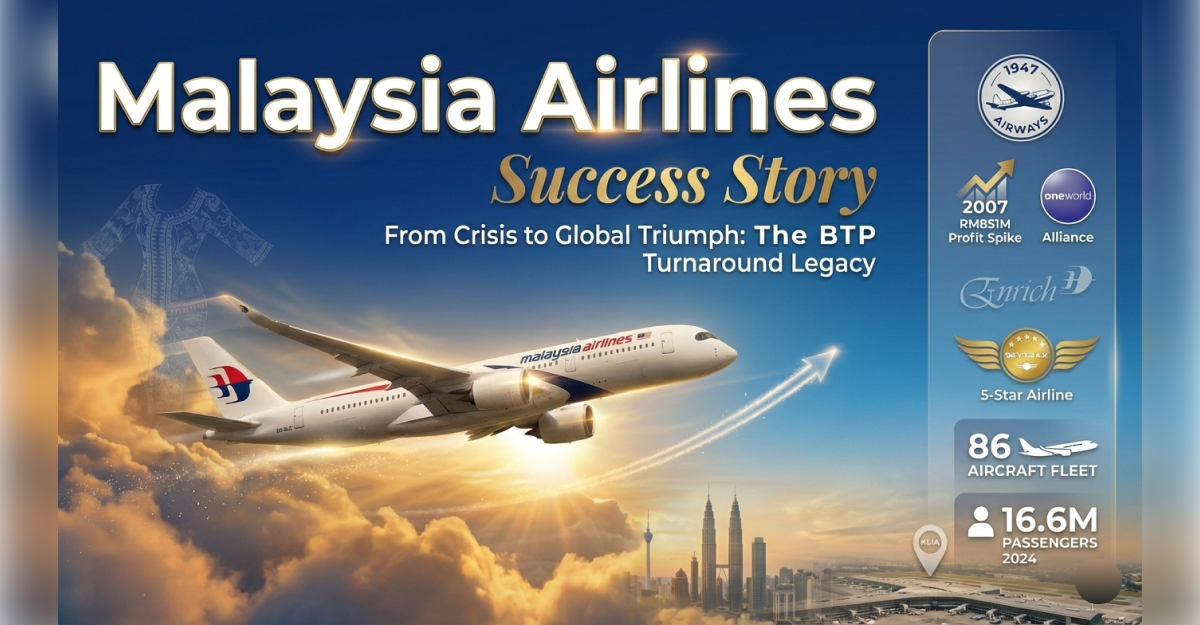
You are looking at an airline that has survived financial collapse, global tragedies, public distrust, and a complete industry shutdown during COVID-19. Yet, it didn’t disappear. Instead, it rebuilt itself piece by piece.
As you read on, you will see how Malaysia Airlines turned repeated crises into one of aviation’s most remarkable comeback stories!
Profile Overview
Malaysia Airlines is Malaysia’s national airline, based at Kuala Lumpur International Airport, which serves as its main hub. From here, you can fly across Asia, Europe, and Oceania on its international network. The airline was earlier known as the Malaysian Airlines System before adopting its current identity.
| Particulars | Malaysia Airlines |
| Founded | 1 May 1947 (as Malayan Airways Limited) |
| Rebranded | Malaysian Airways (1963), Malaysia-Singapore Airlines (1966), MAS (1 Oct 1972) |
| Current Operations Start | 1 Oct 1972 (MAS), 1 Sep 2015 (Malaysia Airlines Berhad) |
| Hubs | Kuala Lumpur International Airport (Primary), Kota Kinabalu International Airport (Secondary) |
| Focus Cities | Kuching International Airport, Penang International Airport |
| Frequent-Flyer Program | Enrich (4+ million members) |
| Alliance | oneworld (joined 1 Feb 2013) |
| Subsidiaries | Firefly, MASwings, MASkargo, Amal |
| Fleet Size | 86 active aircraft (+75 orders pending) |
| Destinations | 69 cities in 40+ countries |
| Parent Company | Khazanah Nasional Berhad (100% via Malaysia Aviation Group) |
| Headquarters | Kuala Lumpur International Airport, Sepang, Selangor, Malaysia |
| Chairman | Wan Zulkiflee |
| CEO | Izham Ismail (until Jan 2026), Nasaruddin Bakar (from 2026) |
| CFO | Boo Hui Yee |
| COO | Ahmad Luqman |
| Latest Financials | RM139 million net profit (2025 H1, +39% YoY), RM54 million (2024 FY) |
| Employees | ~12,000 (group-wide) |
| Load Factor | 80-81% average (2024), peaks at 96% |
| Passengers Carried | 16.6 million (2024) |
| On-Time Performance | 73% (2024) |
| Skytrax Rating | 5-Star (2009-2016) |
Today, Malaysia Airlines operates under the Malaysia Aviation Group, alongside its regional subsidiaries Firefly and MASwings, while also managing cargo operations through MASkargo and pilgrimage-focused charter services through Amal.
Early Foundations and Expansion
To understand the Malaysia Airlines success story, you first need to look at where it all began. Your journey starts in 1947, when Malayan Airways took off with a single Douglas DC-3 flight. At that time, aviation was still new to the region, and every flight symbolized progress. You can see how MAS origins in 1947 aligned with post-war recovery and economic rebuilding across Southeast Asia.
As demand grew, so did ambition. By the 1960s, Malaysia Airlines history shows steady regional expansion, adding routes to Hong Kong and Bangkok. Aircraft upgrades followed, replacing propeller planes with jets that allowed you to reach destinations faster. When Malaysia was officially formed, the airline evolved into Malaysian Airways, reflecting its national identity.
The 1966 merger with Singapore created Malaysia-Singapore Airlines, a bold move that expanded international reach. However, political differences led to a split in 1972, giving birth to Malaysia Airlines as you know it today. This moment defined Malaysia Airlines national carrier success, as MAS inherited domestic dominance and built international feeder routes.
The 1980s marked a golden growth phase. Malaysia Airlines expansion in the 1980s introduced wide-body aircraft like the Airbus A300 and later the Boeing 747 fleet. You would have seen Malaysia Airlines become a serious competitor in long-haul travel, linking Kuala Lumpur to Europe, Australia, and the United States. Load factors rose, routes multiplied, and the airline became a symbol of national pride. Yet, beneath the success, early signs of overexpansion were forming.
Challenges and the Pivotal Turnaround
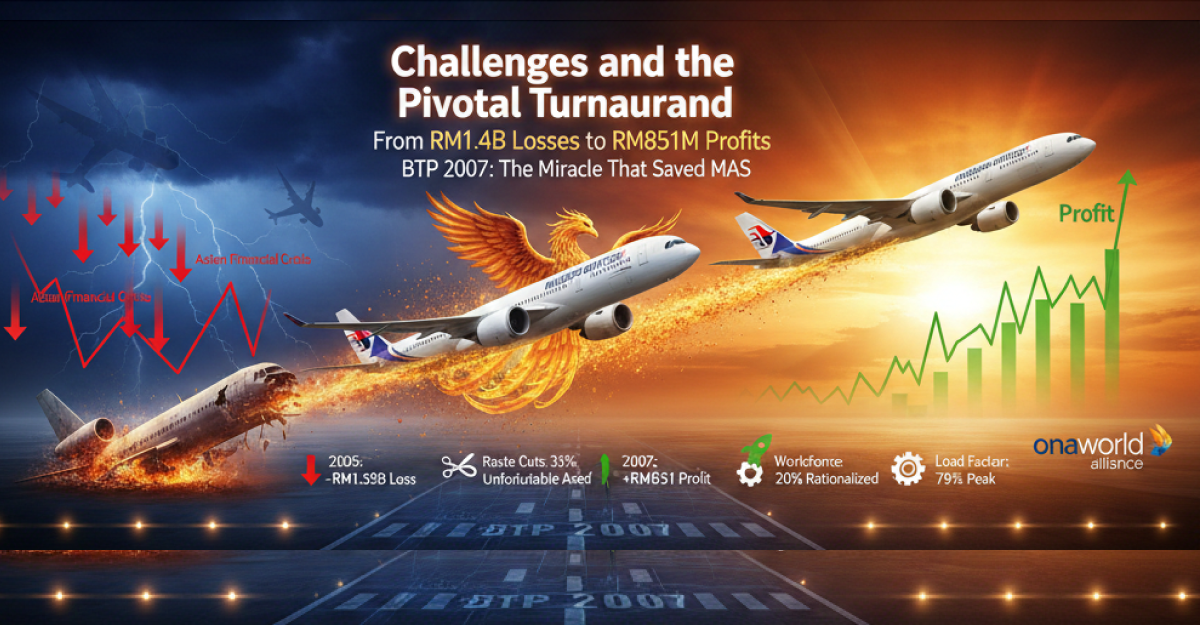
Every Malaysia Airlines success story includes a chapter of hardship, and this one hit hard in the 1990s. As you examine this phase, you realize how unchecked growth can weaken even strong airlines. The Asian Financial Crisis exposed structural inefficiencies, currency pressure, and declining demand. Losses mounted, and by the early 2000s, external shocks worsened the situation.
Fuel prices surged, competition intensified, and low-cost carrier competition from AirAsia changed how you, the passenger, viewed airfare value. By 2005, Malaysia Airlines losses reached RM1.39 billion. This moment forced a reckoning.
Enter MAS Idris Jala as CEO. His leadership changed everything. The MAS Business Turnaround Plan was not gentle. It was direct, data-driven, and ruthless. You saw Malaysia Airlines route rationalization slash unprofitable routes. Workforce rationalization reduced costs without compromising safety. Fuel hedging strategy stabilized expenses, while yield management airlines techniques improved revenue per seat.
By 2007, the results were undeniable. The airline recorded a MAS Net Profit RM851 Million, marking MAS BTP 2007 as one of the most successful airline turnarounds in modern aviation. This phase cemented the Malaysia Airlines turnaround as a global benchmark for cost-disciplined aviation and airline route optimization.
The following table shows the financial performance from 2005 to 2025 in RM billion-
| Year | Revenue | Net Profit/Loss | Key Initiative |
| 2005 | 9.18 | -1.39 | Fuel crisis |
| 2007 | 15.23 | 0.85 | BTP completion |
| 2011 | 13.90 | -2.52 | Post-MH restructuring |
| 2023 | 13.85 | 0.77 | MAG rebound |
| 2024 | 13.68 | 0.05 | Capacity cuts |
| 2025 | N/A | N/A | Network expansion |
Modernization and Global Ambitions
After proving that profitability was possible, the Malaysia Airlines success story shifted toward modernization. You witnessed Malaysia Airlines fleet modernization accelerate with new aircraft designed for fuel efficiency and passenger comfort. The introduction of Malaysia Airlines A350 aircraft and later A330neo jets positioned the airline competitively on long-haul routes.
Let’s have a brief look at the Fleet Evolution of Malaysia Airlines-
| Aircraft Type | Intro Year | Peak Count | Status |
| DC-2 | 1947 | N/A | Retired 1960s |
| Boeing 747-400 | 1993 | 14 | Retired 2010s |
| A350-900 | 2018 | 6 | Active |
| A330neo | 2024+ | Growing | 40 ordered |
A defining milestone came with the MAS Oneworld Alliance membership. This global alliance membership expanded connectivity, allowing you to reach over a thousand destinations through seamless partnerships. The MAS KLIA Hub strategy transformed Kuala Lumpur into a true hub and spoke model, increasing feeder traffic and operational efficiency.
Premium airline services also improved. MAS Golden Lounge upgrades enhanced your airport experience, while Malaysia Airlines Enrich loyalty introduced personalized rewards that deepened customer engagement. These loyalty program innovations mattered in winning back high-value travelers.
Digital tools streamlined bookings, improved on-time performance metrics, and supported yield optimization. You could see how Malaysia Airlines hub strategy blended premium service with efficiency, strengthening its position against regional competitors.
Crisis Recovery and Reinvention
No discussion of the Malaysia Airlines success story is complete without addressing tragedy. In 2014, the MH370 disappearance and MH17 shootdown devastated public trust. The MAS MH370 recovery and Malaysia Airlines MH17 impact tested the airline’s crisis response framework.
The following table describes the Route Network Changes and Business Turnaround Plan of Malaysia Airlines-
| Era | Total Routes | Profitable % | Key Hubs |
| Pre-BTP (2005) | 200+ | 40% | Point to Point |
| Post-BTP (2008) | 100+ | 70% | Kuala Lumpur International Airport (KLIA) hub |
| Current (2025) | 150+ | 80% | KLIA 2 expansion |
Bookings collapsed, and losses surged. A national airline bailout followed, leading to Malaysia Airlines MAG restructuring and the formation of Malaysia Airlines Berhad. Staff reductions, fleet simplification, and brand rebuilding were painful but necessary steps in Malaysia Airlines crisis management.
Then came COVID-19. Flights stopped, revenues vanished, and losses climbed again. Yet this time, experience mattered. Cargo revenue pivot strategies helped stabilize cash flow. Domestic routes and stimulus travel supported demand. By 2023, MAS COVID recovery efforts paid off with profitability returning.
In 2024, you saw Malaysia Airlines 2024 profits, with passenger numbers rising to 16.6 million and MAS load factor 80 percent. The airline proved that resilience was no longer a slogan but a practiced skill.
Achievements
The Malaysia Airlines success story becomes even clearer. MAS Skytrax Awards placed the airline among global leaders, earning a MAS 5-Star Rating for several years. Cabin crew recognition reinforced its premium service reputation.
Operational efficiency improved as fleet utilization rose and on-time performance stabilized. Passenger load factor consistency near 80% reflected smarter capacity planning.
Leadership mattered too. MAS leadership changes brought accountability and vision during critical moments.
Leadership Timeline
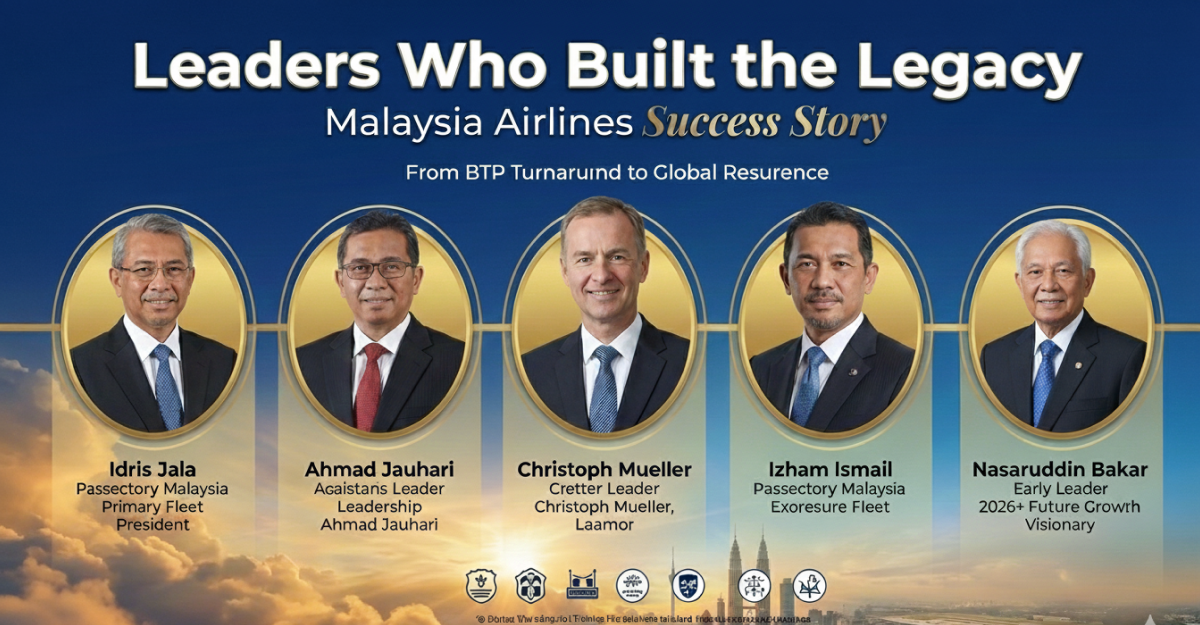
To truly understand the Malaysia Airlines success story, you need to look at the people who steered the airline through its most turbulent years. Each leadership phase brought a different priority, from aggressive turnaround to crisis survival and long-term stability. Some leaders focused on profitability, others on restoring trust after tragedy, while recent leadership has centered on sustainable growth and modernization.
The leadership timeline below shows how changes at the top directly shaped Malaysia Airlines’ recovery, financial revival, and future direction.
| CEO | Tenure | Major Achievement/Challenge |
| Idris Jala | 2005-2009 | BTP (Business Turnaround Plan) Profit Flip |
| Ahmad Jauhari | 2011-2015 | MH Crisis Bailout |
| Izham Ismail | 2017-2025 | MAG Profits, Fleet Orders |
| Nasruddin Bakar | 2026- Present | Growth Acceleration |
Note: We have also explained Indigo vs Emirates Airlines. Go through the article for detailed info.
Comparison: Malaysia Airlines (MAS) vs Singapore Airlines (SIA) vs Garuda Indonesia (GA)
Once you understand the leadership and strategic decisions behind Malaysia Airlines’ recovery, the next question is how the airline performs against its regional rivals.
Comparing load factors, on-time performance, and market strength gives you a clearer picture of where Malaysia Airlines stands today.
| Metric | Malaysia Airlines (MAS) | Singapore Airlines (SIA) | Garuda Indonesia (GA) |
| Founded | 1947 (as Malayan Airways), MAS 1972 | 1972 (from MSA split) | 1949 |
| Alliance | oneworld (joined 2013) | Star Alliance (founding member 1989) | SkyTeam (joined 2014) |
| Fleet Size (2025) | 86 active (+75 orders: A330neo, B737 MAX) | 145 (A350, B777-9, A380 flagship) | 100+ (A330, B737, CRJ regional) |
| Destinations | 69 cities, 40+ countries (Asia/Europe focus) | 140+ cities, 70 countries (global leader) | 80+ cities, 40 countries (Indonesia domestic heavy) |
| Hubs | KLIA (primary), Kota Kinabalu (secondary) | Singapore Changi (world’s best airport) | Jakarta Soekarno-Hatta, Bali Denpasar |
| Passengers (2024) | 16.6 million | 37+ million | 20+ million (domestic dominant) |
| Load Factor (2024 avg) | 80-81% (peaks 96%) | 89% | 75-80% |
| On-Time Performance | 73% (2024) | 85%+ (top global rankings) | 80%+ (world’s most punctual 2023 Skytrax) |
| Skytrax Ranking (2025) | Top 10 Asia (#5), 5-Star (2009-2016) | #1 World, #1 Asia | Top 20 World, Best Cabin Crew 2023 |
| Financials (Latest) | RM139M profit (H1 2025, +39% YoY), RM54M (2024) | SGD 2.1B profit (FY2024), Market Cap ~USD20B | Restructuring, break-even 2024 (post-bankruptcy) |
| Revenue (2024, approx) | RM15-18B (MAG group) | SGD 19B+ | IDR 100T+ (domestic focus) |
| Employees | ~12,000 | 25,000+ | 8,000+ (post-COVID cuts) |
| Parent/Ownership | Khazanah Nasional (100% via MAG) | Temasek Holdings (55%) | Government (60%+), restructuring |
| Key Strengths | Turnaround success, premium regional, fleet renewal | Global premium leader, service excellence | Domestic dominance, punctuality, cabin crew |
| Challenges | LCC competition (AirAsia), supply chain delays | High costs, premium yield pressure | Debt restructuring, Lion Air competition |
| Sustainability | A330neo/A350 (25% emission cuts), net-zero 2050 | SAF adoption, youngest fleet globally | Biofuel trials, fleet modernization |
| Premium Offerings | Golden Lounge, Enrich (4M members) | First Class Suites, KrisShop | Signature Class, GarudaMiles |
| Market Position | Regional premium challenger | Global premium benchmark | Indonesia domestic leader |
| 2025 Growth Plans | 45 new aircraft by 2030, India/Europe expansion | A350-900 ULR, US expansion | Network recovery, international rebound |
The comparison above highlights how Malaysia Airlines stacks up against competitors like Singapore Airlines and Garuda in 2024, showing both its progress and the areas where competition remains intense.
Lessons learnt from Malaysia Airlines Success Story
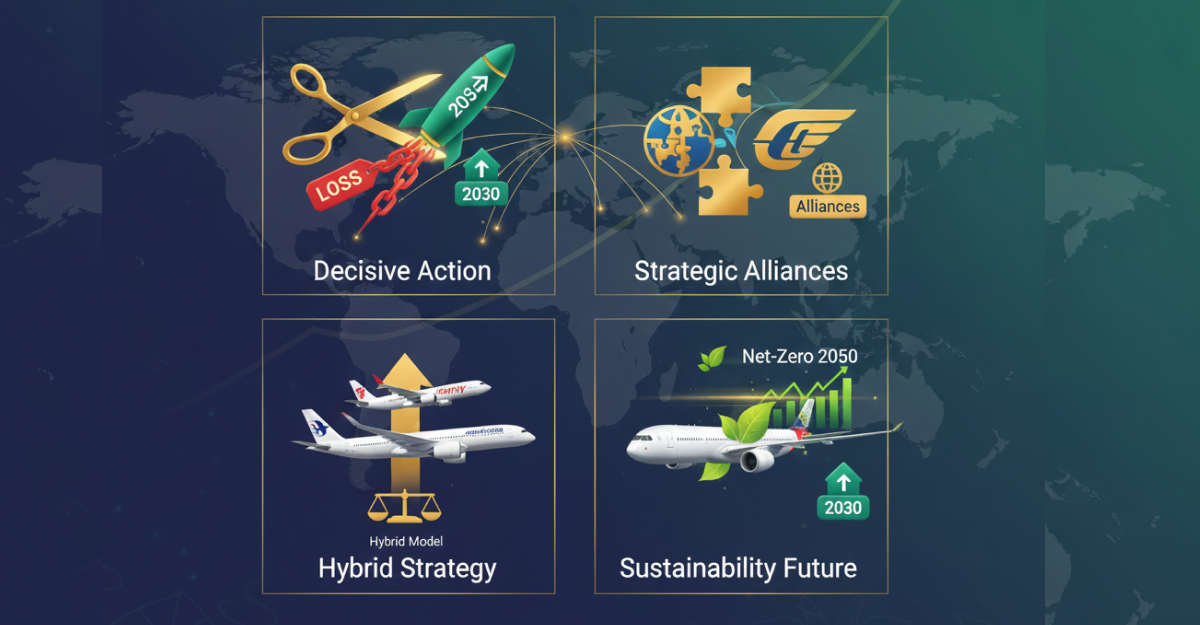
What does the Malaysia Airlines success story teach you? You may wonder! As you can see in the image above, the lessons are-
First, decisive action beats hesitation. The MAS Business Turnaround Plan showed that cutting losses early creates room for recovery.
Second, alliances outperform isolation. The MAS Oneworld Alliance extended reach without excessive risk.
Third, hybrid strategies work.
Combining premium service with low-cost feeder operations through the MAS Firefly subsidiary balanced yield and volume. Sustainability also shapes the future. Malaysia Airlines sustainability ESG goals focus on fleet renewal aviation and emissions reduction, aiming for net-zero by 2050.
Looking ahead, MAS future growth 2030 plans include expanding routes to India and Europe, doubling passenger volume, and reinforcing its role as a competitive Asian hub.
Conclusion
The Malaysia Airlines success story is proof that failure is not the end. From early growth to financial collapse, from tragedy to recovery, you see how leadership, discipline, and adaptability revived a national icon.
Today, Malaysia Airlines stands stronger, wiser, and more focused, offering a lasting lesson in flag carrier resilience and long-term profitability!
