
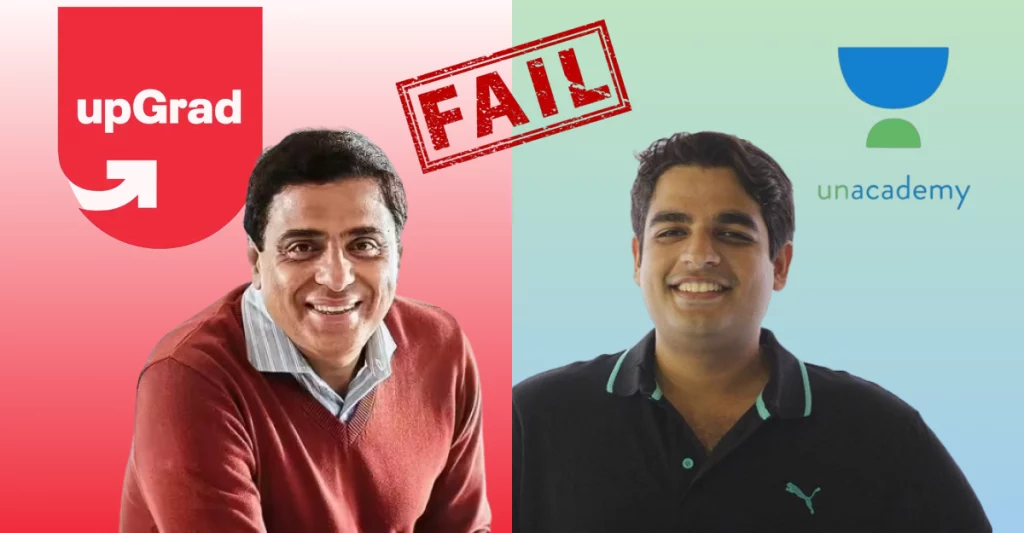
If you’ve been following India’s edtech sector, the news about the upGrad Unacademy deal will catch your attention. The acquisition talks between upGrad, a leader in higher education and upskilling, and Unacademy, the well-known test-prep platform, have officially been called off.
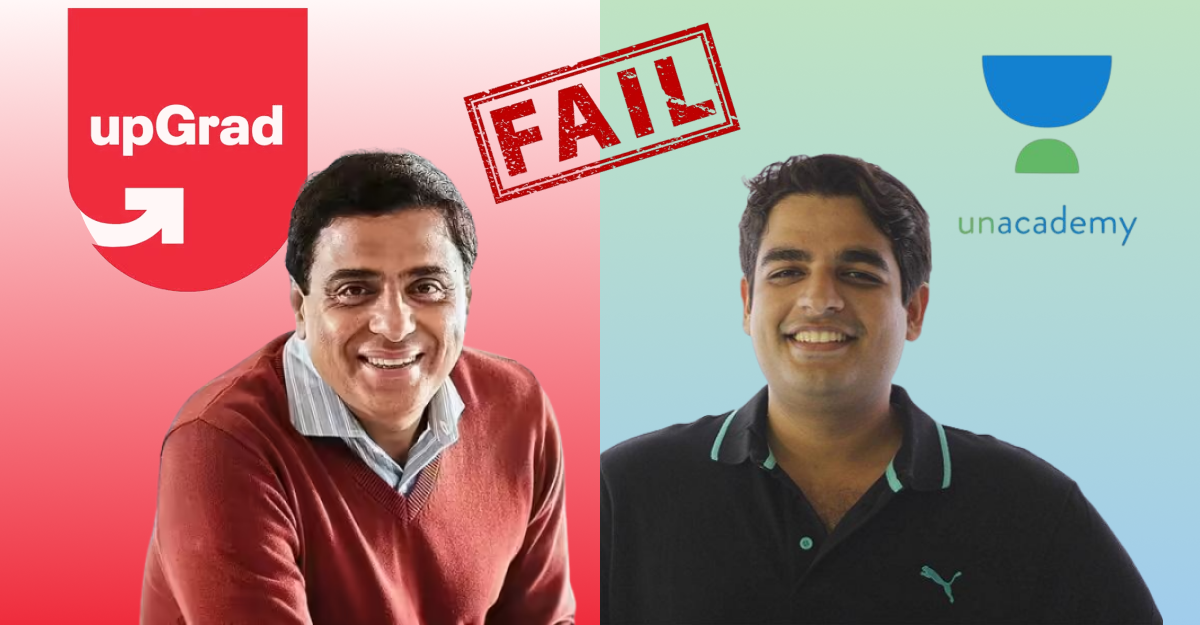
Why?
Simply put, both sides could not agree on the valuation. This decision comes at a time when Unacademy is navigating restructuring, shrinking business lines, and investor pressure.
Here’s everything you need to know about what happened, the numbers, and why it matters to you!
Why the upGrad Unacademy Deal was Initiated?
Earlier, the upGrad Unacademy deal had created a buzz because consolidation in India’s edtech space is picking up pace. You might have read about Unacademy exploring strategic options, including fundraising and mergers, as CEO Gaurav Munjal openly shared in recent months. The aim was to strengthen its core test-prep business while addressing internal challenges, including employee stock option issues.
upGrad, on the other hand, has been actively acquiring companies selectively to broaden its portfolio across higher education, upskilling, and overseas education segments.
Why the Deal Failed? Reasons Behind
The deal failed due to shrinking valuation and business concerns.
(A) Valuation
When talks began, Unacademy’s valuation had dropped drastically from its peak of $3.4 billion in 2021 to roughly $290 million in December 2025, a fall of over 90%. UpGrad found several issues with the business model, including shrinking core operations, stiff competition in offline learning centers, and the need for heavy investment.
Ronnie Screwvala, co-founder of upGrad, confirmed, “Yes, we are not proceeding due to valuation differences. While we cannot comment on specific numbers, it is fair to say that we were unable to arrive at a mutually agreeable valuation.”
Let’s have a quick look at the valuation journey of Unacademy-
| Year | Valuation | Details |
| 2021 | $3.4 billion | Peak valuation during Ed-tech |
| Dec 2025 | $290 million | Roughly one-tenth of peak valuation; acquisition talks with upGrad |
| Current | $290 million | Discussions called off due to valuation & business concerns |
The upGrad Unacademy deal did not fail solely because of valuation. UpGrad also spotted operational challenges that would require urgent attention and capital.
(B) The Business Concerns Behind the Deal
The upGrad Unacademy deal did not fail solely because of valuation. UpGrad also spotted operational challenges that would require urgent attention and capital. Some key points include:-
| Issue | Details |
| Shrinking core business | Unacademy’s primary operations were under pressure, affecting revenue stability |
| Competition | Revamping the business and expanding offline centers would need a massive capital infusion |
| High investment requirement | Revamping the business and expanding offline centers would need massive capital infusion |
| Employee exits | Several high-profile employees left the company, raising concerns about talent retention |
In addition, Unacademy’s parent company, Sorting Hat Technologies, has been grappling with financial pressures.
C) Financial Journey of Unacademy
The financial journey of Unacademy became the biggest red flag for the deal with upGrad-
| Financial Year | Total Income | Loss | Net Worth |
| FY22 | – | – | ₹2,285.53 Cr |
| FY23 | ₹868.8 Cr | ₹1,591.2 Cr | ₹1,189.17 Cr |
| FY24 | ₹864.3 Cr | ₹284.3 Cr | ₹1,078.7 Cr |
To help you understand the risks UpGrad identified, here’s a clear picture of Unacademy’s financials: You can see that while losses have narrowed significantly in FY24, the company’s net worth has been eroding over the past two years. This added to the concerns for upGrad when evaluating the upGrad Unacademy deal.
(D) Employee Stock Options and ESOP Challenges

Another hidden factor behind the deal’s collapse was ESOPs. Unacademy had proposed amendments to its 2018 ESOS scheme, which faced pushback from former employees. The objections were mainly about tax implications and liquidity concerns when exercising stock options at much lower valuations than previous rounds. For you, this means that internal employee satisfaction and compensation uncertainty can directly impact large-scale business deals like acquisitions.
How upGrad Unacademy Deal Failure Impact the Edtech Industry?
You might be wondering why this matters beyond just two companies. The upGrad Unacademy deal is a clear signal of how India’s edtech consolidation is unfolding in 2025.
Here are the key takeaways for you:-
- Valuations are correcting: Companies once valued at billions are seeing drastic reductions, forcing realistic pricing in mergers.
- Focus on core business: Investors and potential buyers are emphasizing companies with a stable, profitable core business.
- Capital-intensive expansion is risky: Expanding offline operations is expensive, and new owners may hesitate to take on that burden.
- Talent management is critical: Employee exits can create serious red flags for potential acquisitions.
upGrad Unacademy Deal: Timeline of Events
The table describes the events showing the evolution of upGrad Unacademy deal-
| Date | Event | Details |
| November 2025 | Reports of advanced acquisition talks emerge | upGrad in discussions to buy Unacademy for $300-400M; term sheet expected, excluding AirLearn app |
| December 2025 | Negotiations continue amid growing strain | Valuation differences become apparent |
| Late Dec 2025-Early Jan 2026 | Talks formally collapse | Failure over price and deal structure; investors to get a minority stake in upGrad |
| Jan 7-9, 2026 | Multiple confirmations of deal breakdown | Uncertainty over Unacademy founders’ future plans post-leadership shifts |
What You Should Watch Next?
Even though the upGrad Unacademy deal is off, this does not mean the end of strategic moves in the edtech sector. Unacademy may still look for:
- Fundraising to stabilize operations
- Partnerships that require less capital than a full acquisition
- Restructuring its offline learning business
For upGrad, the company might continue seeking selective acquisitions that fit neatly into its portfolio without carrying high financial or operational risk.
Wrap-Up: Summarising the upGrad Unacademy deal failure
| Fact | Event |
| Peak valuation of Unacademy | $3.4 billion in 2021 |
| Valuation during upGrad talks | $290 million in Dec 2025 |
| Financial health | Losses reduced from ₹1,591.2 crore (FY23) to ₹284.3 crore (FY24); Net worth eroded over 2 years |
| Reason for deal failure | Valuation differences + operational challenges + competition + employee exits |
| upGrad’s approach | Selective acquisitions in higher education and upskilling |
Final Thoughts
The takeaway is clear: acquisitions in India’s edtech space are no longer about hype. Real numbers, business fundamentals, and internal stability are more important than ever. The upGrad Unacademy deal shows that even big names cannot overlook shrinking business lines, high competition, and financial health when negotiating a merger.
So, while this deal did not go through, it sets the tone for how future mergers in India’s edtech sector will be approached—carefully, cautiously, and with a sharp focus on sustainable business.
FAQs
Q1: Why did the upGrad Unacademy deal fail?
The deal failed due to a huge gap in valuation expectations and operational challenges within Unacademy.
Q2: What was Unacademy’s valuation during the talks?
Around $290 million in December 2025, down from $3.4 billion at its peak.
Q3: Did employee exits affect the deal?
Yes, high-profile exits created concerns for UpGrad regarding talent retention.
Q4: What financial concerns were there?
Unacademy’s net worth and income had eroded over the past two years despite reducing losses.
Q5: Will Unacademy look for another buyer?
Possibly, they may explore fundraising, strategic partnerships, or smaller acquisitions instead.
Note: We have also decoded a few failed mergers and acquisitions. Go through the articles for more details-
- What Went Wrong With The Adobe Figma Acquisition?
- How Did Reliance Funded Milkbasket Fail? The Merger & Its Side Effects
Thanks for reading 🙂
