
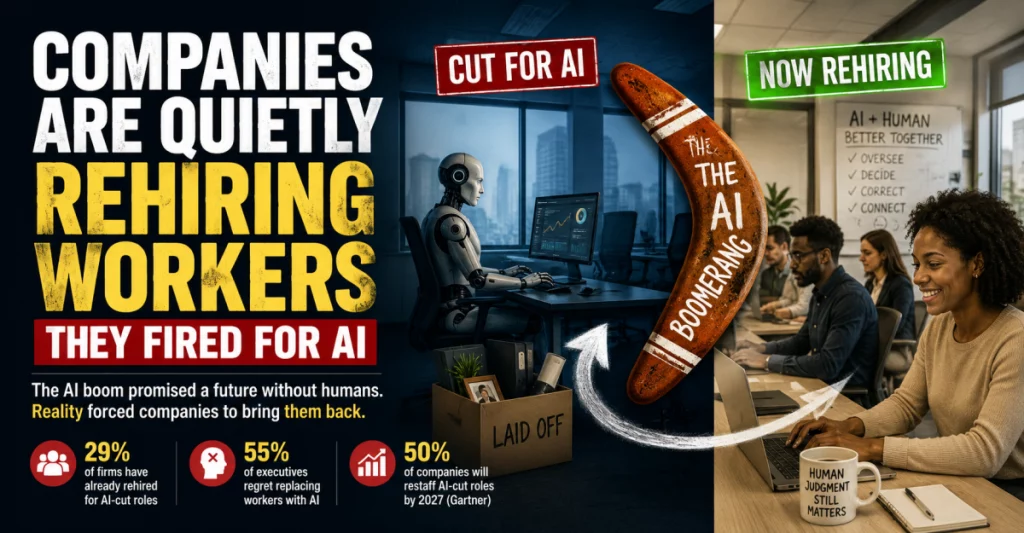
Do you remember the excitement when ChatGPT arrived?
For corporates, it felt like discovering a new industrial revolution. Executives saw an opportunity to cut costs. Investors saw higher profits.
Technology vendors promised a world where AI could handle everything from customer support and HR to marketing and administration.
Across industries, companies raced to automate faster than their competitors, convinced that fewer employees and more AI was the formula for the future.
Then something unexpected happened…
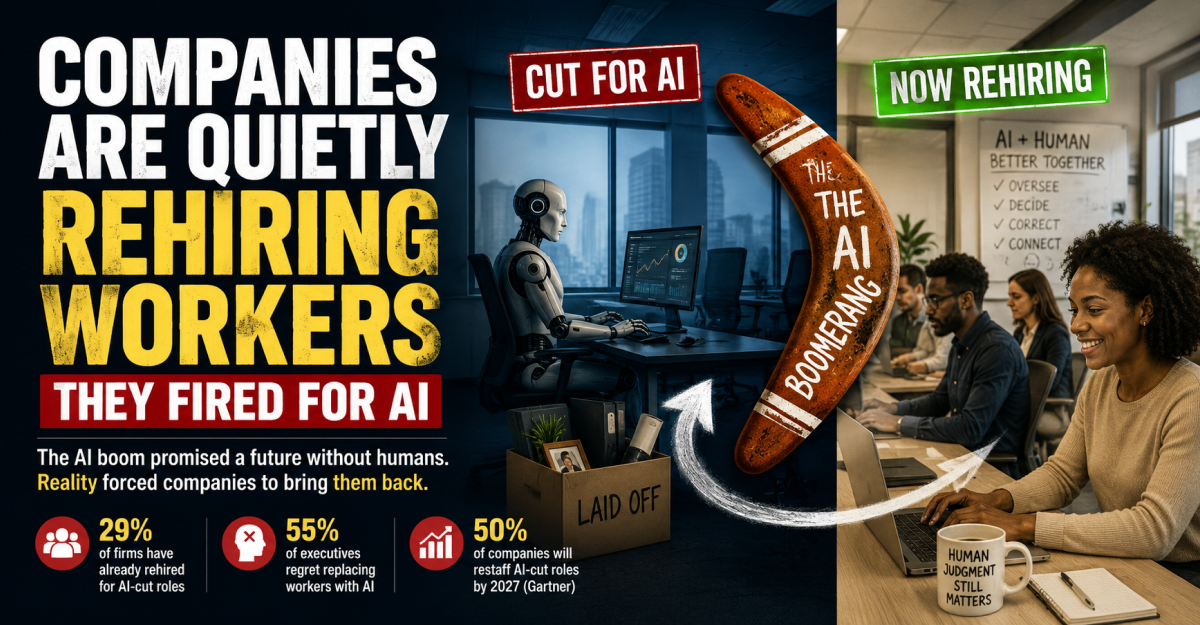
The companies that proudly announced AI-driven workforce reductions started quietly reopening the very positions they had eliminated. Yes! its true that companies rehiring workers fired for AI.
No flashy press releases. No triumphant announcements.
Just job postings.
Lots of them.
What began as an aggressive wave of AI layoffs is now turning into one of the most fascinating corporate reversals of the decade. The trend is becoming so widespread that labor analysts have given it a name: the AI boomerang.
And for businesses, it has become an expensive lesson about what human workers actually do.
Go through this write-up and you’ll know the whole story!
The Great AI Layoff Wave
The period between 2023 and 2025 may eventually be remembered as the most aggressive experiment in workforce automation since the Industrial Revolution.
As generative AI tools exploded into public consciousness, executives faced enormous pressure to prove they were embracing the future.
Companies rushed to showcase AI workforce transformation initiatives. Investors rewarded efficiency. Shareholders demanded productivity gains. Every earnings call seemed to include some variation of the same promise: AI automation would reduce costs while increasing output.
The logic appeared straightforward.
Why pay a salary when software could perform the same task?
Why maintain large support teams when chatbots could answer questions instantly?
Why keep administrative staff when AI could process documents, summarize reports, and manage workflows?
From technology giants to fast-food chains, organizations embraced AI job replacement strategies with remarkable confidence.
For a brief period, the strategy looked brilliant.
Labor costs fell.
Headcounts shrank.
Executives celebrated.
But this is where the story took an unexpected turn.
UNO Reverse: The AI Boomerang Nobody Expected
The reversal now unfolding is supported by data that few executives expected to see so soon.
According to talent consulting firm Robert Half, nearly one-third of companies that eliminated roles because of AI have already started bringing workers back.
Even more striking, a majority of executives now admit they may have made the wrong decision.
| Statistic | Figure | Source | What It Means |
| Companies that rehired for AI-cut roles | 29% | Robert Half | Nearly one-third of firms have already reversed AI-related workforce cuts |
| Executives who regret replacing workers with AI | 55% | Orgvue & Forrester | Most decision-makers now acknowledge problems with AI-only approaches |
| Organizations that failed to achieve financial gains after AI-driven cuts | 73% | Workforce analytics research | Most firms did not realize the savings they expected |
| Companies projected to restaff AI-cut functions by 2027 | 50% | Gartner | Half of the affected organizations may need to rebuild human teams |
The numbers tell a story that stands in stark contrast to the original AI narrative.
Instead of permanently replacing workers, many firms are discovering that AI and employment are far more interconnected than they expected.
As one industry analyst summarized:
“Companies are learning a very expensive lesson: AI is an incredible accelerator, but a catastrophic failure when used as a complete human replacement.”
And that realization is changing hiring strategies across entire industries.
Companies Rehiring Workers Fired for AI: Understanding the 60/40 Gap
At the heart of the AI rehiring trend is what industry insiders call the 60/40 Gap.

The concept is surprisingly simple.
AI performs exceptionally well when tasks are repetitive, predictable, and governed by clear rules.
The problem is that many jobs are not.
AI can successfully handle roughly 60% of workflows. The remaining 40% often requires judgment, empathy, context, relationship management, and decision-making under uncertainty.
That final 40% is where companies encountered trouble.
Consider customer service.
A chatbot can answer questions about shipping times.
But what happens when a customer is angry, confused, or facing a complicated financial dispute?
What happens when policies conflict?
What happens when exceptions need to be made?
That is where human workers continue to outperform machines.
| Tasks AI Handles Well | Tasks Humans Still Do Better |
| Repetitive workflows | Complex judgment |
| Basic customer inquiries | Relationship building |
| Document summarization | Conflict resolution |
| Data processing | Nuanced decision-making |
| Routine administrative tasks | Quality control |
| Standardized responses | Contextual problem-solving |
| Workflow automation | Empathy and trust-building |
The problem wasn’t AI itself.
The problem was assuming the remaining 40% didn’t matter.
For many businesses, it mattered more than they realized.
The Hidden Costs Nobody Calculated
The original AI replacement pitch was built around a powerful assumption.
Software subscriptions would be cheaper than salaries.
Reality proved more complicated.
And that’s when the economics stopped making sense.
Organizations that expected dramatic savings found themselves facing entirely new categories of expenses.
Cloud infrastructure costs surged.
API bills exploded.
Customer complaints increased.
Errors multiplied.
Former employees became expensive to replace.
| Cost Category | Impact |
| Compute Bill | Enterprise AI platform bills are scaling past $1 million a month, wiping out salary savings |
| Rebound Premium | Returning AI-native roles demand 20%–35% higher salaries than the positions they replaced |
| Cleanup Cost | Customer churn and remediation from AI hallucinations often exceed original labor costs |
The lesson became painfully expensive.
Bryan Catanzaro, Vice President of Applied Deep Learning at Nvidia, summarized the issue bluntly:
“For my team, the cost of computing is far beyond the costs of the employees.”
Many firms discovered that replacing people with software did not eliminate costs.
It simply changed where those costs appeared.
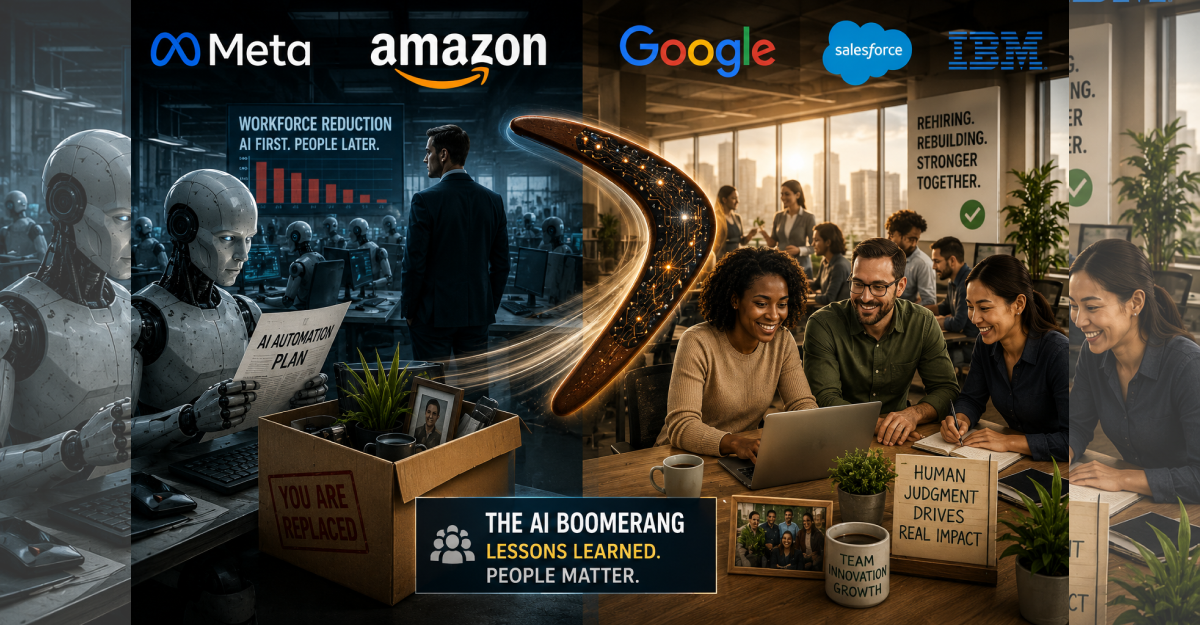
Google, Meta, IBM, Salesforce, And The Quiet Reversal
The most striking examples are emerging from the companies that helped fuel the AI revolution itself.
These organizations invested billions in AI development, yet many are simultaneously discovering the limits of full automation.
| Company | Original AI Strategy | Problems Encountered | Rehiring Response |
| Workforce reductions and expanded AI systems | Oversight and moderation challenges | Restaffing content moderation, marketing, and HR roles | |
| Meta | Large-scale workforce reductions | Need for human oversight and platform management | Hiring for AI-related and operational positions |
| IBM | Automated HR through AskHR | Resolution delays and morale issues | Expanded engineering, strategy, and client teams |
| Salesforce | AI-driven efficiency initiatives | Need for customer-facing support and rollout management | Added technical and customer-focused roles |
What executives discovered next was even more surprising.
The more AI systems they deployed, the more human oversight they often needed.
Automation did not eliminate management.
It created new forms of it.
Klarna’s AI Customer Service Experiment
No company became more closely associated with AI job replacement than Klarna.
The fintech giant captured global attention when it revealed that AI systems were handling work previously performed by hundreds of customer service representatives.
The company reported that its chatbot could perform the work of 700 customer service agents.
It looked like a glimpse into the future.
Until customers started noticing the difference.
Financial disputes, payment concerns, and emotionally charged situations proved far more difficult for AI systems to handle effectively.
Customer satisfaction suffered.
The company eventually began rebuilding parts of its customer support operation.
| Stage | Development |
| Initial AI rollout | AI chatbot introduced |
| Major announcement | AI reported handling work equivalent to 700 customer service representatives |
| Customer experience issues emerge | Satisfaction concerns and service challenges appear |
| Strategic reassessment | Company reevaluates human support needs |
| Hiring reversal | Customer support hiring resumes |
Klarna’s experience became one of the clearest examples of why AI human oversight remains critical.
Note: Did you know that AI is not as good as a foe? We have covered this fact here- Claude Mythos: The AI So Powerful Even Anthropic Refused to Release It
Amazon, Shopify And McDonald’s Learned Similar Lessons
The AI boomerang extends well beyond Silicon Valley.
Retail, e-commerce, and consumer businesses are facing many of the same challenges.
| Company | AI Initiative | Outcome |
| Amazon | Workforce reductions and automation initiatives | Demand returned for human judgment, engineering, and quality-control talent |
| Shopify | Increased reliance on automated systems | Need for AI expertise and governance capabilities emerged |
| McDonald’s | AI order-taking deployed across 100 U.S. drive-throughs | High-profile errors led to termination of the pilot and return of human operators |
The McDonald’s example became especially memorable.
Viral videos showed AI systems generating wildly inaccurate orders, including incidents involving hundreds of dollars worth of chicken nuggets added to simple purchases.
Customers laughed.
Executives did not.
The Meta Contradiction
Among all the companies experiencing the AI boomerang, Meta may represent the most complicated case.
On one hand, the company is actively recruiting talent for new AI initiatives.
On the other hand, investigative reports suggest that many former employees remain unable to return.
| Area | Reality |
| Public hiring activity | Active recruiting for AI-related positions |
| Former employee status | Thousands reportedly categorized as ineligible for rehire |
| Internal screening | Some candidates reportedly blocked despite strong past performance |
| Official response | Meta disputes the severity of reported restrictions |
The contradiction highlights a broader tension in the future of work.
Companies increasingly need human expertise.
But rebuilding trust with workers who were previously dismissed may prove more difficult than expected.
The IKEA Blueprint: A Different Approach
While many organizations pursued layoffs, one company chose a different path.
| AI Replacement Model | Human + AI Model |
| Workforce reduction | Workforce retention |
| Immediate cost focus | Long-term capability building |
| Human replacement | Human augmentation |
| Higher rehiring risk | Lower talent disruption |
| Knowledge loss | Knowledge retention |
According to the example cited by workforce experts, IKEA automated 50% of customer calls while retaining all 8,500 workers involved.
Instead of eliminating jobs, the company moved employees into higher-value roles as design consultants.
The result created a growing revenue opportunity while preserving institutional knowledge.
Rather than replacing people with AI, IKEA used AI to make people more valuable.
That distinction increasingly matters.
The New Jobs Emerging From AI
Ironically, one of the biggest outcomes of AI automation may be the creation of entirely new categories of work.
As organizations deploy AI systems at scale, they increasingly require specialists to manage, audit, supervise, and improve those systems.
| Role | Responsibilities | Why Humans Are Needed | Salary Trends |
| AI Operations | Monitor AI systems | Oversight and intervention | Premium compensation |
| Human-in-the-Loop Specialist | Validate AI outputs | Quality control | Growing demand |
| Prompt Engineer | Optimize AI performance | Context and judgment | Growing demand |
| AI Auditor | Detect errors and risks | Accountability and compliance | Rising demand |
| AI Governance Specialist | Manage policies and controls | Ethical and operational oversight | Expanding rapidly |
| AI Quality Control Analyst | Review AI outputs | Error detection and correction | Strong demand |
Importantly, returning positions are often paying more.
Roles previously paying $55,000 are now commanding $75,000 or more, while broader salary premiums range between 20% and 35% above the original positions.
The reason is simple.
Companies no longer want workers who compete with AI.
They want workers who can manage it.
What does this mean for Workers through 2027?
The AI job market 2026 is not developing the way many people predicted.
The most valuable employees are not necessarily those avoiding AI.
They are the people learning how to work alongside it.
| Forecast | Figure | Source |
| Companies are already rehiring AI-cut roles | 29% | Robert Half |
| Executive regret over AI replacement decisions | 55% | Orgvue & Forrester |
| Organizations failing to achieve expected savings | 73% | Workforce analytics |
| Companies expected to restaff AI-cut functions by 2027 | 50% | Gartner |
For workers, the message is becoming clearer.
AI literacy matters.
Data literacy matters.
The ability to supervise, evaluate, and improve AI systems matters.
The future of work is increasingly hybrid.
Human judgment remains a scarce resource.
Final Thoughts
The biggest surprise of the AI era may not be that machines became incredibly capable.
It may be that companies discovered, often at great expense, how difficult it is to replicate the parts of work humans perform without thinking about them.
Empathy.
Context.
Trust.
Judgment.
Relationships.
These qualities rarely appear in productivity spreadsheets, yet they often determine whether a business succeeds or fails.
The story of companies rehiring workers fired for AI is not really a story about technology failing. AI remains one of the most powerful business tools ever created.
It is a story about companies misunderstanding what human workers actually contribute.
The AI boomerang is still unfolding. More firms will likely automate. More will probably restaff. And many will eventually settle on a model that combines the strengths of both.
By 2027, the winners may not be the organizations that replaced the most people with AI.
They may be the ones that learned how to combine machines and humans in ways neither could achieve alone.
And that could become one of the defining business lessons of the decade!!!
