
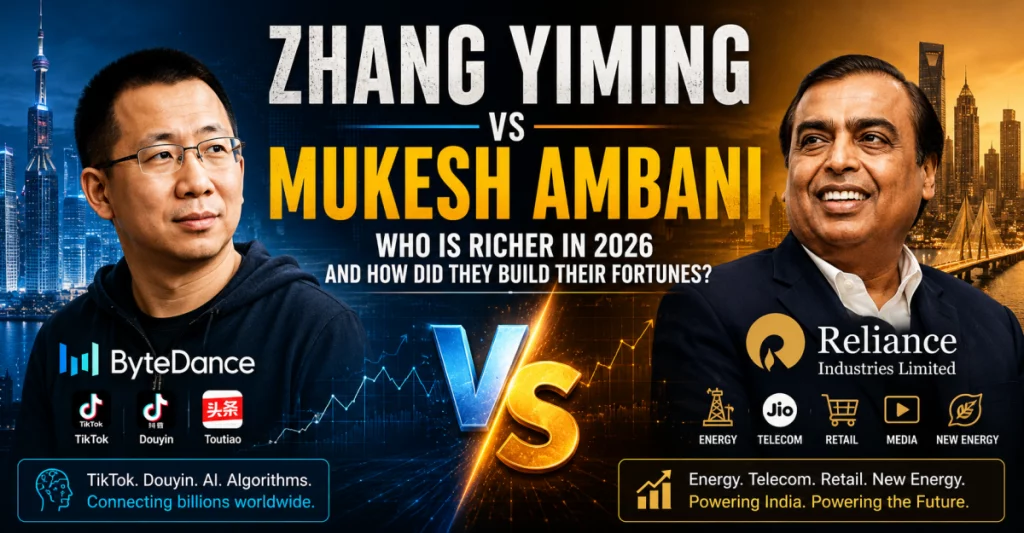
For years, it seemed almost impossible to imagine anyone overtaking Mukesh Ambani in Asia’s wealth race.
The chairman of Reliance Industries had become synonymous with modern Indian capitalism. His empire stretched from oil refineries and petrochemicals to telecom networks, retail stores, digital services, and now renewable energy.
As India’s economy expanded, so did his fortune. Across most billionaire rankings, Ambani appeared firmly established among the richest people not just in Asia, but in the world.
Then, quietly, the leaderboard changed.
There was no blockbuster acquisition. No public listing. No dramatic corporate announcement.
Instead, the shift came from the growing value of a private technology company whose products are used by billions of people every month.
In early June 2026, ByteDance founder Zhang Yiming overtook Mukesh Ambani on Bloomberg’s billionaire rankings, becoming Asia’s second-richest person and China’s richest individual. The development surprised many casual observers, but those who had been tracking the rapid rise of ByteDance knew something important was happening.
The story of Zhang Yiming vs Mukesh Ambani is not simply a comparison of net worth figures.
It is a story about two very different ways of creating wealth. One built through factories, infrastructure, telecom networks, and consumer businesses. The other is built through algorithms, artificial intelligence, digital advertising, and smartphone screens.
And in many ways, it reflects a broader shift taking place across Asia’s economy. Let’s begin their wealth saga!
Story So Far: The Day Asia’s Wealth Ranking Changed
Billionaire rankings change almost every day.
Stock prices move. Private-company valuations fluctuate. Currency markets shift. As a result, fortunes can rise and fall by billions of dollars within weeks.
Yet some changes attract far more attention than others.
When Bloomberg’s Billionaires Index showed Zhang Yiming climbing ahead of Mukesh Ambani in early June 2026, it became a talking point across business media in Asia and beyond.
Why?
Because Ambani had spent years representing the pinnacle of wealth creation in the region. His business empire was often viewed as a reflection of India’s economic ambitions. Meanwhile, Zhang remained a relatively low-profile figure despite controlling one of the world’s most influential technology companies.
The moment symbolized something larger than a ranking update.
It highlighted how rapidly technology-driven fortunes can grow when investors become convinced that a company sits at the center of the next major innovation wave.
In this case, that wave was artificial intelligence, digital content, and platform economics.
Zhang Yiming vs Mukesh Ambani: Billionaire Profile Comparison
Although they now sit close to each other in global billionaire rankings, the paths taken by Zhang Yiming and Mukesh Ambani could hardly be more different.
One inherited a business legacy and expanded it into a modern conglomerate. The other started a technology company from scratch and turned it into one of the world’s most valuable private enterprises.
One is constantly in the public eye. The other prefers to stay out of it.
One built physical infrastructure at enormous scale. The other built digital infrastructure that exists largely in the cloud.
| Attribute | Zhang Yiming | Mukesh Ambani |
| Nationality | Chinese | Indian |
| Approx. Age (2026) | Early 40s; Widely cited as 41 around late 2024 | Mid-60s (born 1957) |
| Main Company | ByteDance Ltd. | Reliance Industries Limited (RIL) |
| Industry | Social media, digital advertising, AI-driven platforms | Energy, telecom, retail, petrochemicals |
| Primary Wealth Type | Self-made tech entrepreneur | Second-generation industrialist turned conglomerate builder |
| Founder vs Inherited Business | Founded ByteDance in 2012 | Expanded and transformed family business founded by Dhirubhai Ambani |
| Public Profile | Low-profile; stepped away from CEO role | High visible corporate leader |
| Main Residence (Reported) | Beijing, China | Mumbai, India |
The contrast makes the Zhang Yiming vs Mukesh Ambani debate especially fascinating.
Both created extraordinary value. But they did it in entirely different ways.
Zhang Yiming vs Mukesh Ambani: Who Is Richer In 2026?
According to Bloomberg’s Billionaires Index in early June 2026, Zhang Yiming currently holds the advantage.
His estimated fortune reached approximately $92.8 billion, placing him ahead of Mukesh Ambani and making him Asia’s second-richest person.
Ambani’s wealth, depending on the source and date, has generally been estimated in the range of $86.9 billion to $93.6 billion.
Yet the rankings are not as straightforward as they appear.
Some billionaire lists continue to show different results. Depending on the methodology used by Bloomberg, Forbes, or Hurun, the ordering can change.
That is why discussions around Zhang Yiming net worth and Mukesh Ambani net worth often produce different answers.
| Metric | Zhang Yiming | Mukesh Ambani |
| Primary List Used | Bloomberg Billionaires Index (Asia/global) | Bloomberg Billionaires Index (Asia/global) |
| Latest Spotlight Date | 2–3 June 2026 | 2–3 June 2026 |
| Approx. Net Worth (USD) | 92.8 billion | ~86.9–93.6 billion |
| Position in Asia (Bloomberg) | 2nd richest in Asia | 3rd richest in Asia |
| Position in Country | 1st in China | 1st in India |
| Global Position (Approx.) | Top 15 globally | Top 15 globally |
| Recent 1-Year Wealth Change | Increased by more than $24 billion | Decline of about $20.8 billion |
But this is where the story gets interesting.
Just two years earlier, this contest was not even close.
How Zhang Yiming Built ByteDance?
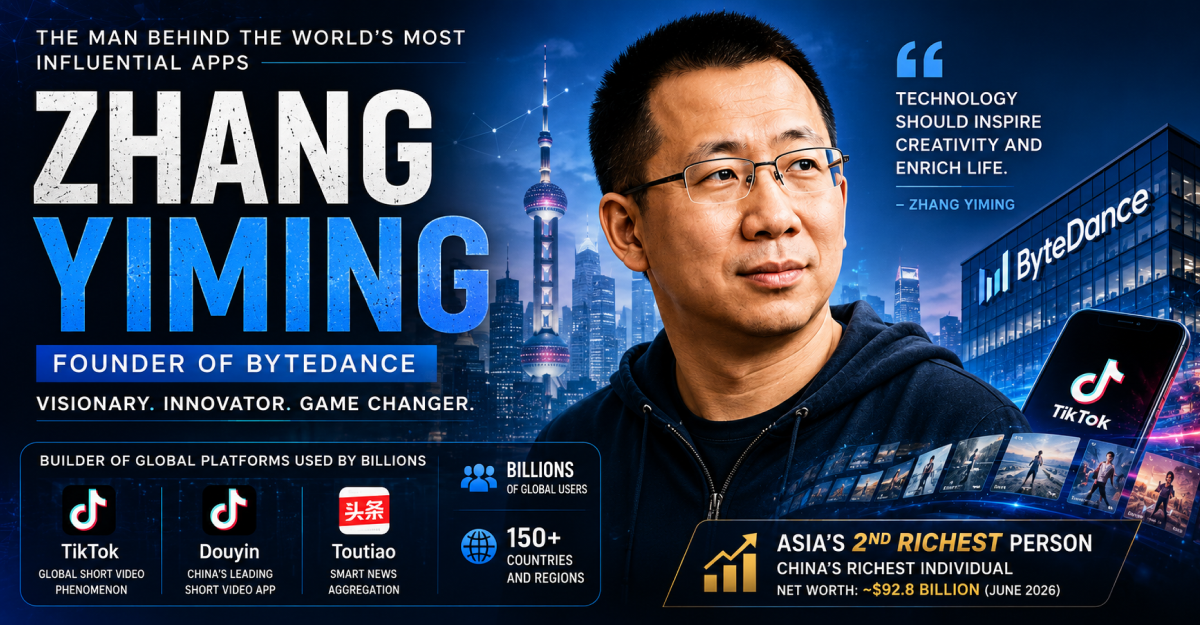
When Zhang Yiming founded ByteDance in 2012, few people could have predicted the scale of what was coming.
The internet was already crowded with social networks, content platforms, and digital media companies. Breaking through seemed increasingly difficult.
Zhang approached the challenge differently.
Instead of focusing primarily on who users followed, ByteDance focused on understanding what users wanted to watch, read, and engage with.
Its recommendation systems became the foundation of products such as TikTok, Douyin, and Toutiao.
Over time, those algorithms evolved into one of the company’s biggest competitive advantages.
The results were extraordinary.
TikTok became a global cultural phenomenon. Douyin dominated China’s short-video market. Advertising revenue surged. User engagement climbed. Investors increasingly viewed ByteDance as one of the most powerful technology platforms in the world.
Key Milestones In Zhang Yiming’s Rise
| Year/Period | Milestone |
| 2012 | Founded ByteDance |
| Early Growth Years | Developed recommendation-driven content ecosystem |
| Expansion Phase | Launched and expanded Douyin in China |
| Global Expansion | TikTok became a major international platform |
| Leadership Transition | Stepped down from day-to-day leadership roles |
| 2026 | Became China’s richest person and Asia’s second-richest billionaire on Bloomberg rankings |
Even after stepping away from daily management, Zhang retained a substantial ownership stake.
That ownership became increasingly valuable as the ByteDance valuation continued climbing.
And that valuation would soon become the key reason he overtook Ambani.
How Mukesh Ambani Expanded Reliance?
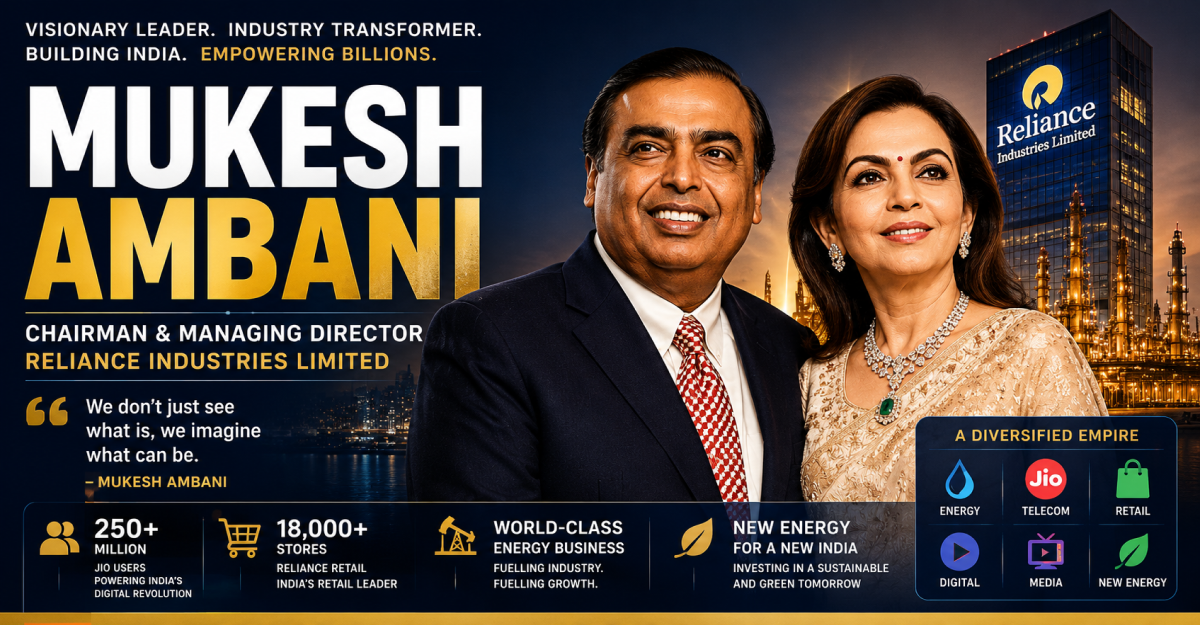
Meanwhile, a very different story was unfolding in India.
Mukesh Ambani inherited a strong business foundation from his father, Dhirubhai Ambani, but he did not simply preserve it.
He expanded it.
Over the past two decades, Reliance Industries has evolved from an energy-focused giant into one of the most diversified corporate groups in the world.
The biggest transformation came with Jio.
When Reliance launched Jio in 2016, it reshaped India’s telecom industry. Affordable mobile data helped accelerate internet adoption across the country and created a digital ecosystem that reached hundreds of millions of consumers.
At the same time, Reliance strengthened its retail operations, expanded consumer businesses, and increased investments in future-focused sectors such as renewable energy.
Major Growth Drivers Behind Mukesh Ambani’s Wealth
| Growth Driver | Impact |
| Oil & Petrochemicals | Long-standing profit engine |
| Reliance Jio | Major telecom and digital platform expansion |
| Retail Business | Large-scale consumer growth |
| Media & Digital Assets | Broader digital ecosystem |
| New Energy Investments | Future growth strategy |
| Reliance Share Performance | Direct driver of personal wealth valuation |
The result is a business empire unlike almost any other.
While Zhang’s fortune is concentrated around a technology platform, Mukesh Ambani wealth is tied to a diversified ecosystem spanning multiple sectors of the economy.
How Mukesh Ambani Expanded Reliance?
Meanwhile, a very different story was unfolding in India.
Mukesh Ambani inherited a strong business foundation from his father, Dhirubhai Ambani, but he did not simply preserve it.
He expanded it.
Over the past two decades, Reliance Industries evolved from an energy-focused giant into one of the most diversified corporate groups in the world.
The biggest transformation came with Jio.
When Reliance launched Jio in 2016, it reshaped India’s telecom industry. Affordable mobile data helped accelerate internet adoption across the country and created a digital ecosystem that reached hundreds of millions of consumers.
At the same time, Reliance strengthened its retail operations, expanded consumer businesses, and increased investments in future-focused sectors such as renewable energy.
Major Growth Drivers Behind Mukesh Ambani’s Wealth
| Growth Driver | Impact |
| Oil & Petrochemicals | Long-standing profit engine |
| Reliance Jio | Major telecom and digital platform expansion |
| Retail Business | Large-scale consumer growth |
| Media & Digital Assets | Broader digital ecosystem |
| New Energy Investments | Future growth strategy |
| Reliance Share Performance | Direct driver of personal wealth valuation |
The result is a business empire unlike almost any other.
While Zhang’s fortune is concentrated around a technology platform, Mukesh Ambani wealth is tied to a diversified ecosystem spanning multiple sectors of the economy.
Note: Did you know how many businesses the Ambani family handles? Go through this article for more info- Mukesh Ambani Business List: Secrets Behind His Business Empire.
The Wealth Explosion: Why Zhang Suddenly Caught Up?
For most of 2024 and much of 2025, Ambani maintained a significant lead.
Then the gap began to close.
And it closed surprisingly fast.
The key driver was not a new TikTok launch or a major acquisition.
It was valuation.
As investors became increasingly optimistic about artificial intelligence, digital content platforms, and recommendation technologies, private-market estimates for ByteDance moved sharply higher.
The company was no longer being viewed solely as a social media business.
Increasingly, it was being viewed as an AI-powered platform company with enormous global reach.
That shift dramatically changed how investors valued the business.
Because Zhang still owned a significant stake, his personal fortune rose alongside the company’s estimated value.
Zhang Yiming vs Mukesh Ambani: How Their Wealth Changed Between 2024 And 2026?
| Year / Period | Zhang Yiming (USD) | Mukesh Ambani (USD) | Source Trend |
| Late 2024 | ~49.3 billion | 102–108 billion | Ambani clearly ahead |
| 2025 (Typical Range) | 50–70 billion | 90–110 billion | Ambani maintains lead |
| Early 2026 (Pre-Rally) | 60–70+ billion | High-80s to low-90s billion | Gap narrows |
| June 2026 Snapshot | 92.8 billion | ~86.9–93.6 billion | Zhang marginally ahead on Bloomberg |
| Overall 2024–26 CAGR (Qualitative) | Wealth almost doubled from ~49 to ~93 billion on some estimates | Strong but more moderate growth tied to multiple sectors | Tech-founder compounding vs conglomerate cycles |
The numbers tell a remarkable story.
In some estimates, Zhang’s wealth nearly doubled in less than two years.
Few fortunes of that size grow so quickly.
Technology Versus Conglomerates
At its core, Zhang Yiming vs Mukesh Ambani is also a comparison between two business models.
One represents the modern technology platform.
The other represents the diversified conglomerate.
Both can create enormous value. But they behave very differently.
ByteDance vs Reliance Industries
| Aspect | ByteDance | Reliance Industries |
| Core Company | ByteDance Ltd. | Reliance Industries Limited |
| Key Brands | TikTok, Douyin, Toutiao | Jio, Reliance Retail brands, fuel and petrochemical brands |
| Sector Exposure | Social media, digital ads, AI-driven content | Energy, telecom, retail, media, new energy |
| Listing Status | Private company | Publicly listed on NSE/BSE |
| Valuation Sensitivity | Private funding rounds, secondary trades, AI optimism | Share price, commodity cycles, regulation, macroeconomics |
| Geographic Focus | China plus global markets | Primarily India with growing international footprint |
| Control Structure | Founder-centric ownership | Promoter-family controlled structure |
Technology businesses can experience rapid valuation expansions when investor sentiment turns positive.
Conglomerates often deliver steadier growth but face more constraints from capital intensity, regulation, and broader economic cycles.
That difference became increasingly visible between 2024 and 2026.
Why Different Rich Lists Disagree?
One of the most common questions readers ask is simple:
If Zhang is richer than Ambani, why do some rankings still show the opposite?
The answer lies in methodology.
Unlike Reliance Industries, which trades publicly every day, ByteDance remains privately held.
Estimating the value of private companies requires assumptions. Different organizations make different assumptions.
As a result, billionaire rankings can diverge significantly.
Why Billionaire Rankings Show Different Numbers
| Source | Methodology | Treatment of Private Assets | Update Frequency |
| Bloomberg Billionaires Index | Daily wealth estimates using market data and ownership stakes | Uses informed estimates for private holdings | Daily |
| Forbes Real-Time Rankings | Market-based calculations with independent assumptions | Often more conservative for private companies | Frequent updates |
| Hurun Rich List | Research-driven estimates with periodic revisions | May use different valuation benchmarks | Periodic |
This is why Bloomberg’s rankings in early June 2026 showed Zhang ahead, while some Forbes-linked coverage still portrayed Ambani as Asia’s richest person.
Ranking Methodology Comparison
| Factor | Bloomberg | Forbes | Hurun |
| Focus | Real-time wealth tracking | Real-time billionaire rankings | Rich-list research |
| Private Asset Valuation | Estimated daily | Often more conservative | Periodic assessments |
| Market Sensitivity | High | High | Moderate |
| Ranking Variability | Frequent | Frequent | Less frequent |
In billionaire rankings, methodology can matter almost as much as market performance.
What Their Wealth Says About Asia’s Future?
The significance of this story extends well beyond two fortunes.
| Factor | Zhang Yiming | Mukesh Ambani |
| Country | China | India |
| Main Company | ByteDance | Reliance Industries |
| Mid-2026 Net Worth | 92.8 billion USD | ~86.9–93.6 billion USD |
| Asia Ranking (Bloomberg) | 2nd | 3rd |
| Country Ranking | Richest in China | Richest in India |
| Wealth Driver | ByteDance valuation growth | Reliance market capitalization |
| Business Model | Technology platform | Diversified conglomerate |
| Wealth Trend (2024–2026) | Rapid acceleration | Moderate but substantial growth |
For decades, Asia’s wealthiest individuals were primarily associated with industrial assets, manufacturing, energy businesses, and property empires.
Today, technology is producing wealth at unprecedented speed.
The rise of China richest person Zhang Yiming demonstrates how digital platforms can create value on a global scale. Meanwhile, the continued strength of India richest person Mukesh Ambani shows that large conglomerates remain central to economic growth across emerging markets.
What makes this moment particularly interesting is that both models are still winning.
Technology platforms continue benefiting from AI, software, and global internet adoption.
Conglomerates continue benefiting from infrastructure development, consumer spending, telecom growth, and energy demand.
The future rankings among Asian billionaires may increasingly depend on which force proves stronger over the next decade.
Final Words
The most fascinating part of the Zhang Yiming vs Mukesh Ambani story is not who happens to be ahead on a particular day.
It is what their rivalry represents.
A decade ago, the idea that a relatively low-profile software entrepreneur could surpass the leader of India’s largest corporate empire might have seemed unlikely. Yet by June 2026, that is exactly what Bloomberg’s billionaire rankings showed.
Zhang Yiming’s rise reflects the extraordinary power of technology platforms, recommendation algorithms, artificial intelligence, and global digital audiences. His fortune demonstrates how quickly wealth can compound when a company becomes deeply embedded in the daily lives of billions of users.
Mukesh Ambani’s journey tells a different but equally important story. Through Reliance Industries, he built one of the most influential conglomerates in the world, spanning energy, telecom, retail, media, and emerging technologies. His empire remains a cornerstone of India’s economic growth story.
Whether Zhang’s lead lasts is impossible to predict. Private-market valuations can change rapidly, and public markets are equally capable of surprising investors.
What seems far more certain is that the future of wealth creation in Asia is changing.
The next generation of the region’s richest individuals may no longer come primarily from oil, manufacturing, or traditional industrial businesses. Increasingly, they may emerge from software platforms, artificial intelligence, and digital ecosystems.
And that is why the story of Zhang Yiming overtaking Mukesh Ambani feels so significant.
It is not merely a change in the rankings.
It may be a glimpse into the next chapter of Asian capitalism itself!
