
For decades, brokerages fought the same battle.
They spent billions of dollars building websites, mobile apps, loyalty programs, research portals, and trading tools designed to keep investors inside their ecosystems for as long as possible.
Every click mattered.
Every extra minute spent inside the app mattered.
Every notification was designed to bring investors back.
But what if the next generation of investors never opens a brokerage app at all?
What if researching a stock, comparing investment opportunities, analyzing risk, and executing a trade all happen inside a conversation with an AI assistant?
That possibility is no longer theoretical.
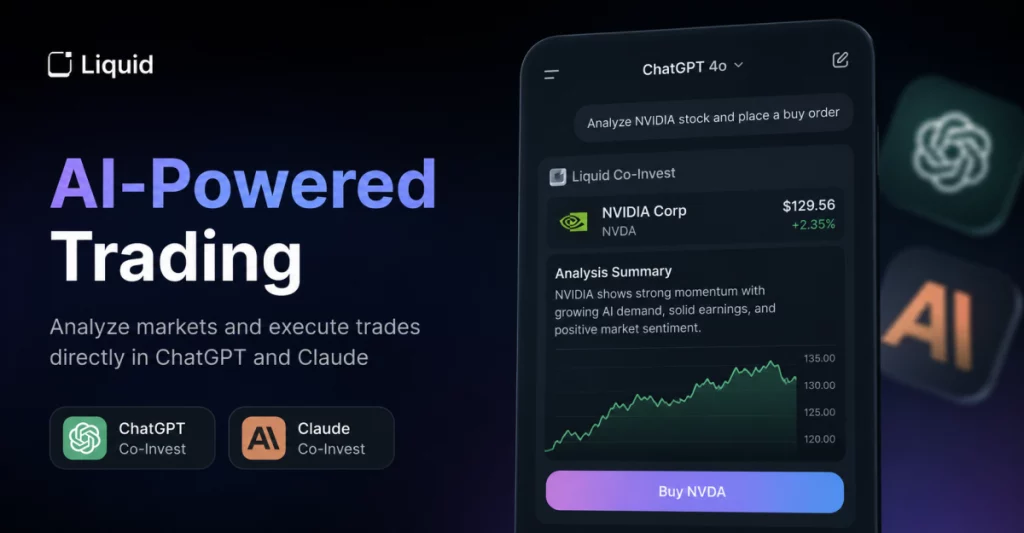
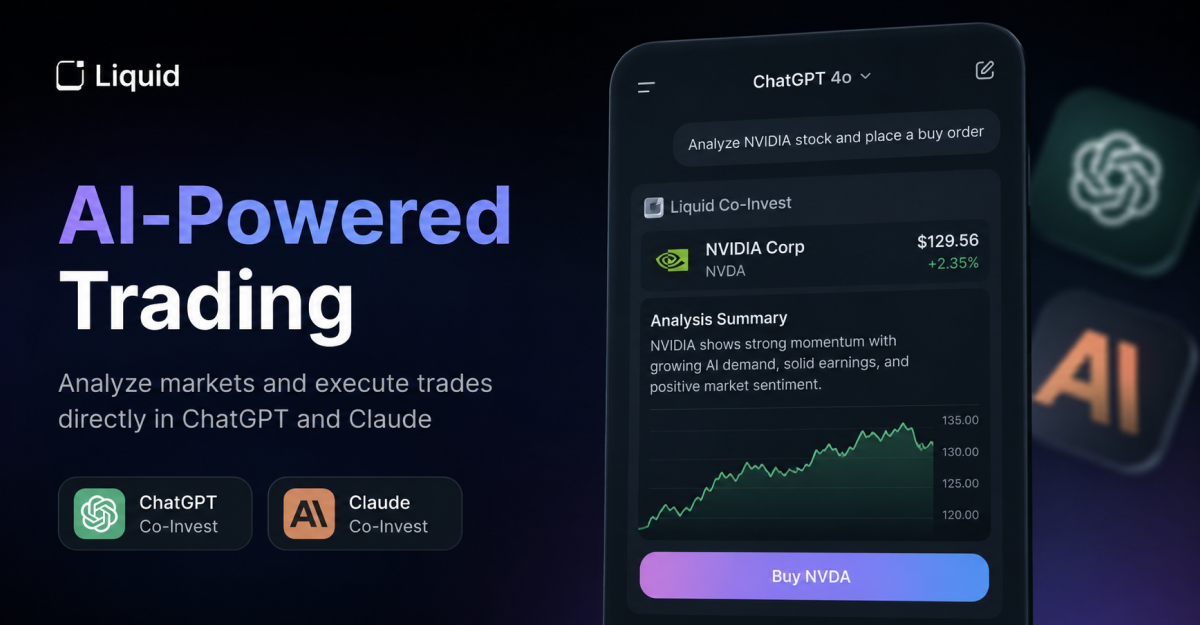
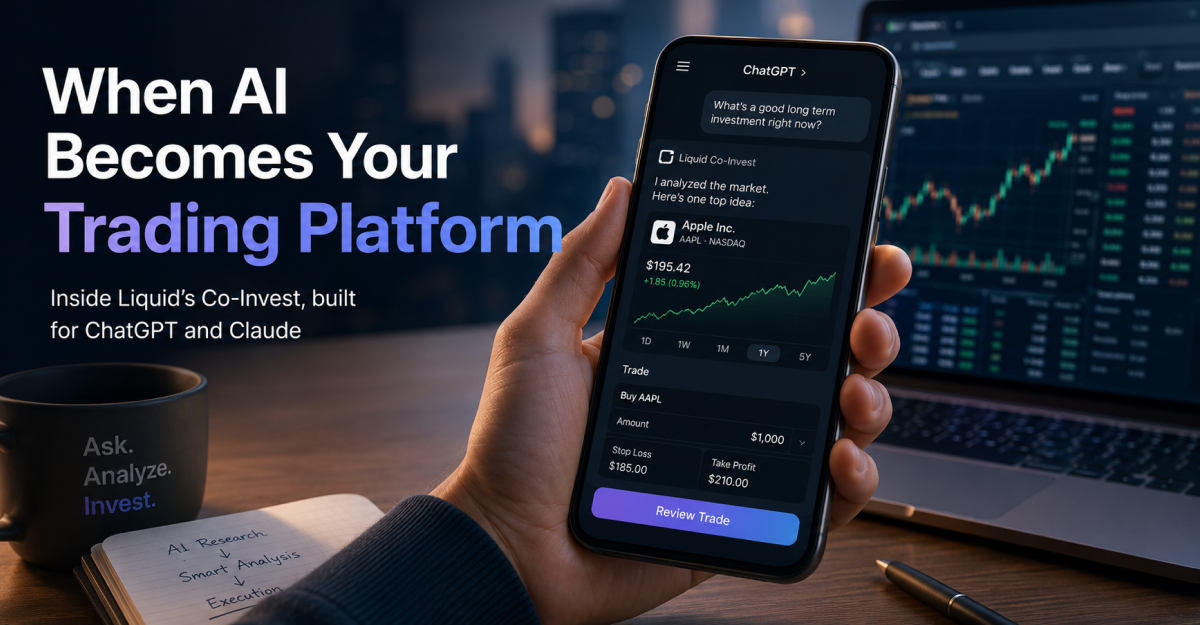
With the launch of Liquid Co-Invest, a new platform embedded directly into ChatGPT and Claude, investors can move from market analysis to live trade execution without ever leaving the chat window.
On the surface, it looks like another fintech innovation.
In reality, it may represent something much bigger.
It raises a fundamental question about the future of finance:
If AI assistants become the primary interface for investing, what happens to traditional brokerages?
The Next Battle in Finance Isn’t Between Brokers
For most of the internet era, financial firms competed against one another.
Today, they may be competing for something entirely different.
Attention.
More specifically, they are competing for a place inside the AI assistants millions of people increasingly use every day.
Consumers already ask ChatGPT and Claude for help planning vacations, comparing products, writing emails, learning new skills, and making purchasing decisions.
Investing may simply be the next category to move into conversational interfaces.
Instead of opening five browser tabs and three finance apps, users can ask:
“Should I buy Nvidia?”
“What are the risks of Bitcoin right now?”
“Compare gold, stocks, and treasury bonds.”
The research process becomes a conversation.
The next logical step is execution.
And that’s where Liquid Co-Invest enters the picture.
The Brokerage Model That Ruled the Internet Era
Traditional brokerages grew by controlling the entire customer journey.
They owned the interface.
They owned the account.
They owned the data.
And they worked hard to keep users inside their platforms.
| Category | Traditional Brokerage Model | AI-Native Investing Model |
| Primary Interface | Website or mobile app | AI assistant |
| Research | Separate research tools | Conversational analysis |
| Trade Execution | Inside the brokerage platform | Inside AI conversation |
| Customer Acquisition | App downloads | AI platform discovery |
| User Engagement | Notifications and platform visits | Ongoing conversations |
| Distribution | Direct consumer relationship | AI-mediated relationship |
| Competitive Advantage | Interface quality | Agent integration quality |
For years, this model worked extremely well.
Companies like Robinhood, Charles Schwab, Fidelity Investments, and Interactive Brokers built massive businesses by becoming destinations.
But AI assistants introduce a new possibility.
The destination may no longer matter.
What Is Liquid Co-Invest?
Imagine asking ChatGPT whether a stock looks attractive, getting an analysis instantly, and then buying it without opening a separate trading app. That’s the idea behind Liquid Co-Invest.
Created by fintech startup Liquid, the platform lets users research markets and place trades directly inside ChatGPT and Claude. Investors can access more than 500 markets, including stocks, cryptocurrencies, currencies, prediction markets, and pre-IPO shares, all from a single conversation.
Founded by Franklyn Wang, Liquid is betting that the future of investing won’t happen inside brokerage apps, but inside the AI assistants people already use every day.
What Liquid Co-Invest Actually Does?
At its core, Liquid Co-Invest combines market analysis and trade execution inside ChatGPT and Claude.
Users can:
- Fund accounts
- Analyze markets
- Build positions
- Set stop-loss orders
- Configure take-profit levels
- Execute trades
- Manage positions
All from within a conversation.
The platform supports more than 500 markets across:
- Cryptocurrencies
- Equities
- Foreign exchange
- Prediction markets
- Pre-IPO secondary shares
Unlike many AI finance tools that redirect users elsewhere to complete transactions, Liquid Co-Invest keeps funding, analysis, and execution within a single workflow.
| Feature | Description |
| AI Interface | Runs inside ChatGPT and Claude |
| Markets Supported | 500+ Markets |
| Asset Classes | Crypto, equities, FX, prediction markets, pre-IPO shares |
| Funding Methods | Cards, wallets, on-chain transfers |
| Risk Controls | Stop-loss and take-profit orders |
| Trade Execution | Directly from chat |
| Custody Model | Non-custodial |
| User Approval | Required for every trade |
| Trading Venues | Hyperliquid, Lighter, Ostium |
| Availability | All 50 US States and many international markets |
One design decision stands out.
Every trade requires explicit user confirmation.
There is no invisible autonomous trading happening in the background.
And that decision may be more important than the technology itself.
Why This Launch Is Bigger Than It Looks?
Many technology breakthroughs succeed not because they are technically superior, but because they remove friction.
The smartphone eliminated the friction of desktop computing.
Streaming eliminated the friction of physical media.
Ride-sharing eliminated the friction of calling a taxi.
AI investing may eliminate the friction between research and execution.
Historically, investors had to move through multiple stages:
Research → Analysis → Account Login → Order Entry → Trade Execution
Liquid Co-Invest compresses those steps into a single experience.
Research and execution happen in the same place.
That may sound like a small change.
It isn’t.
Because convenience often changes behavior faster than innovation itself.
And that’s when the business model starts to change.
The Rise of Agentic Finance
The phrase “agentic trading” has become one of the most discussed concepts in AI finance.
But the term often creates confusion.
Many people imagine fully autonomous systems making financial decisions without human involvement.
The reality is more nuanced.
Agentic finance focuses on AI systems that assist decision-making while operating within predefined rules and permissions.
| Function | Traditional Investing | AI-Assisted Investing |
| Research | User performs manually | AI assists |
| Market Monitoring | User watches markets | AI monitors continuously |
| Risk Analysis | User calculates | AI evaluates |
| Portfolio Comparison | Manual process | Automated |
| Execution Preparation | User enters orders | AI prepares orders |
| Final Approval | User | User |
This model creates a middle ground between manual investing and autonomous trading.
The investor remains in control.
The AI reduces complexity.
The Innovation Is Permission, Not Autonomy
Much of the excitement around autonomous trading misses an important reality.
Trust matters.
Accountability matters.
Regulation matters.
Investors are unlikely to hand complete control of their finances to an AI system overnight.
Instead, the industry appears to be moving toward permission-based automation.
Under this framework:
- AI provides analysis
- AI suggests actions
- AI prepares transactions
- Humans retain authority
That approach aligns more naturally with existing financial regulations and investor expectations.
It also creates a clearer chain of responsibility.
When something goes wrong, someone still made the final decision.
Why Brokers Should Be Nervous?
The biggest implication of Liquid Co-Invest may not be its trading functionality.
It may be what happens to the customer relationship.
Historically, brokerages owned the front-end experience.
But if users begin their financial journeys inside ChatGPT or Claude, brokers risk becoming invisible infrastructure providers.
| Historical Competition | Future Competition |
| App design | API quality |
| User interface | Agent integrations |
| Research portals | AI connectivity |
| Brand loyalty | Execution quality |
| Engagement metrics | Permission systems |
| Customer retention | Compliance infrastructure |
This creates a challenge for firms such as:
- Robinhood
- Coinbase
- Fidelity Investments
- Charles Schwab
- Interactive Brokers
The broker with the best app may not win.
The broker with the best AI integration might.
The Opportunities for Retail Investors
For ordinary investors, the appeal is easy to understand.
Financial markets are often intimidating.
Many people don’t know where to begin.
AI assistants can potentially lower those barriers.
| Benefit | Impact |
| Faster Research | Less time gathering information |
| Simplified Analysis | Easier understanding of complex markets |
| Better Accessibility | More investors can participate |
| Educational Support | Learning while investing |
| Reduced Friction | Fewer steps between research and action |
| Continuous Monitoring | Ongoing market awareness |
| Portfolio Insights | Faster comparison of opportunities |
For many users, the greatest value may not be trading itself.
It may be understanding what they are trading.
The Risks Nobody Fully Understands Yet
Yet the bigger story isn’t the technology.
It’s the risks that emerge when millions of people begin using similar AI systems.
Large language models can hallucinate.
Data feeds can contain errors.
Recommendations can be biased.
And users can become overly dependent on automated guidance.
| Risk | Potential Impact |
| Hallucinations | Incorrect information |
| Data Errors | Poor decisions |
| AI Bias | Distorted recommendations |
| Overreliance | Reduced independent thinking |
| Model Convergence | Similar investor behaviour |
| Crowded Trades | Market instability |
| Automation Risk | Unexpected outcomes |
| Security Risks | New attack surfaces |
Markets thrive on diverse opinions.
If millions of investors rely on similar prompts, similar models, and similar data sources, markets could become more synchronized than ever before.
That possibility remains largely unexplored.
The Regulation Question
Meanwhile, regulators face a different challenge.
Financial regulations were built around human decision-making.
AI introduces new layers of complexity.
| Question | Why does it matter? |
| Who is responsible for recommendations? | Investor protection |
| Who approved the trade? | Accountability |
| How are decisions documented? | Audit trials |
| What disclosures are required? | Transparency |
| How is bias monitored? | Fair treatment |
| How are AI errors handled? | Risk management |
| What supervision standards apply? | Compliance |
Organizations such as the U.S. Securities and Exchange Commission and the Commodity Futures Trading Commission will likely play central roles in shaping how AI investing evolves.
The Competitive Race Is Already Starting
Liquid is not alone.
A broader race is emerging across AI finance.
| Platform | Primary Capability | Execution Location |
| Liquid Co-Invest | Multi-asset trading | Inside chat |
| MoonPay ChatGPT App | Crypto purchases | External checkout |
| Gemini Agentic Trading | AI-connected exchange accounts | Exchenge-linked |
| OpenAI Finance Tools | Financial data and insights | ChatGPT |
| Plaid Integrations | Financial account connectivity | Embedded services |
The common theme is clear.
Financial services are moving closer to where conversations already happen.
The Numbers Behind Liquid
While the broader industry implications are significant, the company itself has already built meaningful scale.
Table: Liquid at a Glance
| Metric | Details |
| Markets Supported | 500+ |
| Trading Volume Processed | More than $3 billion |
| Users | Approximately 40,000 |
| Total Funding Raised | About $25.6 million |
| Latest Funding Round | $18 million Series Seed extension |
| Geographic Reach | All 50 U.S. states and many international markets |
| Major Investors | Paradigm, General Catalyst, Haun Ventures, Left Lane Capital, Neo, SV Angel, K5 Global |
| Asset Classes | Crypto, equities, FX, prediction markets, pre-IPO shares |
| Trading Infrastructure | Hyperliquid, Lighter, Ostium |
| Custody Model | Non-custodial |
Those numbers remain small compared with industry giants.
But platform shifts often begin at the edges.
What Happens If Investors Never Leave ChatGPT?
This is where the story becomes truly interesting.
The long-term significance of Liquid Co-Invest may have little to do with trading.
It may be about distribution.
Throughout technology history, companies that controlled distribution often became the most valuable players.
Search engines controlled discovery.
Mobile operating systems controlled apps.
Social networks controlled attention.
AI assistants may become the next major distribution layer.
| Today | Five Years From Now |
| Brokerages own interfaces | AI-assistants own interfaces |
| Investors open apps | Investors start conversations |
| Research tools are separate | Research is embedded |
| Trading platforms attract users | Infrastructure providers connect to agents |
| Customer relationships are direct | Customer relationships are mediated by AI |
In that world, brokers become infrastructure.
Execution becomes a service.
The AI assistant becomes the operating system for financial decisions.
Users may not care which broker sits underneath the experience, just as most internet users rarely think about the servers powering their favorite websites.
The competitive battleground shifts entirely.
Note: Did you know that while companies like Liquid are bringing AI into trade execution, Indian startup Trendlyne is using AI to simplify stock research and investment analysis for millions of investors? Go through the article for detailed info.
Conclusion
At first glance, Liquid Co-Invest looks like a clever way to place trades inside ChatGPT and Claude.
But the bigger story is not the product.
It’s the possibility that investing itself is becoming conversational.
For decades, brokerages fought to attract users into their own environments.
Liquid is testing a radically different idea: meet investors where they already are.
If that approach succeeds, AI assistants could evolve into the primary front-end for financial services, while brokers, exchanges, and trading venues operate behind the scenes as infrastructure providers.
The opportunities are significant.
Investing could become simpler, faster, and more accessible.
The risks are equally substantial.
Questions around trust, regulation, accountability, market concentration, and AI reliability remain unresolved.
Yet one thing is becoming increasingly clear.
The biggest threat to traditional brokerages may not be another brokerage.
It may be the AI assistant sitting between investors and every financial decision they make!
