
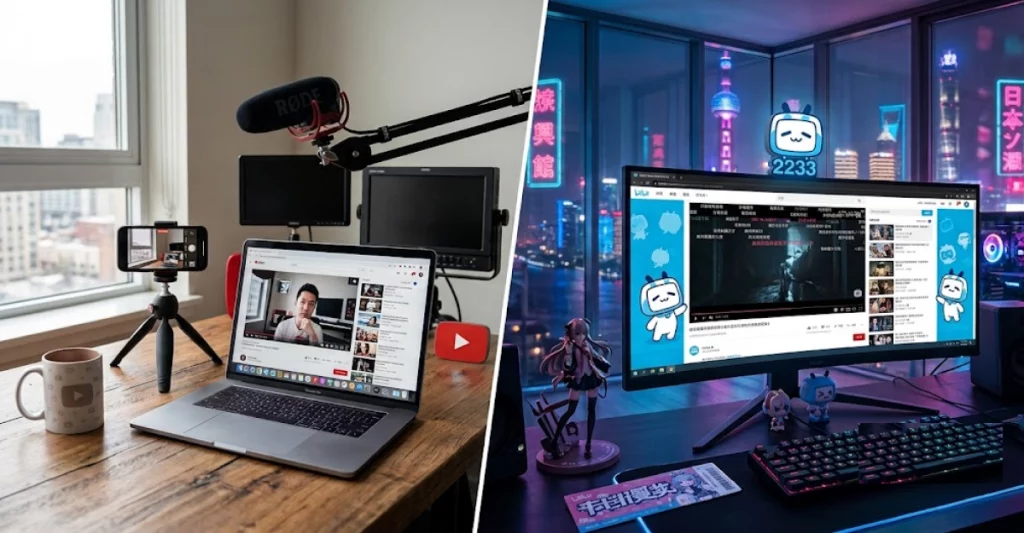
The search for YouTube vs Bilibili took the internet by storm. Reason? China’s latest announcement on “Bilibili going global”!
Let me give you a brief.
Whenever you open YouTube almost anywhere in the world, you find a familiar digital habit: music, gaming, news, tutorials, podcasts, Shorts, and millions of creators fighting for attention.
But that picture could be about to change.
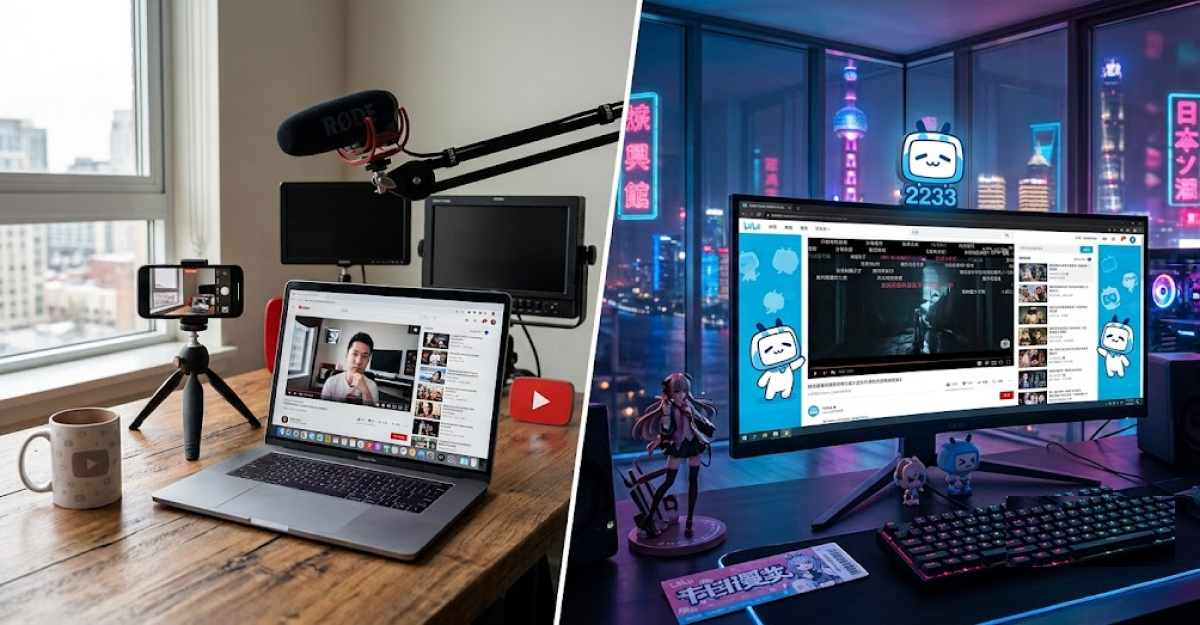
Another player is stepping onto the global video stage, and this time, it is China’s Bilibili. After building a massive following at home, Bilibili is now looking beyond China, taking its creator-focused platform into markets where YouTube has been the dominant name for years.
So, in this article, we will discuss YouTube vs Bilibili thoroughly.
Stay tuned!
Profile Comparison: YouTube vs Bilibili
The easiest way to understand YouTube vs Bilibili is to forget the interface for a moment.
YouTube is built for scale. It wants to be the place people go for almost anything, wherever they are.
Bilibili is built around community. It became popular by giving Chinese users, particularly younger audiences, a place where shared interests could turn into a strong sense of identity.
There is also a geographical wall between them. YouTube is blocked in mainland China, while Bilibili operates inside China’s domestic internet ecosystem. So, although people often search for Bilibili vs YouTube comparisons, these platforms are not fighting for exactly the same users.
| Business Factor | YouTube | Bilibili |
| Parent Company | Alphabet | Bilibili Inc. |
| Founded | 2005 | 2009 |
| Founders | Chad Hurley, Steve Chen, Jawed Karim | Xu Yi |
| Headquarters | San Bruno, California, US | Shanghai, China |
| Core Market | Global | Primarily China |
| Core Strength | Video, creators, advertising | Community, entertainment, gaming, anime and video |
| Business Model | Advertising, subscriptions and premium services | Advertising, memberships, games, live streaming and value-added services |
For years, Bilibili’s biggest limitation was also its biggest strength: China. Now, that may be changing. The platform is pushing beyond its home market with a relaunched international app, plans for an English-language website and efforts to attract creators and users across markets including the US, UK and Japan.
Bilibili has already taken Chinese anime and other content overseas, but expanding the platform itself is a much bigger move. If it can turn its highly engaged community model into a global offering, YouTube could face a challenger that is bringing a very different video culture to the international market.
The scale gap remains enormous, but Bilibili no longer has to compete with YouTube only from behind China’s digital wall.
YouTube Turned Online Video Into A Global Business
YouTube started with a deceptively simple idea: let people upload and watch video online.
Its first video appeared in 2005. Google bought the company the following year, and that acquisition changed the trajectory of online video. What began as a website for uploaded clips became one of the world’s largest advertising and creator businesses.
Today, YouTube is almost impossible to fit into one category. Someone might use it to watch a 30-minute documentary in the morning, a live sports stream at night and several Shorts in between. Music, podcasts, gaming, education and livestreaming have all become part of the same ecosystem.
That breadth is YouTube’s secret weapon.
Alphabet does not report one standalone figure for total YouTube revenue, so claiming a single number for the platform’s entire business would be misleading. However, YouTube advertising alone generated $11.06 billion in the second quarter of 2026, up 13% year over year.
Its scale also gives creators something Bilibili cannot easily replicate: access to audiences across countries. YouTube says more than 3 million creators are part of its Partner Program, while more than $100 billion has been paid to creators, artists and media companies over the last four years.
That has turned the YouTube creator economy into an industry of its own.
Note: Did you know YouTubers are beating Hollywood at filmmaking? Go through this article for detailed info!
Bilibili Built Something More Personal
Bilibili took a different route.
The platform emerged in 2009 from China’s anime, comics and gaming community. Instead of trying to become everything to everyone immediately, it built a culture around people who already shared specific interests.
That culture still matters.
One of Bilibili’s most recognisable features is danmu, or bullet comments. Instead of comments sitting underneath a video, viewers can send messages that appear across the screen while the video plays.
It sounds like a small design choice. It is not.
Danmu makes watching feel collective. Thousands of people can react to the same joke, scene or gaming moment together. The result is a platform where users are not simply consuming content. They are participating in a community.
Over time, Bilibili expanded beyond anime and gaming into education, technology, lifestyle and other forms of user-generated content.
Its audience is still strongly tied to younger Chinese internet users, and that cultural connection has become one of its biggest competitive advantages.
YouTube vs Bilibili Users: The Scale Gap Is Huge
The numbers make one thing immediately clear: Bilibili is not bigger than YouTube.
YouTube has an estimated global monthly audience of roughly 2.5 billion, while Bilibili reported 371 million monthly active users in the second quarter of 2026.
But there is an important catch.
Comparing these numbers without considering geography misses the real story. YouTube users are spread across the world. Bilibili users are overwhelmingly concentrated in China, where the platform has built a deeply localised ecosystem.
| Metric | YouTube | Bilibili |
| Monthly Active Users | About 2.5 billion, latest widely cited estimate | 371 million, Q2 2026 |
| Daily Active Users | Not separately disclosed | 116.5 million, Q2 2026 |
| Core Geography | Global | China |
| Major Audience | Broad global audience | Primarily Chinese users |
Bilibili also reported that users spent an average of 113 minutes per day on the platform in Q2 2026. That level of engagement helps explain why the company can remain strategically important despite being far smaller than YouTube.
YouTube Revenue Vs Bilibili Revenue
This is where the difference in business design becomes particularly interesting.
YouTube is fundamentally an advertising powerhouse. The larger its audience becomes, the more valuable its advertising inventory can become. Premium subscriptions, YouTube Music, memberships and other paid services provide additional revenue.
Bilibili has built a more diversified machine.
Advertising is growing quickly, but the company also makes money from mobile games, livestreaming, memberships and other value-added services.
In 2025, Bilibili generated RMB30.35 billion in revenue and reported its first full-year GAAP profit. In Q2 2026, revenue reached RMB7.94 billion, while advertising revenue jumped 28% year over year to RMB3.13 billion.
| Business Metric | YouTube | Bilibili |
| Latest Reported Revenue | $11.06B YouTube ads, Q2 2026 | RMB7.94B total, Q2 2026 |
| Advertising Revenue | $11.06B, Q2 2026 | RMB3.13B, Q2 2026 |
| Major Additional Revenue | Premium, Music and paid services | Games, memberships, livestreaming and VAS |
| Profitability | Alphabet reports YouTube within broader segments | RMB339.1M net profit, Q2 2026 |
The figures are not perfectly comparable because Alphabet does not disclose YouTube’s complete standalone revenue, while Bilibili reports its total company revenue. Still, the scale difference is unmistakable.
Why Is Bilibili So Popular In China?
The answer goes beyond anime.
Bilibili has created something that is difficult to manufacture with advertising money: belonging.
Its users can identify themselves through the communities, creators, games and interests they follow. Danmu reinforces that feeling by turning individual viewing into a shared experience.
This is particularly powerful among younger audiences, who have grown up with Bilibili as part of China’s digital culture.
That does not mean Bilibili has no serious competition. Tencent Video, iQIYI, Youku and Douyin all compete for Chinese users’ attention, although their formats and business models differ.
The China Factor Changes Everything
The biggest reason a direct Bilibili vs YouTube comparison can be misleading is simple: YouTube cannot operate normally in mainland China.
That has given Bilibili an enormous local advantage.
Instead of fighting YouTube head-on, Bilibili has developed alongside China’s own internet ecosystem. It understands the language, content preferences, regulatory environment and commercial habits of its home market.
YouTube has a much larger world to conquer. Its competitors include TikTok, Instagram, Facebook and Twitch, while streaming services such as Netflix compete for attention in selected content categories.
So the two platforms face very different competitive pressures.
Creators: Reach vs Local Depth
For creators, YouTube has the obvious advantage of reach.
A successful creator can build an audience in multiple countries, earn advertising revenue and add memberships, Super Chat, Super Thanks, shopping, sponsorships and other income streams.
Bilibili offers a different proposition. Its creators can earn through advertising, fan support, memberships, livestreaming, commercial partnerships and gaming-related opportunities.
The key difference is not necessarily who pays creators more. There is no universal answer.
It is who the creator wants to reach.
For a creator targeting a global audience, YouTube is the obvious heavyweight. For someone targeting China’s digital audience, Bilibili offers something far more valuable: direct access to a huge, highly engaged local community.
| Factor | YouTube | Bilibili |
| Geographic Reach | Global | Primarily China |
| Core Audience | Broad | Youth and community focused |
| Biggest Strength | Scale and monetisation | Community and niche engagement |
| Content Breadth | Extremely broad | Entertainment, gaming, anime and UGC |
| Main Revenue Engine | Advertising | Diversified revenue mix |
| Key Advantage | Global creator ecosystem | Deep Chinese user community |
| Main Challenge | Competition and creator retention | Competition and profitability |
Chinese video platform Bilibili is making a bigger push into international markets, moving beyond its reputation as a China-focused alternative to YouTube. With a revamped overseas app and plans to bring more creators and viewers onto the platform, Bilibili appears to be positioning itself as a more serious global contender in online video.
Bilibili’s Global Expansion
The creator payout story is only one part of a much larger international strategy. Bilibili has reportedly revamped its overseas app, initially focusing on Android, while an iOS version and an English-language website are also part of its expansion plans.
The goal appears to be making the platform easier for international users to discover and use, with simpler registration and a more localised experience.
Bilibili is also reportedly building its international presence on the ground. The company has been recruiting community managers in cities including Los Angeles, London, Tokyo, Istanbul, Mexico City and São Paulo. A creator-brand marketplace is also reportedly being developed, potentially giving creators another route to commercial partnerships.
A Huge Chinese User Base, And A New Challenge For YouTube
Bilibili’s global ambitions are backed by an already sizeable home-market audience. Founded in 2009, the platform has grown into one of China’s major video services, with hundreds of millions of monthly active users.
Its international experiment has also attracted some high-profile names. YouTube star MrBeast reportedly joined Bilibili in 2024 and went on to build a following of around 8.8 million on the platform.
That does not mean Bilibili is anywhere close to matching YouTube’s global scale. But attracting internationally recognised creators could help it move from being primarily a Chinese video platform to becoming a genuine global contender.
For YouTube, that makes Bilibili worth watching. The Chinese platform is not simply taking its content overseas. It is attempting to take its entire creator-and-community ecosystem with it.
YouTube vs Bilibili: Who Pays More To Creators?
For creators, the real question is not just which platform has more users. It is which one can put more money in a creator’s pocket. YouTube has had years to build its monetisation system, while Bilibili is now using creator payouts as part of its push to attract talent beyond China.
Reports circulating online claim Bilibili may offer creators around $0.70 per 1,000 views, or roughly ₹60-₹66. But there is an important catch: Bilibili has not officially confirmed this as a fixed rate. Actual earnings can vary based on audience location, advertising demand, content type, traffic quality and other deductions.
YouTube, meanwhile, has a more established revenue-sharing system. Eligible creators can earn from ads, YouTube Premium, channel memberships, Super Chat, Super Thanks and other features. YouTube says creators receive 55% of net revenues from ads on their public videos, while Shorts use a separate revenue-sharing model.
| Creator Monetisation Factor | YouTube | Bilibili |
| Reported/Official View Payout | No fixed universal rate; ad revenue share applies | Around $0.70 per 1,000 views reported online, not officially confirmed |
| Advertising | Major creator income source | Major monetisation stream |
| Memberships | Channel memberships | Paid memberships |
| Fan Support | Super Chat, Super Thanks | Fan support and livestreaming |
| Shorts/Short Video | Shorts revenue-sharing model | Short-video monetisation available |
| Global Reach | Extremely broad | Expanding beyond China |
| Creator Advantage | Mature monetisation ecosystem | Growing opportunity for international creators |
So, who pays more? There is no reliable one-number answer. YouTube has the more established and transparent creator monetisation infrastructure, while Bilibili’s reported payout has attracted attention precisely because the platform is trying to make itself more appealing to creators entering its global expansion.
For now, YouTube remains the safer benchmark for a mature creator business, while Bilibili is the newer challenger trying to make creators take notice.
Final Words on YouTube vs Bilibili
So, where does that leave you in the YouTube vs Bilibili battle?
If you are looking at sheer scale, YouTube is still in a league of its own. But if you are looking at what could come next, Bilibili is far more interesting. It has already built a massive community in China and is now taking that model beyond its borders.
You may not see Bilibili replacing YouTube anytime soon, but you could soon see creators, brands and viewers having another major platform to choose from. And that is exactly what makes Bilibili’s global expansion worth watching.
Thanks for reading 🙂
