
In today’s world, where Obesity is becoming endemic in many countries, people are desperately searching for a cure. The cure? Fitness and good health! Yes, if you are physically and emotionally fit, you’ll be healthy. That’s the simple mantra.
But you know what… Following a fitness regime is difficult when you have a busy schedule. Worry not! There’s a solution for that too… Fitness devices!
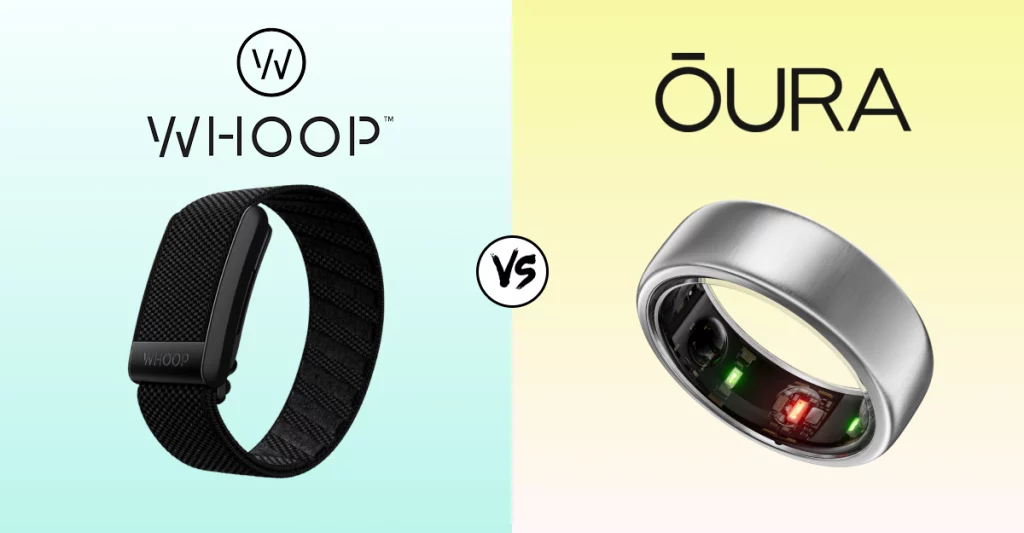
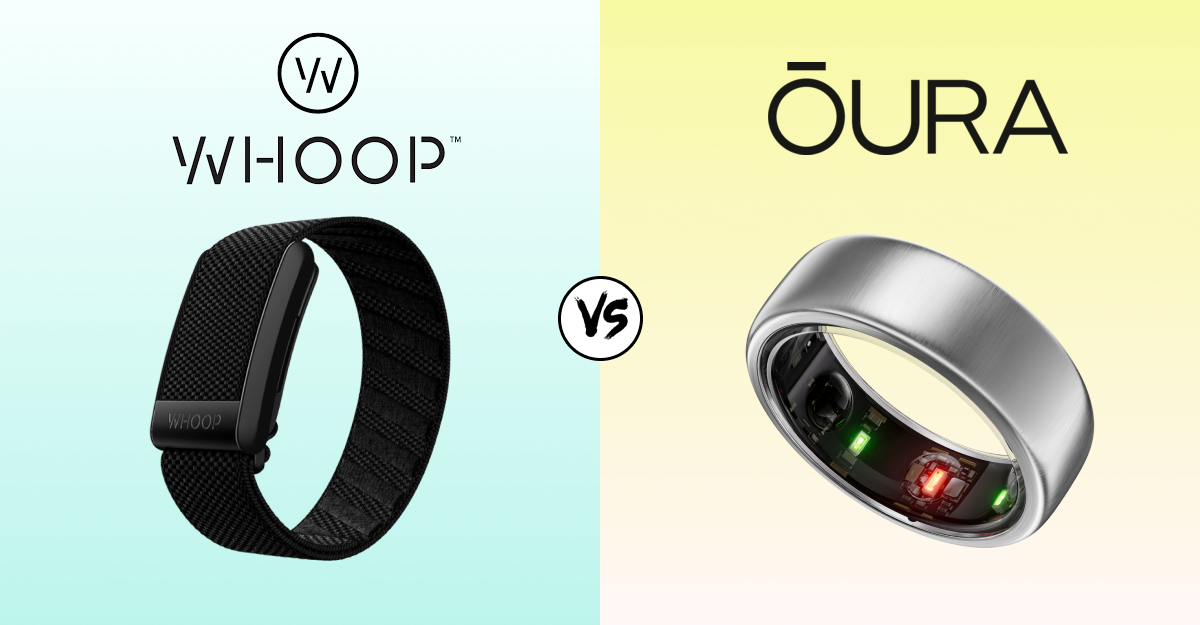
Here are the two such fitness devices in such fierce competition- Whoop vs Oura. So, let’s go through a detailed comparison of both fitness devices.
Whoop vs Oura: Key Differences
Do you know Whoop 4.0 and the Oura Ring 3, both fitness trackers offer unique features and pricing structures that cater to different user needs. Let’s understand their key differences through the following table-
| Feature | Whoop | Oura Ring |
| Form Factor | Wristband | Ring |
| Primary Focus | Fitness and Recovery | Sleep and overall wellness |
| Data Output | Detailed metrics with complex readouts | Streamlined, user-friendly summaries |
| Sleep Tracking | Sleep performance percentage; sleep debt calculator | Sleep score (0-100) and efficiency metrics |
| Fitness Tracking | Automatic activity detection; strain monitoring | Tracks steps and basic activity |
| Battery Life | Can charge while wearing; lasts several days | Lasts several days; must be removed to charge |
| Subscription Model | $30/month or $239-$399 for annual plans | $5.99/month after initial purchase of $299-$349 |
| App Usability | Complex but rich in data | Intuitive and easy to navigate |
| Special Features | Custom recovery plans, team features | Symptom tracking, menstrual cycle tracking |
| Style | Athletic look; may not suit formal wear | Sleek design; resembles jewelry |
As you can see, both devices cater to different user preferences. Whoop is ideal for those seeking in-depth fitness insights, while Oura Ring is better suited for users prioritizing aesthetics and a holistic approach.
In the upcoming section, we will compare the key features in detail.
Pricing Structure Whoop vs Oura
Don’t you wonder whether your fitness approach will be pocket-friendly or not? If yes, then the following table is going to help you-
| Pricing Structure | Whoop 4.0 | Oura Ring 3ed Gen |
| Upfront Cost | Free for the device | $299 (Heritage) to $349 (Horizon) |
| Subscription Cost | $30/month | $5.99/month after the first month |
| Annual Subscription Cost | $288/year ($24/month) | $71.88/year ($5.99/month) |
| 18-Month Subscription Cost | $324 total ($18/month) | N/A |
| Total Cost after 1 Year | $360 (monthly plan) or $288 (annual plan) | $299-$349 (upfront) + $71.88 (annual subscription)= $370-$420 |
| Total Cost after 2 years | $720 (monthly plan) or $399 (two-year plan) | $299-$349 + $143.76 = $442.76- $492.76 |
This table describes that Whoop 4.0 has no upfront cost but requires a higher monthly subscription fee, making it potentially more expensive over time if paid monthly. Whereas Oura Ring has a higher initial purchase price but lower ongoing subscription fees. Thus, it may be economical for you if you prefer a one-time investment with minimal monthly costs.
Primary focus: Fitness vs Overall Wellness
As you have read in the “key differences” table, the primary focus of Whoop and Oura are different. Both of them are fitness trackers, then how come their prime features are different? You may wonder. Go through the following table, and you’ll find out-
| Features | Whoop | Oura Ring |
| Primary Focus | Recovery & Fitness | Sleep and wellness |
| Data Presentation | Detailed metrics and analytics | Simplified scores for easy understanding |
| Sleep Tracking | Sleep performance percentage; sleep debt calculator | Sleep score (0,100) and efficiency metrics |
| Fitness Tracking | Strain monitoring and cardio zones | Tracks steps and basic activity |
| Comfort | Can be worn 24/7; may feel bulky when sleeping | Lightweight and discreet; comfortable for sleep |
| Style | Sporty design; less suitable for formal wear | Sleek, jewelry-like appearance; versatile for various occasions |
Which one should you wear?
The answer is simple- If you are a fitness enthusiast, go for Whoop and if you are looking for overall wellness prioritizing sleep, then go for Oura ring.
Look, Whoop is better suited for those focused on fitness, recovery, and detailed metrics. If you are an athlete or want to optimize your training, then you must go for it.
On the other hand, Oura ring is more appropriate if you prioritize sleep quality, wellness, and aesthetics. Usually, it appeals to those who prefer a discreet wearable that can blend with everyday attire.
Which one is more comfortable?
Okay, so Whoop can be worn continuously but may feel intrusive during sleep due to its wristband design. Users have noted it can be cumbersome while engaging in certain activities.
Contrarily, Oura Ring is generally considered more comfortable for sleeping and daily wear. Reason? It is lightweight and unobtrusive. After all, wearing a ring is a super-comfortable thing. That’s why many users prefer it over a wristband during the night.
In short, your choice will depend on your primary focus- fitness tracking or sleep/wellness monitoring- and your comfort preference regarding wearability
Note: We have also discussed Whoop vs Apple Watch in detail. To know which one is better for you, kindly go through the article “Whoop vs Apple Watch: Which is better for you in 2024?”
Whoop vs Oura: Which provides more accurate data?
When you’re investing your money as well as your effort towards fitness, getting accurate data is an obvious expectation. The following table showcases a thorough comparison of Whoop vs Oura on the accuracy of data-
| Data Accuracy | Whoop | Oura Ring |
| Miscalculation | Underestimates total sleep time by 12.2 minutes; accurate heart rate but underestimates HRV by 4.5 ms | Overestimates total sleep time by 1.5 minutes; accurate heart rate and HRV, with an average calculated over the night |
| Sleep Tracking | Identifies 86% of sleep epochs correctly compared to polysomnography; detailed sleep analysis but less accurate on stages | Identifies 89% of sleep epochs correctly; provides a simpler breakdown of sleep stages (light, REM, deep) |
| Heart Rate Monitoring | Accurate during cardio; underestimates heart rate by 0.3 bpm compared to ECG | Slightly overestimates heart rate by 0.1 bpm; continuous monitoring throughout the night |
| User Experience | Complex data presentation may overwhelm casual users; detailed reports available after a month | User-friendly interface with easy-to-understand summaries; instant synching with the app. |
Let me summarize the table in short. Whoop excels in providing detailed fitness and recovery data, making it suitable for serious athletes who want granular insights. However, its underestimations in sleep time and variability may affect overall accuracy.
Oura Ring is specially designed for users focused on sleep quality and general wellness, offering a more straightforward approach to data presentation. Its slight overestimation of sleep time is less impactful compared to Whoop’s greater underestimation.
Businesswise Comparison: Whoop vs Oura
Here comes the most important part of the article i.e. businesswise comparison where we will see who is doing a better business in the global market as well as the Indian market-
| Business Aspects | Whoop | Oura |
| Market Position | Strong presence in fitness and athletic communities; targeted marketing towards serious athletes and fitness enthusiasts. | Appeals to a broader audience interested in wellness and lifestyle, including casual users focused on sleep and health monitoring. |
| Revenue Model | A subscription-based model with no upfront cost for the device; monthly fees of $30 or annual plans available. | Upfront purchase of the ring ($299-$349) followed by a lower subscription fee of $5.99/month. |
| User Base | Estimated over 125 million people have access to Whoop as of 2023; primarily athletes and fitness-focused individuals. | Over 2.5 million rings sold since launch; appeal to both fitness enthusiasts and general wellness users. |
| Growth Rate | Rapid growth, especially during the pandemic as more people focused on health and fitness; partnerships with professional sports teams and organizations. | Steady growth with a focus on lifestyle branding; popularity surged due to its discreet design and ease of use. |
| Profitability | Continues to invest heavily in marketing and partnerships, which may impact short-term profitability but aims for long-term growth | More stable revenue model due to upfront sales; lower online costs could lead to better profitability over time |
| Global Reach | Strong presence in North America, expanding into Europe and Asia, particularly among sports professionals. | Global reach with significant sales in Europe and North America, gaining traction in Asia due to increasing health awareness. |
| Investment & Valuation | Valued at approximately $3.6 billion after recent funding rounds; backed by notable investors in the sports industry. | Valued around $2.55 billion; received substantial investment for expansion and technology development. |
Now, let’s analyze their market performance.
By now, you must have realized that Whoop has positioned itself as a leader in the fitness tracking market. And that too particularly among athletes who seek detailed metrics for performance optimization. Its subscription model encourages long-term commitment from users, which can lead to stable revenue streams.
Oura, on the other hand, has carved out a niche in the wellness market, appealing to users interested in sleep quality and overall health rather than just fitness metrics. Its design and user-friendly interface have contributed to its popularity.
Indian Market Insights
Let’s zoom in to India where both brands are gaining traction as consumers are becoming more health conscious. Whoop has started targeting Indian athletes and fitness enthusiasts through localized marketing strategies. However, it faces stiff competition from established brands like Fitbit and Garmin.
Oura is also expanding its reach in India, leveraging its sleek design and wellness focus to attract a wider audience beyond just fitness enthusiasts.
In other words, both companies are performing well within their respective markets, Whoop appears to have a slight edge in terms of revenue generation due to its subscription model targeting serious athletes.
However, Oura’s broader appeal and lower upfront costs may allow it to capture a larger share of the general wellness market.
Final Words
The choice between Whoop and Oura depends on individual preferences regarding fitness tracking versus overall wellness monitoring.
Each brand has carved out its niche, appealing to different segments of the health-conscious consumer market.
