
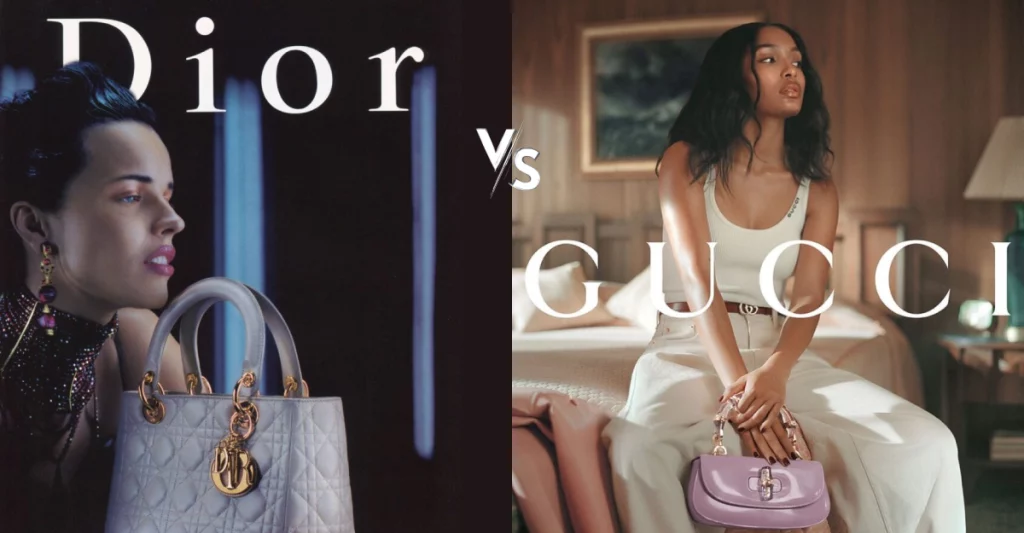
When it comes to luxury fashion, you can’t escape the eternal question — Dior vs Gucci, which one truly stands above the other? Whether you love the soft, romantic feel of Dior or the bold and rebellious charm of Gucci, both brands have shaped global fashion for decades.
In 2026, their rivalry has reached new heights, not just in design but in business, beauty, and brand value. You’ll be surprised to see how these two icons differ in their roots, creativity, and financial power.
Let’s see who truly wins the Dior vs Gucci battle this year!
Profile Overview: A Quick Glance
Before we jump into the details, it’s essential for you to understand where both brands come from. Dior vs Gucci isn’t just a clash of fashion houses—it’s a story of heritage, innovation, and leadership.
Dior was founded on 16th December 1946 by Christian Dior and Marcel Boussac in the heart of Paris. It became an immediate sensation after introducing the “New Look” that celebrated femininity with elegance. Today, Dior operates under the Christian Dior SE company, with Bernard Arnault as Chairman and Antoine Arnault as CEO and Vice-Chairman. Dior’s global presence includes 535 stores worldwide by 2025, showcasing everything from couture to skincare and even spirits.
On the other hand, Gucci, founded in 1921 by Guccio Gucci in Florence, Italy, began as a humble leather goods workshop. Over the decades, it grew into a bold and eclectic global name. Now a part of the Kering Group, Gucci continues to influence global fashion under Sabato De Sarno, who’s known for reshaping its creative direction toward understated luxury. The brand has around 500+ boutiques worldwide.
Let’s have a quick look at the profile of both companies-
| Particulars | Dior | Gucci |
| Company Type | Public (Christian Dior SE, listed on Euronext Paris) | Public (Subsidiary of Kering Group, listed on Euronext Paris) |
| Industry | Luxury goods | Luxury goods |
| Founded | 16th December 1946 | 1921 |
| Founders | Christian Dior; Marcel Boussac | Guccio Gucci |
| Headquarters | 30 Avenue MontaigneParis, France | Florence, Italy |
| Number of Locations | 535 stores worldwide (2025) | Approx. 500+ boutiques globally |
| Key People | Bernard Arnault (Chairman);Antoine Arnault (CEO and Vice-Chairman) | Jean-François Palus (Kering CEO interim); Sabato De Sarno (Gucci Creative Director) |
| Products | Clothing, cosmetics, fashion accessories, jewelry, perfumes, spirits, watches, wines | Clothing, leather goods, shoes, handbags, jewelry, watches, fragrances, home decor |
| Owner | Groupe Familial Arnault via Financière Agache (97.5% of shares; 2024) | Kering Group (majority owner) |
Both Dior and Gucci are publicly listed on Euronext Paris, representing the heart of European luxury and artistry. But while Dior thrives under Groupe Arnault’s 97.5% ownership, Gucci’s future is shaped by the strategic vision of Kering Group.
Features Comparison of Dior vs Gucci
Both Dior and Gucci houses have shaped the way you see fashion, beauty, and self-expression.
Let’s look at how these icons compare across style, innovation, and vision.
| Aspect | Dior | Gucci |
| Product Focus | Gender-specific fashion (notably feminine, experimental luxury, plus menswear), couture, skincare, etc. | Eclectic, bold fashion for men and women, leather goods, shoes, bags, fragrances, home decor |
| Skincare & Beauty Philosophy | Advanced anti-aging, science-driven (spa innovations with tech: cryotherapy, LED therapy, etc.) | Emphasis on experimental beauty, vibrant colors, and bold makeup; also sustainable beauty initiatives |
| Perfume Approach (2025) | Iconic lines (e.g. J’adore, Miss Dior); large perfume and scented beauty portfolio | Trendsetting scents blending tradition and modernity; e.g. Gucci Bloom, Memoire d’une Odeur |
| Notable Recent Launches | Dior Spa New York (flagship spa with futuristic treatments, 2025) | New bold collections under Sabato De Sarno with a fresh take on understated elegance (2024–25) |
| Price Range (Handbags, 2025) | $3,000-$7,000 | Wide range from $1,200 to $5,000+ for iconic bags |
| Instagram Followers | ~46.7M | ~39 million |
| Sustainability Initiatives | Committed to cutting carbon by 46% by 2030, flower farming for biodiversity | Leather sourcing transparency; circular fashion steps; Kering group sustainability programs |
| Recent Creative Focus | Modern, experimental luxury, tech integrations, exclusive spa experiences | Shift towards understated luxury under new director; balancing heritage with minimalism |
| Ownership Structure | Controlled by Groupe Arnault via Financière Agache; 97.5% ownership (2024) | Subsidiary of Kering Group |
| Brand DNA | Bold femininity, artistic innovation, color, and creativity | Vibrant maximalism to evolving minimalism, vintage flair, eclectic boldness |
As you can see, Dior vs Gucci isn’t just a fashion comparison—it’s a clash of philosophies. Dior’s refined grace contrasts beautifully with Gucci’s fearless flair. Whether you lean toward Dior’s modern sophistication or Gucci’s bold reinvention, both brands invite you to express who you are through luxury that tells a story.
Dior vs Gucci: Business Comparison & Financial Highlights
Behind the glamour of the runway lies the real test of power—profitability. In the luxury race of Dior vs Gucci, numbers reveal how each brand turns style into global success. Dior dominates with scale and resilience under LVMH, while Gucci faces a new chapter of transformation within Kering.
The following table describes how their financial strength and strategy stack up against each other–
| Business Aspects | Dior | Gucci |
| Market Capitalization | Not explicitly disclosed (LVMH parent controls via Groupe Arnault) | $23.8 billion |
| Revenue | €84.7 billion (2024); ($89.0 billion USD); H1 2025: €39.8 billion ($41.8 billion) | $6.3 billion (2024 est., including 2025 H1 $3.15 billion) |
| Operating Profit | H1 2025: €9 billion ($9.45 billion USD) with 22.6% operating margin | H1 2025: €486 million ($511.5 million) with ~16% margin |
| Net Profit | H1 2025: €5.9 billion ($6.2 billion USD); 2025 estimate: €5.2 billion ($5.47 billion USD) | H1 2025: €474 million ($502 million USD) |
| Brand Value (2025) | 7ᵗʰ strongest global luxury brand, AAA+ rating; $20.5 billion estimated brand value | $18.1 billion estimated brand value in 2025 |
| Revenue Growth Trend (2025) | H1 2025 down 3% organically vs. H1 2024 | Down approximately 26% YoY |
| Expenses/CapEx (2025) | Operating margin maintained at high 22–23%; Free cash flow €4 billion ($4.2 billion USD) | Increasing costs, restructuring expenses, retail and marketing investments |
| Key Financial Highlights | Resilient margins, highest luxury group profitability, major Asia/US share | Sharp sales decline, creative director transition, cutting wholesale exposure |
| Operating Margin (full year) | 23.1% (2024) | Approx. 16% (2025 est.) |
| Free Cash Flow (full year) | €10.5 billion ($11.03 billion) | Not publicly disclosed precisely; Kering group shows cash generation |
From the figures, it’s clear that Dior vs Gucci represents two very different business stories. Dior thrives on steady expansion and unbeatable margins, while Gucci is navigating change to rebuild momentum. Yet both remain pillars of modern luxury—one defined by stability, the other by reinvention. Their rivalry proves that in fashion, success wears many faces.
Note: We have also explained Dior vs Chanel. Go through it for more information.
Final Thoughts: Who is the winner?
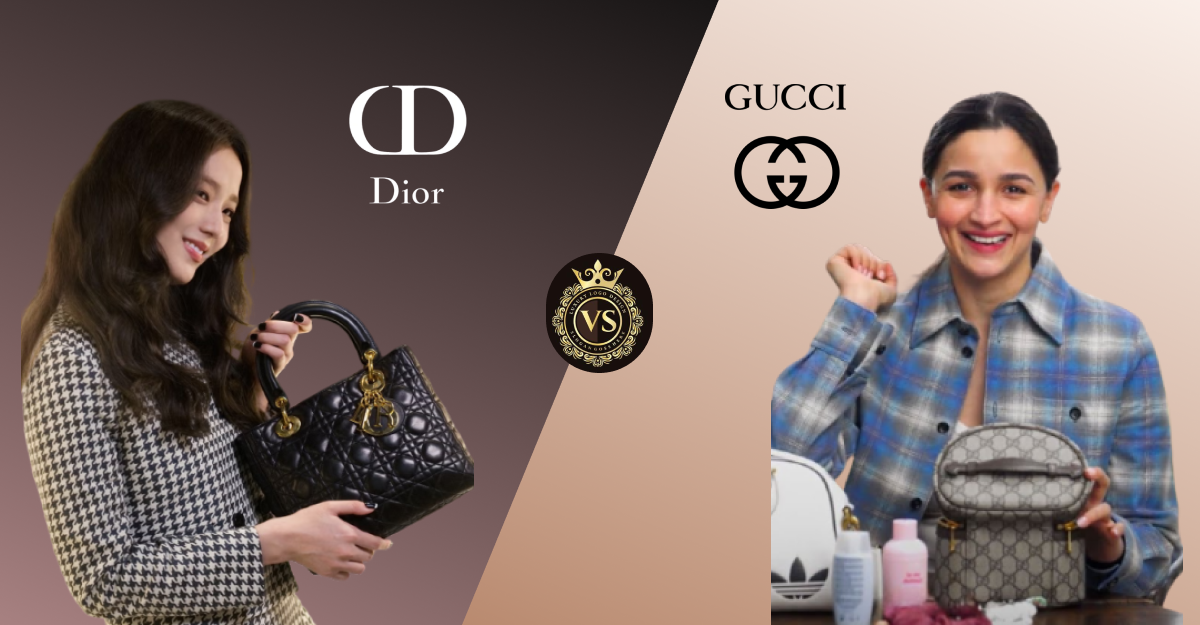
So, after going through every angle—style, vision, business, and creativity—who truly comes out on top in Dior vs Gucci? The answer depends on what luxury means to you.
If you’re drawn to quiet sophistication, Dior wins your heart. It’s elegant, refined, and effortlessly modern—like art that never shouts but always stands out. Dior speaks to those who value timeless grace and innovation wrapped in perfection.
But if you live for bold expression and individuality, Gucci takes the crown. It’s vibrant, daring, and unpredictable—a celebration of freedom and fearless style. Gucci invites you to stand out, not blend in.
In the end, there’s no absolute winner in Dior vs Gucci—just two extraordinary visions of luxury. Dior defines beauty through poise and precision, while Gucci turns creativity into rebellion. Together, they remind you that true luxury isn’t about choosing sides—it’s about finding the brand that mirrors you.
FAQs: Dior vs Chanel
1. Which brand is more expensive—Dior or Chanel?
Chanel generally sits higher in the price bracket, especially for handbags, which range up to $10,000, while Dior bags typically go up to $7,000. However, Dior offers a broader price spectrum across more product categories.
2. Who owns Dior and Chanel?
Dior is controlled by Groupe Arnault through Financière Agache, which owns 97.5% of its shares. Chanel is privately owned by the Wertheimer brothers, maintaining full independence.
3. Which brand has better perfumes—Dior or Chanel?
It depends on your taste. Dior offers more frequent innovations with lines like J’adore and Miss Dior, while Chanel’s No. 5 and Coco Mademoiselle remain legendary for their timeless charm.
4. Who earns more—Dior or Chanel?
Dior, as part of LVMH, reported €84.7 billion in revenue (2024), while Chanel recorded $18.7 billion. Dior leads in scale, but Chanel’s exclusivity ensures high profit margins.
5. Which brand is more sustainable?
Both are progressing, but Chanel took earlier action by banning fur and exotic skins in 2018. Dior is focusing on reducing carbon emissions and supporting eco-friendly farming.
6. Who has a stronger social media presence?
Chanel leads with 59.8 million Instagram followers, compared to Dior’s 46.7 million, showing stronger digital engagement.
7. What’s new for Dior and Chanel in 2026?
Dior unveiled its futuristic Dior Spa in New York, while Chanel launched its fine jewelry and watch flagship on Fifth Avenue, New York. Both continue to expand luxury beyond clothing.
Thank you for reading! We would love to hear your thoughts—who’s your winner in the Dior vs Gucci debate? Share your opinions in the comment section below!
