
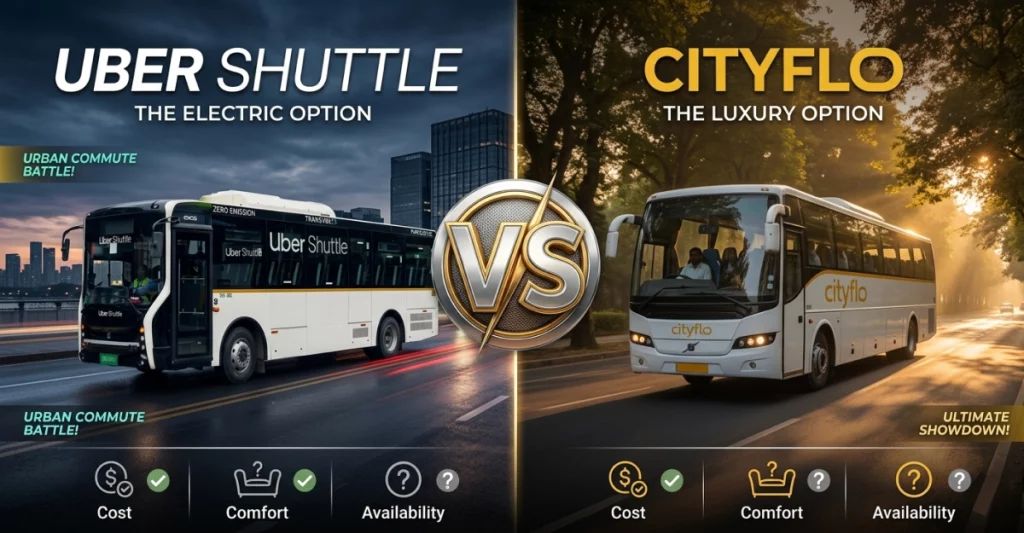
If you’ve ever struggled through peak-hour traffic in a metro city, you already know the problem. Public buses are crowded, cabs are expensive, and driving yourself is exhausting.
That’s exactly where services like Uber Shuttle and Cityflo stepped in.
Both promised something simple but powerful. A predictable, app-based, comfortable ride to work.
But here’s the catch- One of them is no longer around…
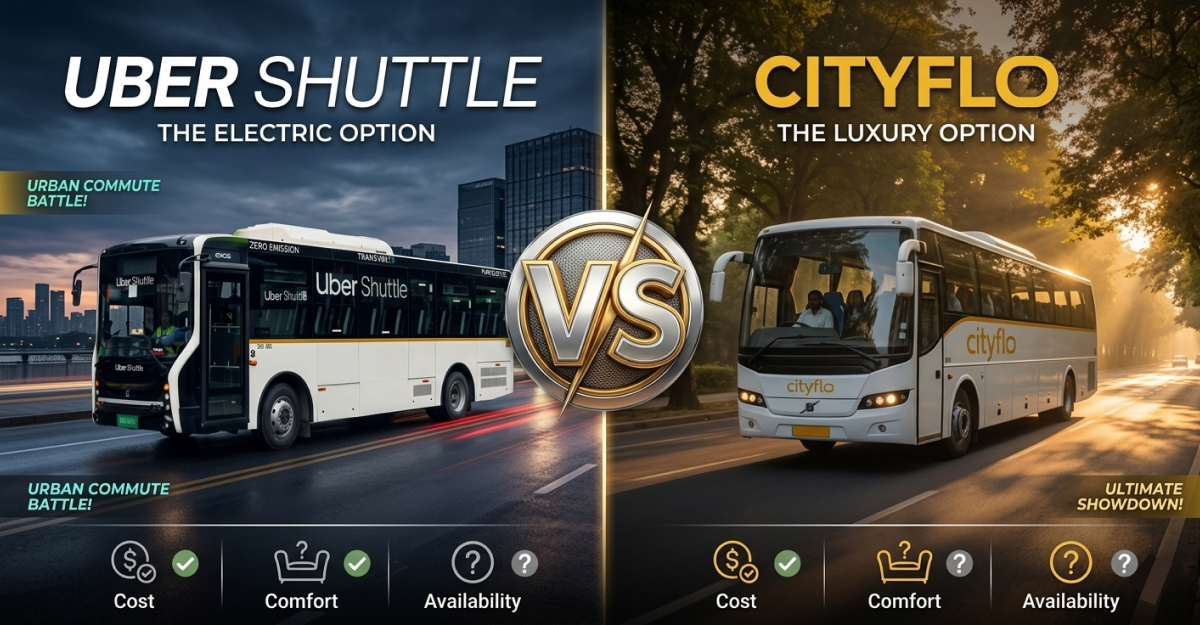
So when people search for Uber Shuttle vs Cityflo in 2026, they’re not just comparing features. They’re trying to understand what worked, what didn’t, and what actually makes sense today.
Let’s break it down properly!
Backstory: What Was Uber Shuttle, and What Is Cityflo?
Before comparing, you need to understand how both services were built.
Uber Shuttle: The Mass Commuting Experiment
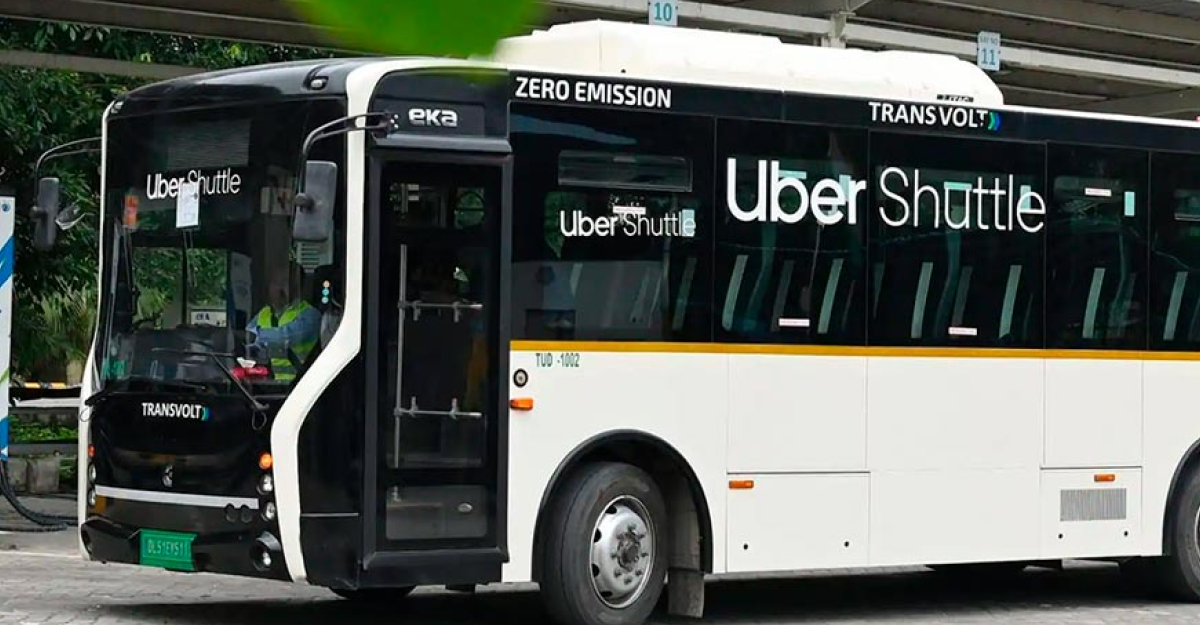
Uber Shuttle was designed as an extension of the main Uber app. Instead of booking a cab, you could reserve a seat on an AC bus running on fixed routes.
It was available in cities like:
- Delhi NCR
- Mumbai
- Hyderabad
The idea was simple:-
Affordable Rides + Predictable Timing + App Convenience.
It targeted people who wanted something better than public transport but cheaper than cabs.
Cityflo: Built Only for Office Commute
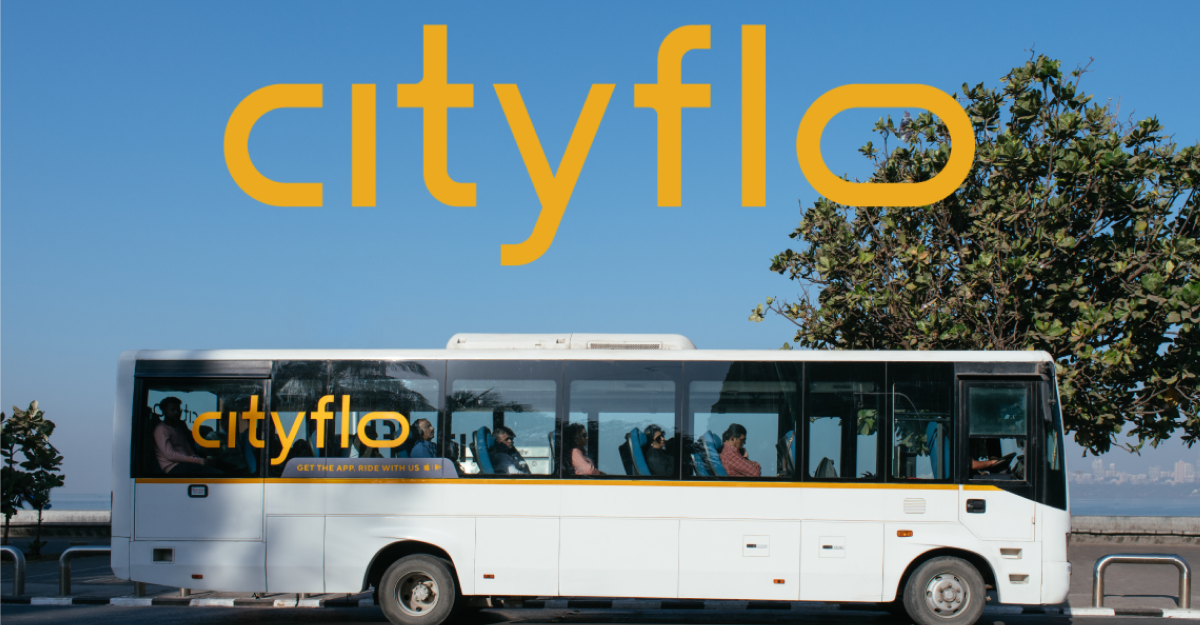
Cityflo took a very different approach.
Instead of being part of a larger app, it was built specifically for office commuters. Everything from routes to pricing to bus design is focused on daily work travel.
It operates mainly in:
- Mumbai and nearby regions
- Hyderabad
- Delhi NCR (select corridors)
Cityflo is not trying to serve everyone. It is focused on a specific audience: salaried professionals with fixed routines.
Uber Shuttle vs Cityflo: Core Business Difference
This is where the biggest difference lies.
| Business Aspects | Uber Shuttle | Cityflo |
| Business type | Product line within Uber’s multi‑service ride‑hailing platform | Independent mobility startup focused on premium office buses |
| Operating status (2026) | Partners with operators but curates a premium bus experience | Actively operating in multiple cities |
| Primary cities / regions | Delhi‑NCR, earlier Mumbai, Hyderabad, Kolkata (via state partnership) | Mumbai, Thane, Navi Mumbai, Hyderabad, Delhi‑NCR |
| Target user segment | Broad commuters needing shared, affordable bus rides | Office commuters and corporate professionals |
| Fleet / asset model | Aggregates partner bus operators on Uber’s tech platform | Partners with operators but curates premium bus experience |
| Strategic focus | Shared mobility experiment later deprioritised for B2B employee transport | Core business is office commute on selected corridors |
| Regulatory posture | Worked under state agreements and faced crackdowns on app‑based shuttles | Subject to similar app‑bus regulatory environment but still running |
Uber Shuttle was an experiment…
Cityflo is a focused business…
And that difference shaped everything else!
Latest Update: Why Uber Shuttle Shut Down While Cityflo Survived?
This is the question most people really care about.
Uber Shuttle had scale, brand power, and technology. Yet it exited the market.
Cityflo, much smaller in comparison, is still growing.
Here’s why-
1. Focus vs Expansion
Uber Shuttle tried to serve a broad audience across multiple cities.
Cityflo focused only on high-demand office routes.
Result:-
Cityflo built stronger demand on specific corridors.
2. Business Priority Shift
Uber shifted its strategy towards B2B employee transport, which offers better margins and predictable contracts.
Shuttle did not align with that direction.
3. Ridership Challenges
Despite early traction, Uber Shuttle struggled with consistent occupancy across all routes.
Cityflo avoided this by carefully curating routes with high demand.
4. Experience Positioning
Uber Shuttle focused on affordability.
Cityflo focused on comfort and reliability.
In daily commuting, many users are willing to pay slightly more for a better experience.
Note: If you’re one of those who were affected by the Uber Shuttle shutdown and are looking for alternatives, then you’re at the right place. We’ve explained the Top 10 Uber Shuttle Alternatives in Delhi NCR. Give this article a read because I’m sure it will be very helpful.
Service Design: How the Experience Actually Feels?
Let’s talk about what matters most to users. The experience-
| Dimensions | Uber Shuttle | Cityflo |
| App experience | Accessed inside the main Uber app under “Uber Shuttle” | Dedicated Cityflo app for office buses and passes |
| Booking model | Pre‑book seat on fixed routes and time slots | Advance booking with ride packs and weekly/monthly plans |
| Seat policy | Seat‑based; standing discouraged | Reserved seating only; no standing |
| Vehicle type | AC buses from partner fleets; specs varied | Premium AC buses including BharatBenz coaches |
| Comfort features | AC, fixed routes, app‑managed boarding; focus on efficiency | Extra‑legroom buses, quieter office crowd, comfort‑first pitch |
| Route design | Fixed residential–commercial routes optimised with Uber data | Curated office corridors with multiple peak‑hour trips |
| Live tracking | Bus location and ETA in the Uber app | In‑app GPS tracking for all buses |
| Safety & hygiene | Standard Uber safety stack and support | Emphasis on sanitisation and third‑party hygiene certification |
| Brand positioning | Affordable, efficient shared commute to cut congestion | Comfortable, stress‑free office commute vs driving or cabs |
Here’s are some of the highlights shared by the users for Uber Shuttle vs Cityflo-
Booking Flow
- Uber Shuttle: Inside Uber app
- Cityflo: Dedicated app
Uber’s advantage was familiarity. Cityflo’s advantage is specialization.
Seating
- Uber Shuttle: Seat-based, but not always strictly enforced
- Cityflo: Strict reserved seating, no standing
This alone makes a big difference in comfort.
Bus Quality
- Uber Shuttle: Varied depending on operator
- Cityflo: Consistent premium buses
Cityflo controls the experience more tightly.
Onboard Environment
- Uber Shuttle: Mixed crowd
- Cityflo: Mostly office commuters
This leads to quieter, more predictable rides on Cityflo.
Pricing Comparison of Uber Shuttle vs Cityflo: Which Is Cheaper?
This is where things get interesting-
| Scenario | Uber Shuttle | Cityflo |
| Typical Ride (10-20 km) | ₹50–₹150 | ₹79–₹150 |
| Entry Fare | Around ₹50 | As low as ₹49 (promo) |
| Subscription | Limited | Strong pack-based pricing |
| Effective Cost (Heavy Users) | Moderate | Can drop significantly |
Key Insight-
- Uber Shuttle was cheaper for occasional rides
- Cityflo becomes cheaper for regular commuters using packs
Cityflo’s pricing is designed for consistency, not one-off savings.
Demand and User Base: Uber Shuttle vs Cityflo
Another major difference in the Uber Shuttle vs Cityflo debate is the type of users.
Uber Shuttle Users
- Mixed commuters
- Price-sensitive riders
- Occasional users
Cityflo Users
- Office professionals
- Fixed schedules
- Daily commuters
Cityflo’s audience is narrower but more loyal.
That’s a big reason it works.
Routes and Coverage
Uber Shuttle tried to cover multiple types of routes.
Cityflo focuses on:-
- Residential to office hubs
- Peak-hour demand
- High-density corridors
This means:-
- Fewer routes
- Better optimization
Cityflo sacrifices scale for efficiency.
Comfort vs Cost: The Real Trade-Off
If you simplify everything, the comparison comes down to one thing.
| Priority | Better Option |
| Lowest Cost | Uber Shuttle (historically) |
| Comfort and Reliability | Cityflo |
| Long Term Daily Commute | Cityflo |
| Flexible occasional use | Uber Shuttle |
Uber Shuttle tried to sit in the middle.
Cityflo clearly chose the premium side of the spectrum.
Real-World Use Case for Uber Shuttle vs Cityflo
Let’s take a simple example.
A 20 km office commute in Delhi NCR.
With Uber Shuttle (earlier)
- Cost: ₹80–₹120
- Experience: Decent but variable
- Availability: Depends on the route
With Cityflo
- Cost: ₹100–₹140
- Experience: Consistent
- Availability: Limited but reliable
For a daily commuter, predictability often wins over saving ₹20.
What Users Really Care About?
After all the comparisons, user behavior reveals the truth.
People value:
- Guaranteed seating
- On-time arrival
- Clean and quiet buses
- Predictable routes
Cityflo delivers strongly on these.
Uber Shuttle was delivered partially.
However, people are worried about the stoppages. Yeah… Many people who had nearby stops for Uber Shuttle don’t see the same stoppage location in Cityflow.
The Bigger Picture: What This Comparison Tells Us?
The story of Uber Shuttle vs Cityflo is not just about two services.
It reflects how urban commuting is evolving in India.
Key Takeaways
- Mass solutions struggle without consistent demand
- Focused services can outperform bigger platforms
- Comfort is becoming a priority, not a luxury
- Subscription models are shaping the daily commute
Cityflo aligned with these trends.
Uber Shuttle did not. However, Uber Shuttle aligned with the budget better!
Uber Shuttle vs Cityflo: Which One Is Better in 2026?
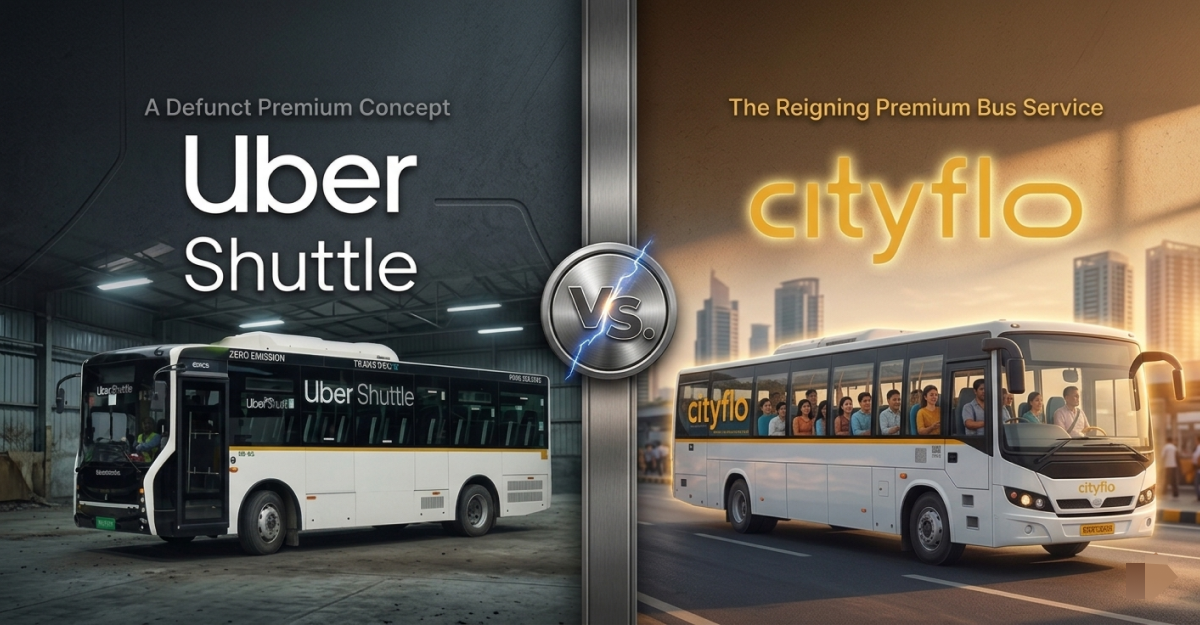
Let’s answer the question directly.
If Uber Shuttle still existed
It would be:
- Better for budget users
- Good for flexible commuting
- Ideal for occasional rides
In reality today
Cityflo is the clear winner because:
- It is operational
- It offers consistent quality
- It is built for daily commuters
Final Verdict on Uber Shuttle vs Cityflo
Uber Shuttle was a smart idea that came at the right time, but did not evolve with the market.
Cityflo is a more focused, disciplined version of that idea.
If your priority is:
- Saving money occasionally, Uber Shuttle made sense
- Building a reliable daily routine, Cityflo is the better choice
And that’s why, even after Uber’s exit, the demand for structured, app-based bus commuting continues to grow.
Because the problem never went away.
Only the approach changed.
By the way, if you have been a daily user of Uber Shuttle and just switched to Cityflo, then we would like to know your experience. Feel free to share your experiences in the comments section!
Thanks for reading 🙂
