
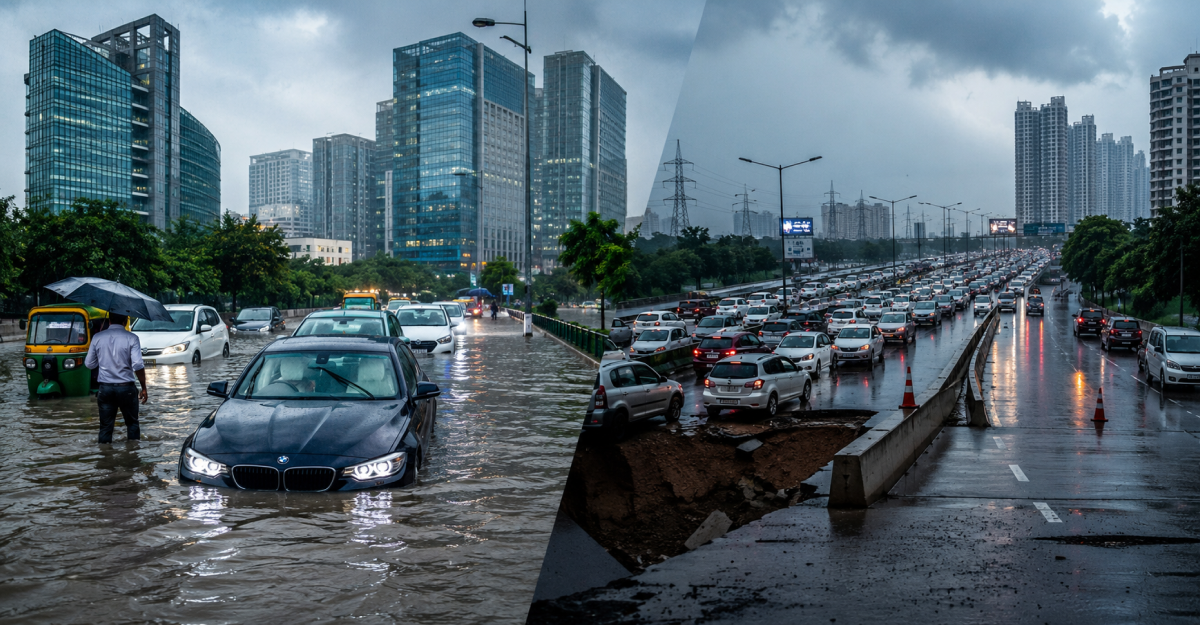
Every monsoon, the same scenes play out in Gurugram. Cars crawl through flooded roads, office workers spend hours stuck in traffic, and social media fills with videos of waterlogged streets in one of India’s richest cities.
For a place proudly known as the Millennium City, the contrast is hard to ignore. Gurugram is home to towering office buildings, multinational corporations, luxury apartments, and one of India’s largest business districts. Yet, a few hours of heavy rainfall are often enough to bring large parts of the city to a standstill.
So why does this happen every year despite hundreds of crores being spent on drainage projects? The answer lies in a combination of geography, rapid urbanisation, ageing infrastructure, and years of reactive planning.
This write-up explains why Millennium City continues to struggle with waterlogging and traffic jams despite its economic success!
Why Is Gurugram Called the Millennium City?
If you’ve ever wondered- Why Gurugram is called Millennium City?, the answer lies in its extraordinary transformation over the last three decades.
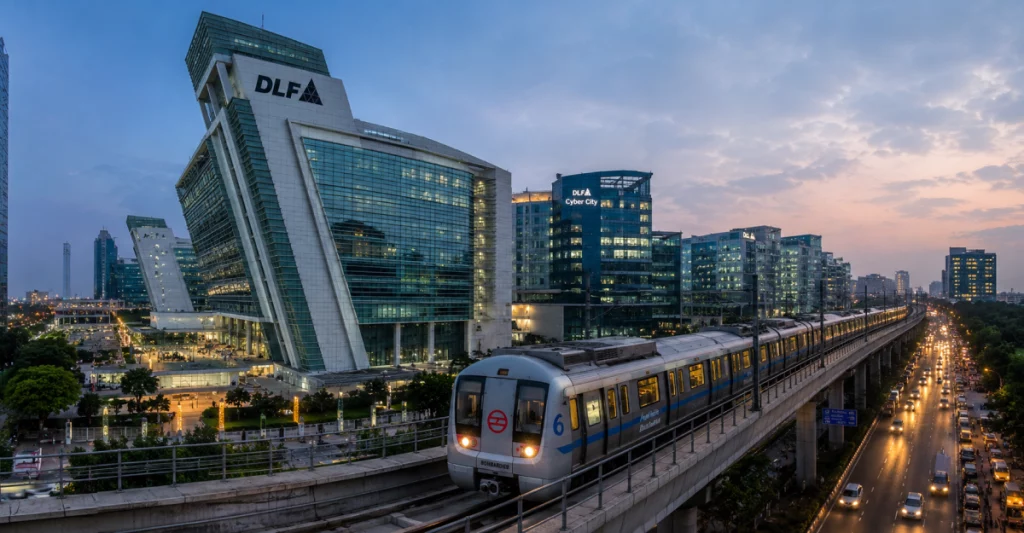
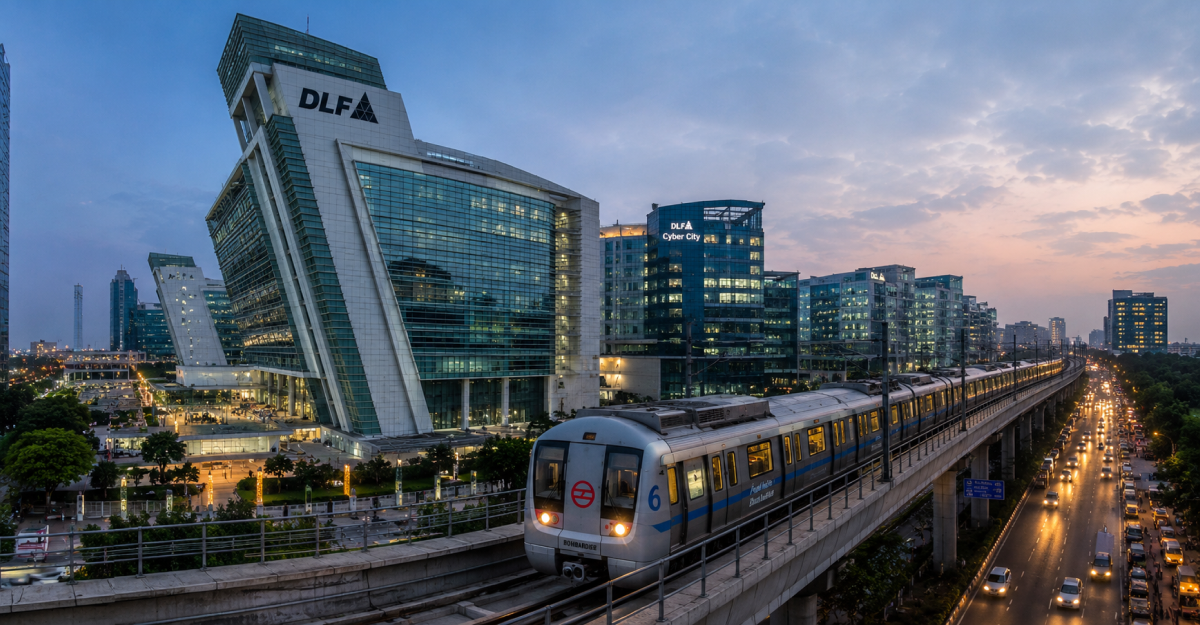
Once a quiet town on the outskirts of Delhi, Gurgaon, now officially called Gurugram, became one of India’s fastest-growing corporate hubs after economic liberalisation in the 1990s. Companies such as DLF developed large commercial districts, including the iconic DLF Cyber City, attracting global technology firms, banks, consulting companies, and Fortune 500 businesses.
Today, Gurugram’s Millennium City is one of the biggest employment centres in the National Capital Region (NCR). Its proximity to Delhi, excellent connectivity through the Delhi Metro, highways, and airports, along with modern office infrastructure, made it a preferred destination for international businesses.
The city’s name was officially changed from Gurgaon to Gurugram in 2016, reflecting its historical connection with Guru Dronacharya from the Mahabharata. However, the nickname Millennium City remains widely used because it represents Gurugram’s image as a modern business powerhouse.
| Metric | Latest Figure |
| Contribution to Haryana’s revenue | Around 50% to 60% |
| Estimated annual GDP contribution | Around ₹2 lakh crore (about 0.6% of India’s GDP) |
| Fortune 500 companies present | Around 250 |
| Corporate offices | Over 25,000 |
| Per capita income ranking | Among India’s top three major urban centres |
| Billionaires (Hurun India Rich List) | 23 |
| Average residential property price | Around ₹1 crore |
Why Just One Rain Brings the Millennium City to a Halt?
The July 2026 monsoon once again exposed Gurugram’s infrastructure challenges.
Following heavy rainfall, a section of NH-48 near Narsinghpur collapsed, forcing emergency repairs and traffic diversions. The incident triggered an 8 to 10-kilometre traffic jam stretching towards IFFCO Chowk, leaving thousands of commuters stranded for hours.
Office employees struggled to reach workplaces, buses were delayed, and commercial transport slowed significantly. Even people travelling from Rajiv Chowk to Millennium City Centre or using the Millennium City Centre Metro found last-mile connectivity severely affected because the surrounding roads were flooded.
Although metro services continued operating, reaching stations became difficult as several approach roads remained underwater.
The incident was not an isolated event. Similar disruptions have occurred during nearly every major monsoon over the past decade.
Why Does Waterlogging Happen Every Monsoon?
Many people assume heavy rainfall alone causes flooding. In reality, Gurugram’s geography makes the problem much worse.
The city sits in a relatively bowl-shaped landscape. Rainwater naturally flows down from the nearby Aravalli Hills into the lower parts of the city. Much of this water eventually enters the Badshahpur Drain, the city’s primary stormwater channel.
During intense rainfall, the drain cannot carry all the incoming water quickly enough. Water then spills onto roads, residential colonies, and commercial areas.
Rapid urbanisation has added another layer to the problem.
Large stretches of land that once absorbed rainwater have been replaced by concrete buildings, parking lots, roads, and pavements. Instead of soaking into the ground, rainwater now flows rapidly across hard surfaces, overwhelming the drainage network.
Natural ponds, wetlands, and drainage channels have also disappeared because of development and encroachments. Without these natural buffers, even moderate rainfall can create urban flooding.
Poor maintenance makes matters worse. Drains clogged with silt, garbage, and construction debris lose much of their carrying capacity before the monsoon even begins.
| Cause | How It Creates Flooding |
| Low-lying terrain | Water naturally collects in lower areas |
| Heavy rainfall | Drains exceed their designed capacity |
| Rapid urbanisation | Concrete prevents groundwater absorption |
| Drainage limitations | Stormwater cannot exit quickly |
| Poor maintenance | Silt reduces drain capacity |
| Blocked drains | Garbage prevents water flow |
| Loss of natural water bodies | Less natural storage for rainwater |
Why Traffic Jams Become So Severe
Flooding and traffic congestion are closely linked.
When sector roads become submerged, vehicles are forced onto major roads such as NH-48. At the same time, flooded underpasses and blocked highway exits reduce the number of usable routes.
Drivers avoid waterlogged lanes by moving toward the centre of the road, narrowing carriageways and slowing traffic even further.
Gurugram also sees enormous daily movement between Delhi, Gurugram, and Noida. Thousands of office workers travel every morning and evening. When one major corridor fails, congestion spreads across the city within minutes.
According to LocalCircles surveys, the impact has become widespread.
| Survey Finding | Percentage |
| Gurugram commuters delayed due to waterlogging | 96% |
| Delhi commuters delayed | 88% |
| Noida commuters delayed | 66% |
| Residents affected by waterlogging (2024) | 86% |
| Residents dissatisfied with monsoon preparedness | 62% |
Where Are the Biggest Waterlogging Hotspots?
Some locations flood almost every monsoon because of their topography, drainage capacity, or heavy traffic.
Major hotspots include:
- Sohna Road
- Subhash Chowk
- Golf Course Extension Road
- Udyog Vihar
- Narsinghpur
- Sector 10A
- Sector 48
These areas receive heavy runoff while also carrying high traffic volumes. Once water begins accumulating, vehicles quickly back up, creating citywide congestion.
Even commuters travelling between Millennium City Centre Gurugram, Huda City Centre, and nearby commercial districts often face delays because connecting roads become difficult to navigate.
For metro users travelling between Millennium City Centre to Anand Vihar Metro or passing through stations such as Chandni Chowk Metro Station, train services generally remain reliable, but reaching metro stations by road becomes the biggest challenge.
Hundreds of Crores Have Been Spent; So Why Hasn’t the Problem Been Solved?
Authorities have invested heavily in drainage improvements.
The Gurugram Metropolitan Development Authority (GMDA) says around ₹503 crore was spent on drainage-related works between 2016 and 2025.
One of the biggest recent projects is the ₹105 crore Leg-4 stormwater drain, a 4.3-kilometre channel designed to reduce pressure on the Badshahpur Drain.
Every year, authorities also carry out desilting, repair drains, and deploy pumps during heavy rainfall.
The problem is that many of these measures help manage emergencies rather than eliminate the underlying causes.
Experts say long-term solutions require redesigning the entire stormwater network to match today’s much larger urban population and changing rainfall patterns.
| Project | Cost | Objective | Current Status |
| Leg-4 stormwater drain | ₹105 crore | Reduce pressure on Badshahpur Drain | Operational |
| Citywide drainage upgrades | ₹503 crore (2016-2025) | Improve stormwater management | Ongoing |
| Annual desilting initiatives | Varies annually | Increase drain capacity before monsoon | Conducted every year |
The Hidden Economic Cost of Waterlogging
Waterlogging is much more than an inconvenience.
Many companies ask employees to work from home after severe rainfall because reaching offices becomes nearly impossible.
Businesses lose productive working hours, delivery vehicles face delays, and fuel consumption rises as vehicles remain stuck in traffic.
Floodwater also damages cars and motorcycles, leading to expensive repairs and insurance claims.
Auto-rickshaw drivers, cab operators, restaurants, local shops, and delivery workers often lose an entire day’s income when roads become impassable.
For a city that contributes significantly to Haryana’s economy, these repeated disruptions create substantial economic losses every monsoon.
Can Gurugram Ever Solve Its Flooding Problem?
The good news is that many of the solutions are already known.
Gurugram needs larger stormwater drains designed for today’s rainfall patterns, regular desilting before every monsoon, better protection of natural drainage channels, expanded rainwater harvesting, and smart flood monitoring systems that provide real-time alerts.
Urban planning also needs to consider climate resilience. Future development should preserve natural water bodies instead of replacing every open space with concrete.
Most importantly, agencies such as the GMDA, Municipal Corporation of Gurugram (MCG), and other departments must coordinate more effectively. Flood management works best when roads, drains, and transport systems are planned together rather than separately.
What Does This Mean for the Future of India’s Millennium City?
Gurugram has earned its reputation as India’s Millennium City through economic growth, world-class office spaces, and global investment. But modern cities are judged by more than skyscrapers.
Reliable drainage, efficient roads, resilient public transport, climate-ready infrastructure, and thoughtful urban planning are equally important.
As climate change increases the frequency of intense rainfall events, Gurugram’s ability to solve its flooding problem will shape its future reputation as much as its ability to attract multinational companies.
Note: We have also covered- Noida vs Gurgaon: Which is Better for Living in 2026? Go through the article for detailed information.
Wrap-Up
Gurugram remains one of India’s most important economic engines, attracting businesses, talent, and investment from across the world. Yet, recurring monsoon flooding highlights long-standing weaknesses in drainage infrastructure and urban planning.
Recent investments show that authorities recognise the scale of the challenge, but lasting improvements will require more than emergency pumps and annual repairs. Stronger engineering, coordinated planning, regular maintenance, and climate-resilient infrastructure are essential if the city wants to break this cycle.
A city celebrated globally as the Millennium City should not only build taller towers and larger corporate campuses. It must also build infrastructure capable of standing up to the demands of a rapidly growing and changing urban future!
