
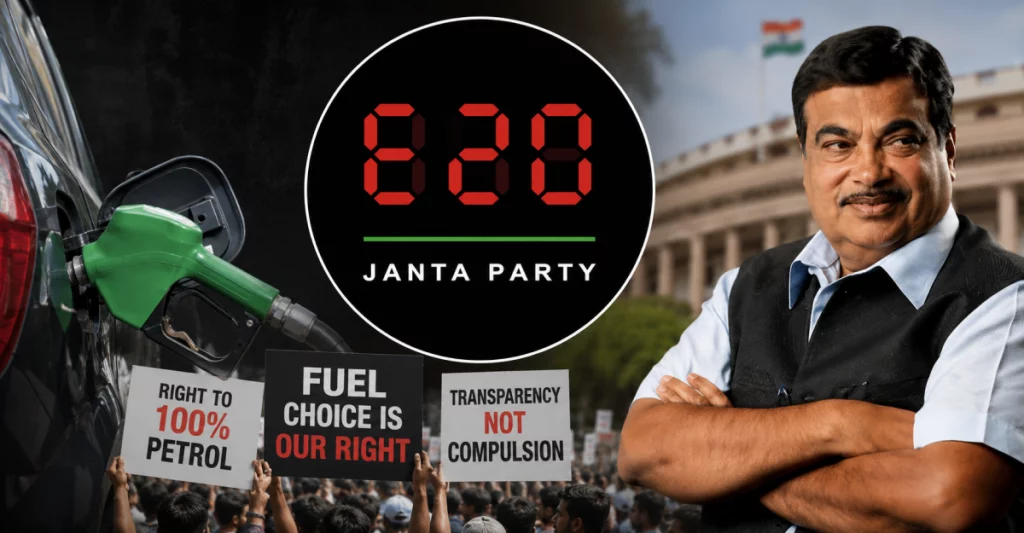
If you recently came across videos or posts from the Cockroach Janta Party (CJP) protest at Delhi’s Jantar Mantar, you may have noticed another name starting to pop up online: the E20 Janta Party.
No, this is not another political party asking for votes. It is a newly formed pressure group that has taken aim at one of India’s biggest fuel-policy changes: the move towards petrol blended with up to 20% ethanol.
The group’s message is simple: if motorists want 100% petrol, they should be allowed to buy it.
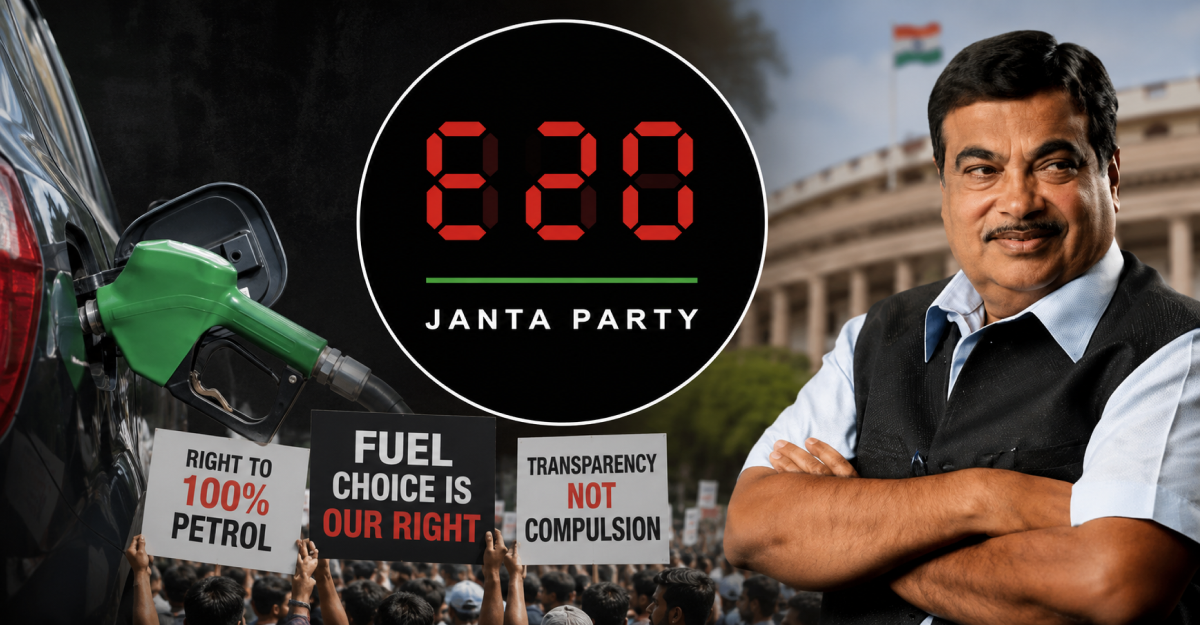
But that’s not all. The E20 Janta Party is also demanding greater transparency around ethanol-blended fuel and has called for Union Road Transport and Highways Minister Nitin Gadkari’s resignation over the policy.
The campaign has quickly turned a technical debate about fuel composition into a much wider conversation about consumer choice, vehicle mileage, maintenance costs and government accountability. Some transport groups have also joined the discussion, while the government maintains that it has not received widespread or substantiated complaints about E20 affecting vehicle performance.
So, what exactly is going on? Why has E20 petrol suddenly become such a hot topic, and what does the E20 Janta Party actually want?
Let’s find out!
What Is the E20 Janta Party?
The name might sound like a political outfit, but the E20 Janta Party describes itself as a pressure campaign focused on India’s ethanol-blending policy.
Its biggest demand is one that many vehicle owners can understand immediately: give consumers a choice.
The group wants 100% petrol to be available alongside ethanol-blended petrol. It also wants fuel pumps to clearly tell customers what they are buying, government data on ethanol blending to be made public, and independent studies to examine the real-world effects of different fuel blends.
That includes questions many motorists already ask: Does E20 reduce mileage? Does it affect older engines? Does it increase maintenance expenses? And, ultimately, does switching to higher ethanol blends make driving more expensive for some consumers?
The group says it is not demanding that ethanol blending be scrapped altogether. It also says it is not asking for free fuel or subsidies.
Its argument is essentially about choice and transparency. If one vehicle owner is comfortable using E20 while another prefers 100% petrol, why should both be forced to buy the same fuel?
That question is at the heart of the campaign.
From CJP to E20 Janta Party: Why Is This Campaign Getting Attention?
This is where the story gets interesting.
The E20 Janta Party campaign reportedly drew inspiration from the Cockroach Janta Party, or CJP, an online movement that gained public attention around the NEET paper leak controversy.
After the CJP protest at Jantar Mantar became a talking point, the emergence of another similarly styled campaign naturally attracted curiosity online. The E20 Janta Party soon began building its own social media presence and pushing the fuel debate into public view.
The two movements should not, however, be treated as the same organisation. The E20 Janta Party has a specific focus: ethanol-blended petrol and consumer choice.
And its timing is significant. India has been steadily moving towards higher ethanol blending, with the government saying the country achieved its 20% blending target during the 2025-26 Ethanol Supply Year.
That means the debate is no longer just about what fuel policy might look like in the future. For many motorists, it is already about the fuel they are putting into their vehicles today.
E20 Petrol Explained: What Are We Actually Putting in Our Tanks?
Let’s keep this simple.
E20 petrol means petrol blended with up to 20% ethanol by volume. It does not mean that the fuel contains 20% petrol.
Ethanol is a biofuel that can be produced from agricultural feedstocks such as sugarcane and grains. India has been increasing ethanol blending for several reasons.
The government wants to reduce the country’s dependence on imported crude oil, improve energy security and support domestic ethanol production and agricultural supply chains. It also sees ethanol as having potential environmental benefits.
On paper, the logic is straightforward.
But when a policy affects millions of vehicles, the real-world experience can be more complicated.
| Aspect | What It Means |
| E20 | Petrol blended with up to 20% ethanol |
| Main Policy Goal | Reduce dependence on imported crude oil |
| Potential Benefit | Greater use of domestically produced ethanol |
| Key Concern | Compatibility and efficiency for some vehicles |
| Consumer Debate | Choice, transparency and fuel availability |
So, Why Are Some Vehicle Owners Worried?
This is where the E20 debate moves from government policy to something far more personal: your monthly fuel bill.
Critics have raised concerns that higher ethanol blends may affect fuel efficiency in some vehicles. Others have questioned whether older engines and fuel systems, particularly those not designed for higher ethanol concentrations, could face compatibility or maintenance issues.
But there is an important distinction here.
It would be wrong to say that E20 automatically damages every vehicle or causes the same mileage loss for everyone. The impact can depend on the vehicle’s age, engine design, fuel system, calibration and manufacturer’s specifications.
The government has itself acknowledged that E20 can cause marginal efficiency reductions in some vehicles originally designed for E10.
This is why the argument is not as simple as saying “ethanol is bad.” Newer vehicles designed and certified for E20 may perform differently from older models.
For a person driving an older car or commercial vehicle every day, however, even a small change in fuel economy can become a significant expense over months and years.
And that is precisely why critics want more independent data.
What Does the Government Say?
The government, unsurprisingly, sees the picture differently.
Its position is that E20 is safe for vehicles designed and certified for the blend and that there is no evidence of widespread vehicle damage caused by the policy.
In a July 2026 clarification, the Ministry of Petroleum and Natural Gas said it had not received widespread or substantiated complaints from vehicle manufacturers, automobile associations or consumer organisations about E20 affecting fuel efficiency, engine performance, maintenance costs or the driving experience.
The government has also highlighted the larger economic argument behind ethanol blending.
According to the official position, greater ethanol use can help reduce crude oil imports, save foreign exchange, strengthen domestic energy security and create demand for agricultural products.
So, while critics are asking, “What about my mileage?”, the government’s argument is looking at a much bigger question: “What happens to India’s energy security if we remain heavily dependent on imported crude?”
Both questions matter.
| Issue | E20 Janta Party / Critics | Government Position |
| 100% Petrol | Wants it available as a consumer choice | Continues supporting ethanol blending |
| Vehicle Performance | Raises concerns about mileage and maintenance | Says there are no widespread substantiated complaints |
| Fuel Transparency | Wants clearer labelling and public data | Points to existing policy and testing framework |
| Independent Studies | Calls for independent research | Cites government and industry testing |
| Policy Direction | Wants greater consumer choice | Continues the ethanol-blending programme |
Note: We have also explained EV vs Petrol: Which Cars Are Better For People & Economy? Give it a read and share your thoughts in the comment section.
Why Are Transport Associations Joining the Protest?
If you think the E20 debate is limited to private car owners, think again.
Transport operators have a much bigger stake in fuel costs because their vehicles are on the road for long hours every day.
The Delhi Taxi and Tourist Transporters and Tour Operators Association has announced a march to Parliament on August 4, 2026, to protest against E20 petrol.
Transport operators have raised concerns about fuel efficiency, operating expenses, maintenance and the impact on older commercial vehicles.
For someone running a taxi or tourist vehicle, even a small increase in fuel consumption can directly affect earnings. That makes the E20 debate particularly sensitive for the commercial transport sector.
However, the concerns raised by transport associations remain claims by the industry and should not automatically be treated as proof that E20 is causing widespread damage across India’s vehicle fleet.
What About 100% Petrol?
This is perhaps the most straightforward demand made by the E20 Janta Party, but implementing it nationwide is not quite as simple.
India does have premium petrol products with higher octane ratings, but high-octane petrol should not automatically be described as ethanol-free petrol. Octane rating and ethanol content are two different things.
The group’s demand is therefore for a clearly identified, widely available 100% petrol option that consumers can choose if they do not want ethanol-blended fuel.
For motorists, the issue is not just whether such fuel exists. It is also about whether it is available near them and whether they can afford it.
That brings the debate back to the same question: Should consumers have a genuine choice at the fuel pump?
Why Is Nitin Gadkari Being Asked to Resign?
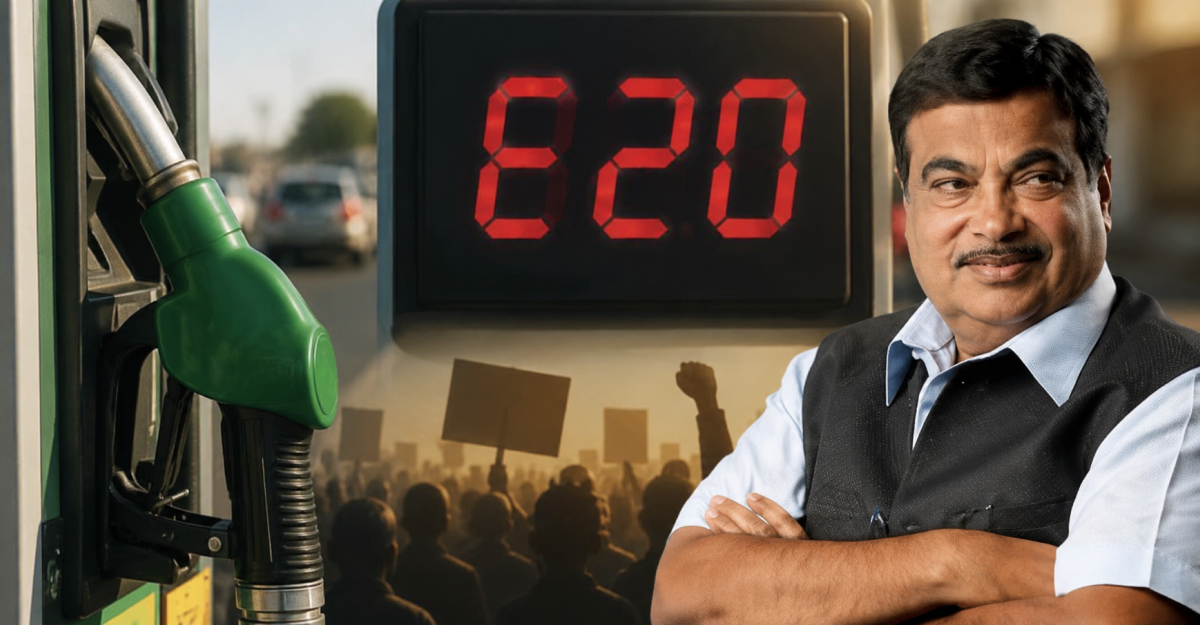
Nitin Gadkari is the Union Minister for Road Transport and Highways and one of the most recognisable faces in India’s transport and automobile policy discussions.
The E20 Janta Party has demanded his resignation over the government’s ethanol-blending policy.
The demand is a political call for accountability from the campaign. It should not be interpreted as evidence that Gadkari personally controls every aspect of India’s ethanol policy. The programme involves multiple government ministries and agencies, including those responsible for petroleum, energy and agriculture.
Gadkari has nevertheless been a prominent public supporter of alternative fuels and ethanol-based mobility, making him a natural target for criticism from opponents of the policy.
What About Nitin Gadkari’s Family and Ethanol Businesses?
This is where things can quickly become confusing, especially on social media.
Claims have circulated linking Nitin Gadkari’s family to companies operating in the sugar, agro-processing and ethanol sectors. However, there is a crucial difference between a minister personally owning a company, a family member being associated with a company, and a company having historical or business connections with a larger group.
Public corporate records show associations involving members of the Gadkari family with companies including Manas Agro Industries and Infrastructure Ltd. CIAN Agro Industries and Infrastructure has also been mentioned in public reporting in connection with the family.
However, these facts alone do not establish that Nitin Gadkari personally owns or controls these companies, nor do they prove that his policy decisions were influenced by such associations.
Similarly, references to Purti Power and Sugar or Wainganga Sugar and Power should be examined through current corporate records rather than presented as proof of personal ownership.
Any allegation of a conflict of interest requires stronger evidence than simply pointing to a family member’s corporate association.
What Does All This Mean for You?
For the average vehicle owner, the E20 controversy ultimately comes down to a few practical questions.
What fuel is going into your vehicle? Is your vehicle designed for it? How does it affect your mileage? And do you have another affordable option if you do not want to use it?
The answers will not necessarily be identical for every motorist.
A new vehicle certified for E20 is not in the same position as an older car designed around lower ethanol blends. A private car owner driving a few kilometres every day also has different concerns from a taxi operator whose vehicle runs continuously.
That is why the debate needs more than slogans.
It needs clear fuel labelling, reliable government data, independent testing and transparent communication from vehicle manufacturers.
The Bigger Question Behind the E20 Janta Party Campaign
At first glance, the fight appears to be about ethanol.
Look closer, and it is really about something bigger: CHOICE.
The government sees ethanol blending as a way to reduce India’s dependence on imported crude oil, strengthen energy security and support domestic agriculture. Critics are asking whether those national goals should come at the cost of reduced fuel choice or higher running expenses for certain vehicle owners.
The E20 Janta Party has brought that tension into the spotlight.
Whether you agree with the campaign or not, its rise shows that ethanol blending is no longer a technical policy discussion happening inside government offices. It has reached fuel pumps, transport unions, social media feeds and conversations among everyday motorists.
The real test now is whether India can move towards its ethanol goals while giving consumers something equally important: clear information, compatible fuel choices and enough evidence to make an informed decision!
