
If you have been house hunting in Gurugram lately, you probably already know one thing: space here does not come cheap anymore. Home prices have climbed sharply across several parts of the city, while rents have followed the same upward direction.
Now, it looks like the city’s commercial real estate market is telling a similar story.
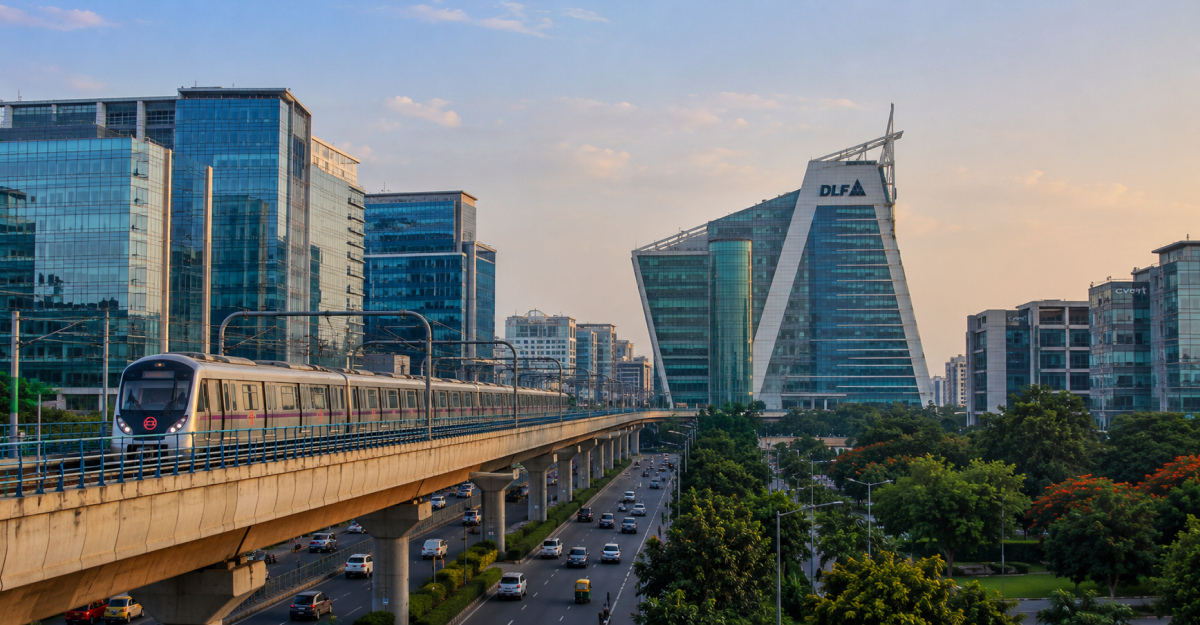
The Gurugram office market has crossed the 100 million sq ft mark in 2026, making it the largest office market in North India, according to CBRE’s Corridors & Clusters: Driving Haryana’s Next Growth Phase report.
For anyone who has watched Gurugram grow over the years, the number may not come as a complete surprise. The city has been adding corporate towers, business parks and large office campuses at a remarkable pace.
But there is an interesting question hiding behind this impressive number: Can Gurugram’s infrastructure keep up with the city it is becoming?
After all, this is a city that can have some of India’s biggest corporate offices and some of the country’s most expensive real estate, yet still finds itself struggling with waterlogging during heavy monsoon rains. The contrast is hard to miss.
So, the 100 million sq ft milestone is worth looking at beyond the headline.
Gurugram Office Market Crosses 100 Million Sq Ft Milestone
Let’s first understand what the number actually means.
“Office stock” simply refers to the total amount of completed office space available in a market. In Gurugram’s case, that figure has now crossed 100 million sq ft.
And the market is not expected to stop there.
CBRE estimates that Gurugram’s office stock could grow to around 120 to 125 million sq ft by 2030. The growth has been supported by years of companies taking up office space, developers adding new buildings and investors putting money into commercial real estate.
| Metric | Key Figure |
| Total office stock in 2026 | 100 million+ sq ft |
| Potential office stock by 2030 | 120 to 125 million sq ft |
| Office leasing from 2021 to Q1 2026 | 40 million sq ft |
| New office supply during the same period | 21 million sq ft |
| Investment inflows since 2018 | Nearly $6 billion |
The numbers paint a clear picture. Gurugram is no longer simply a popular office destination in the NCR. It has become a commercial real estate market large enough to compete at the highest level nationally.
How Gurugram Became a Corporate Powerhouse?
Gurugram’s transformation has been hard to miss.
A few decades ago, the city was largely seen as a satellite town of Delhi. Today, its skyline is filled with corporate towers, luxury housing projects, shopping destinations, and sprawling business parks.
The reasons behind this growth are fairly straightforward. Gurugram offers proximity to Delhi, access to the airport, connectivity to the wider NCR, and an established ecosystem of businesses and talent.
That combination attracted IT companies, financial services firms, BPOs, consulting companies, startups, and global corporations.
As more companies arrived, demand for office space increased. As demand increased, developers built more. And as the city became more attractive to investors, land and commercial property became increasingly valuable.
It is a familiar cycle for anyone who has followed Gurugram’s housing market.
The difference is that this time, the pressure is playing out in the office market.
Five Years of Strong Office Leasing and New Supply
Between 2021 and Q1 2026, Gurugram recorded around 40 million sq ft of office leasing, while approximately 21 million sq ft of new office supply was added, according to CBRE.
The two terms are worth understanding.
Leasing means companies are taking up office space. New supply means newly completed buildings are entering the market.
The gap between the two numbers shows how strong occupier demand has been.
One reason is the growing preference for large-format office campuses. Instead of operating from smaller, scattered offices, large companies are increasingly looking for bigger developments where they can accommodate substantial workforces and create dedicated corporate environments.
That is changing the shape of Gurugram’s skyline once again.
Gurugram Attracts Nearly $6 Billion in Investment Since 2018
Businesses are not the only ones paying attention.
CBRE estimates that Gurugram has attracted nearly $6 billion in investment inflows since 2018. A large portion has gone towards land and site acquisitions, while built-up office assets have also attracted significant capital.
| Asset / Investment Category | Share of Investment |
| Land and site acquisitions | Around 50% |
| Built-up office assets | Around 38% |
| Industrial and logistics developments | Nearly 5% |
| Other asset classes | Around 7% |
The message is fairly clear: investors are willing to put serious money behind Gurugram’s future.
Land accounts for around half of the investment, which suggests that investors are not only interested in the office buildings that exist today. They are also betting on what can be developed tomorrow.
But this is where the story gets complicated.
You can build another office tower in Gurugram. You cannot build an entire city’s infrastructure overnight.
Green Buildings and Institutional Ownership Reshape the Market
There is another shift happening beneath the visible growth.
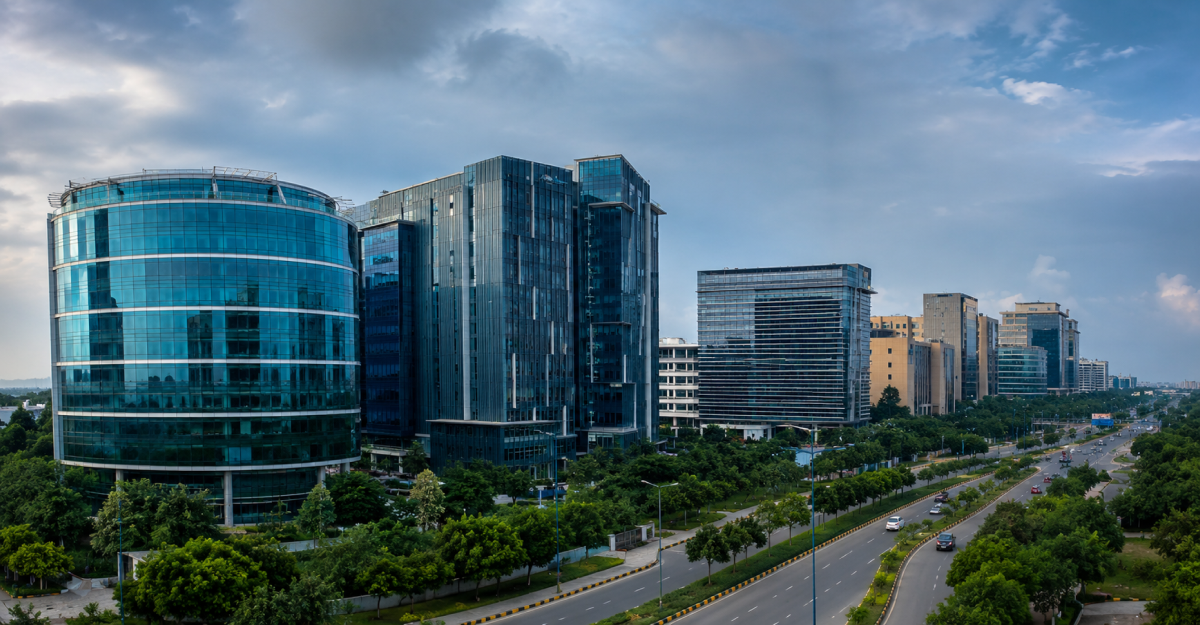
Around 59 million sq ft of Gurugram’s 100 million sq ft office stock is green-certified, according to CBRE. Around 35 million sq ft is institutionally owned.
Green-certified buildings are designed to meet recognised standards for environmental performance, including areas such as energy and resource efficiency.
Institutional ownership, meanwhile, means properties are owned by large professional investors or investment platforms. This can bring more structured management and a longer-term approach to maintaining commercial assets.
For companies, this matters because office buildings are no longer judged only by their location and appearance. Sustainability, operating efficiency and workplace quality are increasingly part of the decision-making process.
The market is therefore growing not just in size, but also in sophistication.
Global Companies Continue to Drive Office Space Demand
International companies have played a major role in this expansion.
According to CBRE, international occupiers leased more than 17 million sq ft of office space in Gurugram over the past five years.
That demand is understandable. Companies looking to expand in India can find access to talent, established business infrastructure, Grade A office buildings, and proximity to Delhi and the airport.
The result is a market where global and domestic companies are competing for high-quality office space.
And when demand rises in a market where land is limited, one thing tends to happen.
Prices go up.
That is a trend homebuyers in Gurugram are already familiar with.
Large Corporate Campuses and Foreign Universities Could Support Future Growth
Gurugram’s commercial story may also be entering a new phase.
CBRE has highlighted the rise of large corporate campuses as well as the emergence of foreign universities in Grade A technology parks.
If the trend develops further, Gurugram could gradually move beyond its traditional identity as a city of corporate offices. Technology, education, research and other knowledge-driven activities could become part of the commercial ecosystem.
The Development Management Agreement, or DMA, model could also support some future projects. In simple terms, this structure allows developers and investors to work together on projects, potentially reducing the amount of capital a developer needs to commit upfront.
However, the model is not a magic solution. Its usefulness will depend on the structure and economics of individual projects.
Gurugram Office Market Could Reach 125 Million Sq Ft by 2030
CBRE expects Gurugram’s office stock to reach between 120 and 125 million sq ft by 2030.
That means millions of additional square feet could be added to an already massive commercial ecosystem.
The potential drivers are familiar: corporate expansion, global capability centres, technology companies, large campuses, international occupiers and institutional investment.
But Gurugram’s growth comes with a reality that residents know all too well.
The city has to deal with traffic congestion, infrastructure pressure, rising property prices and recurring waterlogging during heavy rains. When roads struggle to handle existing traffic and parts of the city flood during monsoons, adding millions more sq ft of offices raises legitimate questions about whether infrastructure development is moving at the same speed as real estate development.
Note: We have explained it here- Why Gurugram’s Millennium City Struggles With Waterlogging And Traffic Jams Every Year?. Go through it for more details.
This does not take away from Gurugram’s commercial success. It simply highlights the challenge ahead.
What the 100 Million Sq Ft Milestone Means for Gurugram?
Crossing 100 million sq ft is a major achievement for the Gurugram office market. It shows how dramatically the city has changed and how much confidence businesses and investors have placed in its future.
But the next 25 million sq ft may be more challenging than the first 100 million.
Gurugram now has to prove that it can grow without allowing its infrastructure to fall further behind. The city needs more than impressive skylines and premium office spaces. It needs reliable roads, better drainage, stronger connectivity, and civic systems that can support the people working and living there.
The story of Gurugram 100 million sq ft office space is therefore not just about real estate.
It is about a city that has become expensive enough to attract global businesses and investors, while still dealing with some very basic urban challenges.
By 2030, the Gurugram office market could reach 120 to 125 million sq ft.
The bigger question is whether Gurugram itself will be ready for it?
What do you think? Share your thoughts in the comments below!
Thanks for reading 🙂
