
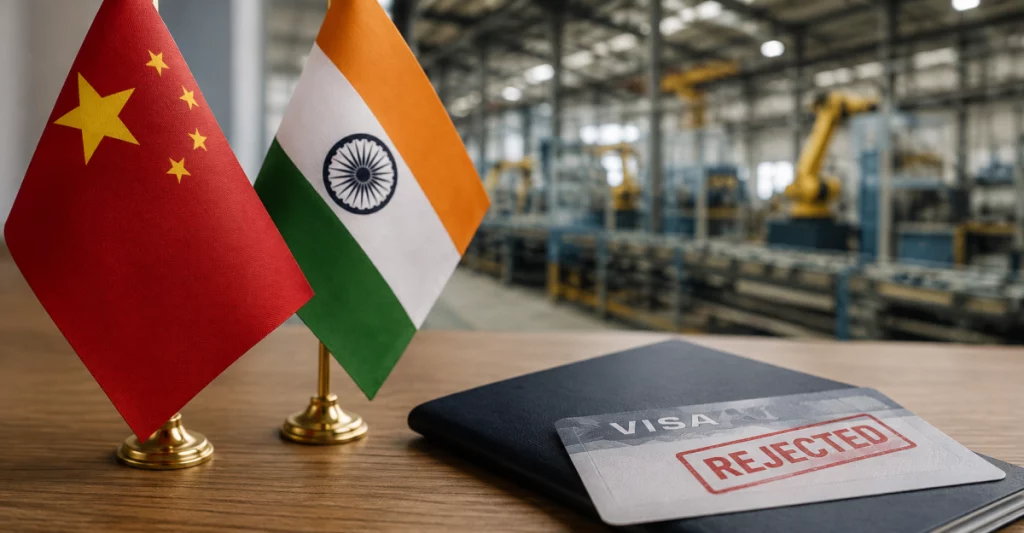
For an Indian manufacturing company, China business visa is more than a travel document. It can determine whether an engineer reaches a factory on time, whether a machine is installed as planned, or whether a production line gets the technical support it needs.
That is why reports of growing difficulty in obtaining Chinese business visas are attracting attention across the Indian industry.
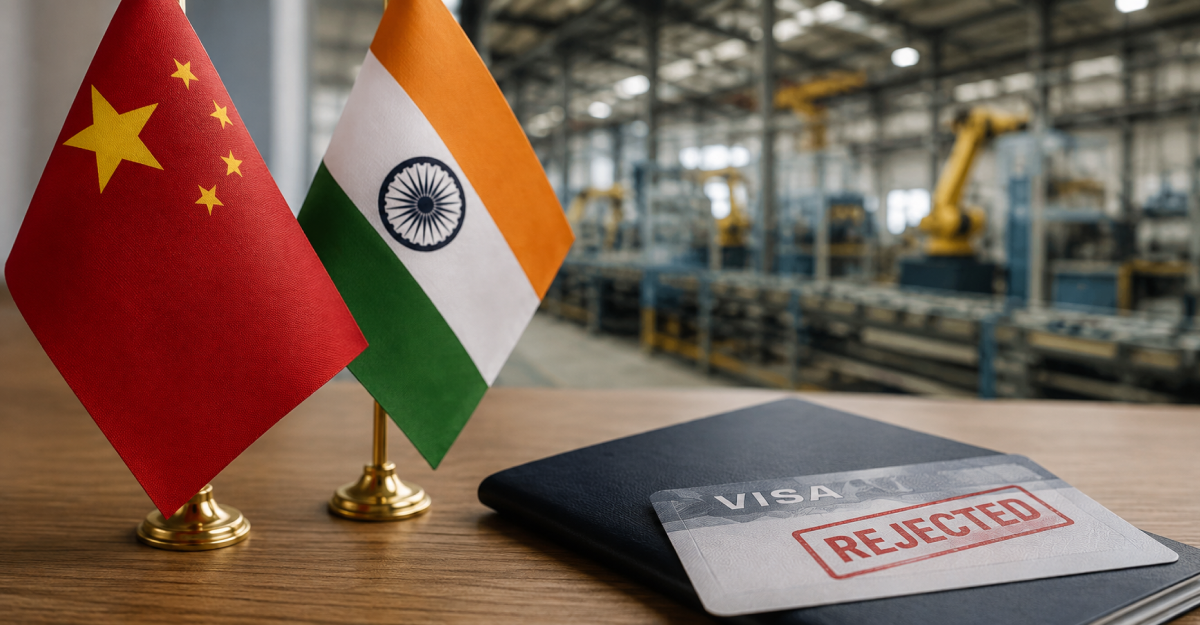
Indian executives travelling to China for business are reportedly facing longer processing times and more rejections. Executives at electronics and automobile contract manufacturing companies told the media that only around 20% to 40% of applications from some companies have been approved in recent months, compared with near-complete approval rates earlier.
The figures are based on accounts from individual companies and should not be treated as an official nationwide rejection rate. China has not announced a blanket suspension of business visas for Indians.
Chinese Business Visas Are Becoming Harder for Indian Executives
According to executives cited in the report, the change is being felt in several ways. Applications are taking longer, some are being rejected, and applicants may have to submit fresh applications after a rejection.
For companies that regularly send employees to China, the uncertainty can make routine business travel harder to plan.
What Has Changed for Indian Business Travellers?
| Earlier Situation | Reported Situation Now |
| Near-complete approvals reported by some companies | Approval rates reportedly down to 20%-40% for some companies |
| Relatively smooth processing | Longer processing times |
| Fewer reported rejections | More applications reportedly being rejected |
| Repeat business travel was easier to plan | Fresh applications may be required |
| Regular movement of executives and technical staff | Greater uncertainty around travel |
China’s official visa information for India continues to provide a normal application process for business travellers. Its 2024 guidance said qualified applications generally took three working days for express processing and four working days for regular processing.
That makes the recent accounts from companies particularly significant, but also underlines why they should be viewed as reported developments rather than evidence of a formally announced nationwide policy.
Why Does This Matter to Indian Manufacturers?
The impact goes beyond an executive missing a flight.
Indian manufacturers often work with Chinese suppliers for machinery, components and technical systems. Chinese personnel may be needed for equipment installation, commissioning, maintenance, quality checks, troubleshooting, production-line setup, training and supplier coordination.
India itself has recognised the importance of foreign technical specialists to manufacturing. In 2025, the government brought several activities related to installation and commissioning of equipment under the business visa regime and created a Production Investment Visa category covering activities such as quality checks, maintenance, production, training, supply-chain development and plant commissioning.
Consider an electronics manufacturer installing specialised equipment imported from China. If Chinese engineers are expected to calibrate the machinery or train Indian staff, a visa delay could push back that work. It does not necessarily mean the entire factory will stop, but a delayed technical visit can affect a much larger project schedule.
How Dependent Is India on China?
India’s dependence on China varies widely by product and industry. It would be misleading to say that every Indian industry imports half of its components or capital goods from China.
Government data, however, shows substantial Chinese exposure in several important categories. In FY2024-25, China accounted for 37.94% of India’s electronics component imports, 43.41% of telecom instrument imports and 49.46% of computer hardware and peripherals imports. China also accounted for 45.30% of imports of certain industrial machinery and 30.13% of electric machinery and equipment imports.
Areas Where Chinese Supplies Matter
| Area | Why China Matters |
| Electronics | Components, machinery and production equipment |
| Automobiles | Components, machinery and specialised inputs |
| Industrial manufacturing | Capital goods and industrial machinery |
| Technology | Hardware and electronic components |
| Renewable energy | Equipment and supply-chain inputs |
| Pharmaceutical manufacturing | Bulk drugs and intermediates |
The dependence is especially visible in electronics. NITI Aayog’s trade analysis noted that integrated circuits were India’s largest electronics import category in 2024, with imports worth $23.8 billion.
This explains why even a relatively narrow disruption involving business travel can become a concern for manufacturers that operate across both countries.
Companies Are Raising the Issue With the Government
Several companies have reportedly approached the Centre informally and urged it to raise the matter with Beijing.
A person familiar with India-China relations also confirmed that the government is aware of the issue, according to the report. However, the more forceful interpretation offered by that unnamed source, that the visa restrictions are part of a deliberate effort to obstruct India’s growth, remains an allegation rather than an established government finding.
That distinction matters.
There is a clear difference between companies reporting higher rejection rates and the government establishing why those applications are being rejected.
The Chinese Embassy in New Delhi did not respond to the source article’s request for comment.
Some individual applicants have also discussed delays and rejections on online forums. Such accounts can show that applicants are experiencing difficulties, but they cannot establish an official rejection rate or national policy on their own.
China Has Not Officially Explained the Reported Restrictions
At present, there is no publicly stated Chinese explanation establishing that the reported business visa difficulties are a deliberate economic measure against Indian companies.
That leaves an important question unanswered: are the reported rejections part of a temporary tightening, case-by-case scrutiny, administrative changes, or a broader policy shift?
Until Chinese authorities provide clarity, it would be premature to describe the development as confirmed economic retaliation.
The India-China Relationship Behind the Visa Issue
The backdrop is a relationship that has remained complicated since the Galwan Valley clash in 2020 and the military standoff that followed.
India subsequently introduced tighter scrutiny of investments from countries sharing a land border through Press Note 3. Under the framework, investments from such countries, including China, generally require government approval.
Visa restrictions have also affected Chinese personnel travelling to India. The issue became particularly important for manufacturers that needed Chinese technicians to install and operate imported machinery. India later introduced mechanisms to facilitate technical personnel working with eligible manufacturing projects.
The relationship has shown some signs of economic adjustment since then. In March 2026, the government eased parts of the Press Note 3 framework by setting a 60-day approval timeline for certain investments from land-bordering countries in areas including electronic components and capital goods, while retaining restrictions in strategic sectors.
Against this backdrop, fresh uncertainty around business travel could complicate efforts to rebuild commercial links.
Why the Timing Matters for India’s Manufacturing Push?
India is trying to expand domestic manufacturing in electronics, automobiles, semiconductors, renewable energy, consumer technology and industrial goods.
But building a domestic manufacturing ecosystem takes time. Factories can be located in India while some of the machinery, components and technical expertise still come from abroad.
That creates a difficult transition.
India wants to reduce supply-chain dependence on China, but many Indian manufacturers still need Chinese inputs while domestic alternatives are being developed.
This is particularly important for industries where China has built large-scale supplier networks over decades.
Note: We have also explained- “India Vs China Economy: Which Is Better Placed For Growth?” Go through the article for detailed info.
What Could Happen If Visa Delays Continue?
If the reported difficulties persist, companies could face several operational challenges.
These may include delayed factory projects, longer equipment installation schedules, higher costs for technical support, difficulties in supplier negotiations and delays in commissioning new production lines.
Manufacturers may also accelerate efforts to identify alternative suppliers or develop local technical capabilities.
None of these consequences should be assumed to have already occurred across the industry. They are potential outcomes if visa uncertainty becomes prolonged or widespread.
What Happens Next?
The immediate focus is likely to remain on individual visa cases and whether approval rates improve.
Indian companies may continue approaching industry bodies and the government. New Delhi could raise the matter through diplomatic channels if it decides the issue warrants intervention. Beijing may also clarify whether any change in visa processing has taken place.
For companies, another response could be greater supply-chain diversification.
If the reported restrictions continue, manufacturers may have an additional reason to reduce dependence on a single source of machinery, components and technical expertise.
The key issue is whether the current visa difficulties are temporary or become a broader pattern in India-China business relations.
India-China Business Visa Issue at a Glance
| Fact | Details |
| Issue | Indian executives reporting greater difficulty obtaining Chinese business visas |
| Reported approval rate | Around 20%-40% for some companies |
| Earlier experience | Near-complete approvals reported by some executives |
| Affected sectors | Electronics and automobile contract manufacturing, among others |
| Business impact | Potential delays to projects, equipment and technical work |
| Chinese response | Embassy did not respond to the source’s request for comment |
| Government awareness | Centre is reportedly aware of the issue |
| Broader context | Strained India-China relations since 2020 |
The Chinese business visa issue, therefore, is not simply about Indian executives finding it harder to travel.
For manufacturers, the movement of people can be closely tied to the movement of machinery, technology and production know-how. If engineers and business executives cannot travel easily, projects involving Chinese equipment and suppliers can become harder to execute.
At the same time, India’s dependence on Chinese components and machinery remains significant in several industries.
That makes the reported visa tightening an important business issue to watch. The real impact will depend on whether the difficulties remain temporary or develop into a broader change in India-China business relations!
