
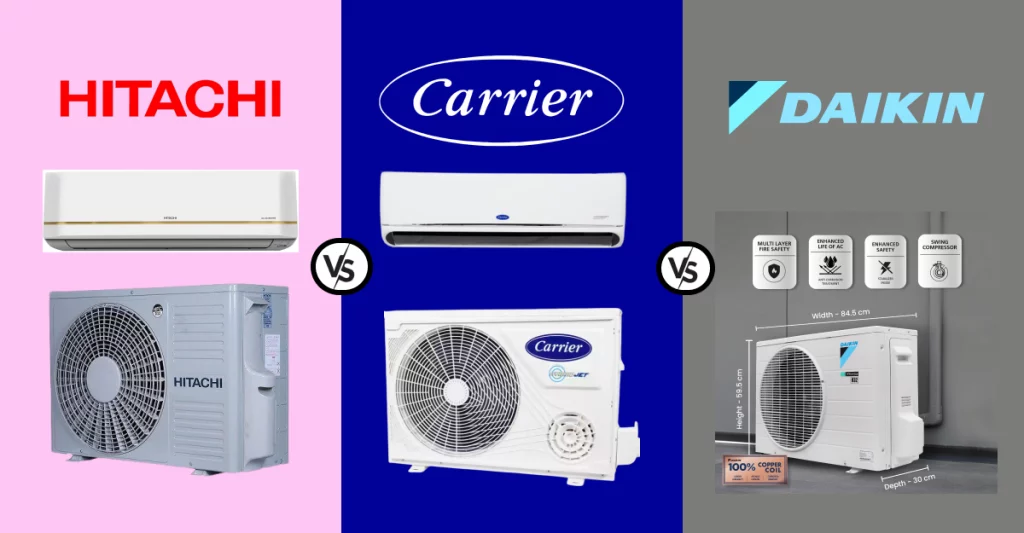
If you live in an area where summer feels like a furnace, choosing the right air conditioner isn’t just about comfort—it’s about survival. When the temperature soars past 40°C (104°F), you need an AC that doesn’t just cool but thrives in extreme heat.
Three brands dominate this space i.e. Hitachi, Carrier, and Daikin.
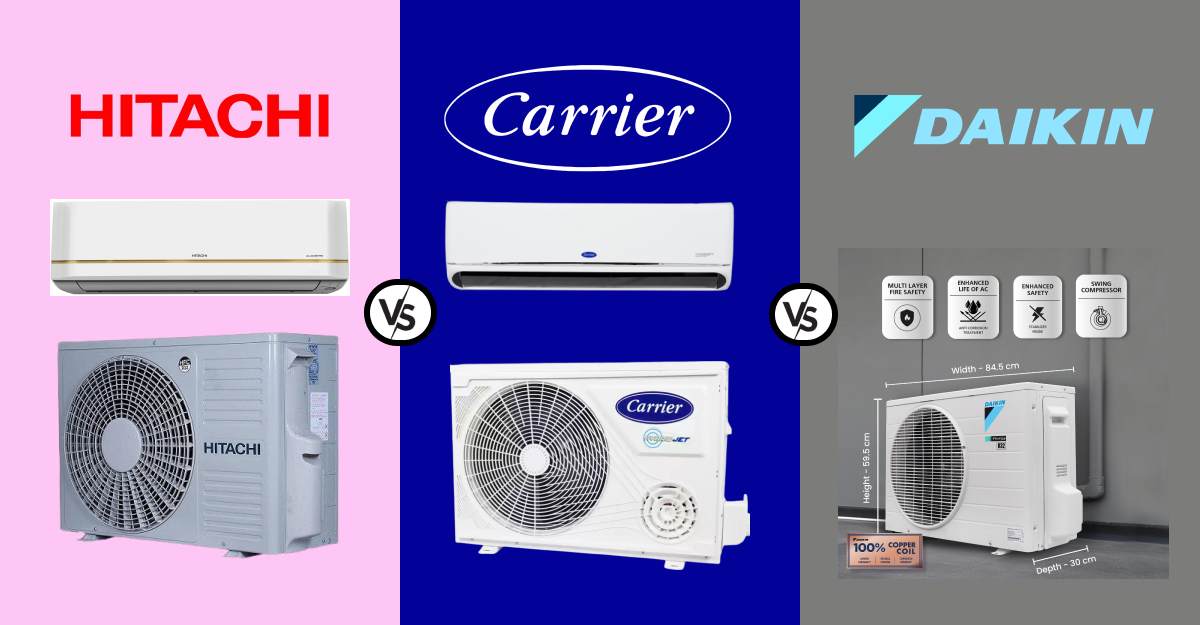
But which one is the best? Which brand truly delivers powerful cooling when you need it most?
Let’s dive into Hitachi vs Carrier vs Daikin to compare their strengths, features, and performance in extreme temperatures.
Stay tuned!
Profile Comparison: Hitachi vs Carrier vs Daikin
First of all, let’s have a look at their profiles-
- Hitachi, founded in 1910 in Japan, is a name synonymous with durability. It has built a strong reputation for reliable air conditioning systems designed to last for years.
- Carrier, an American company established in 1915, revolutionized air conditioning. Known for affordability and powerful cooling, Carrier is a household favorite in extreme climates.
- Daikin, founded in 1924 in Japan, leads the market in air conditioning innovation. It’s famous for energy efficiency and smart cooling technologies.
Now let’s compare the backgrounds of Hitachi vs Carrier vs Daikin-
| Particulars | Hitachi | Carrier | Daikin |
| Founded | 1910 | 1915 | 1924 |
| Headquarters | Tokyo, Japan | Palm Beach Gardens, Florida, USA | Osaka, Japan |
| Core Products | Air conditioning, elevators, industrial machinery, IT services | Air conditioning, heating, and refrigeration systems | Air conditioning, refrigeration, heating systems |
| Market Position | Strong presence in residential and commercial sectors; known for reliability and durability. | One of the largest HVAC manufacturers; focuses on affordability and robust cooling solutions. | Market leader in air conditioning; recognized for innovation and energy efficiency. |
| Global Reach | Operates in over 150 countries with a focus on Asia and North America. | Air conditioning, refrigeration, and heating systems | Global operations in over 150 countries; significant market share in Europe and Asia. |
| Research & Development | Invests heavily in R&D for technology advancements in HVAC systems. | Focuses on developing energy-efficient technologies and sustainable solutions. | Known for innovation in inverter technology and smart home integration. |
| Sustainability Initiatives | Committed to reducing environmental impact through energy-efficient products. | Actively promotes eco-friendly refrigerants and energy-saving technologies. | Leader in sustainable practices with a focus on reducing carbon footprint through innovative products. |
| Customer Base | Primarily targets homeowners aged 30-55; also caters to commercial clients. | Appeals to a broad demographic, focusing on homeowners aged 25-60; popular among businesses. | Targets diverse age groups from young homeowners (25+) to large commercial enterprises; strong focus on families. |
All three brands have a global presence and invest in sustainability and innovation. However, Hitachi focuses on longevity, Carrier on powerful cooling, and Daikin on efficiency and smart features.
Features Comparison of Hitachi vs Carrier vs Daikin: Which AC Handles Extreme Heat Best?
If you’re comparing Hitachi vs Carrier vs Daikin for extreme heat, you need to look at their various features-
| Feature | Daikin | Carrier | Hitachi |
| Cooling Efficiency | Known for consistent cooling and humidity control, ideal for extreme heat | High cooling power with efficient compressors, suitable for extreme temperatures | Advanced compressor technology ensures quick cooling, even in larger spaces |
| Energy Efficiency | High COP (up to 4.36) and IPLV(C) (up to 5.8), very energy-efficient | Eco-friendly refrigerants and high ISEER ratios, optimized for energy savings | High SEER and COP ratings; advanced inverter technology minimizes electricity consumption |
| Noise Levels | Moderate noise levels (58 dBA); lacks insulation materials, causing vibrations. | Very quiet models (e.g., Carrier 24ANB1 at 40 dBA), insulated designs reduce noise significantly | Slightly quieter than Daikin (56 dBA), with intelligent noise control features |
| Durability | Reliable and durable with long-term investment value | Durable copper condensers and robust build quality | Renowned for quality and innovation; reliable components ensure longevity |
| Advanced Features | Smart cooling sensors, air purification systems, Wi-Fi connectivity, and self-cleaning filters | Intelligent alert systems, 5-layer protection, inverter technology, and eco-friendly refrigerants | Intelligent sensors adjust cooling based on human presence; precise temperature control |
| Heating Capability | Reliable but slower heating performance compared to others | Efficient heating with heat pumps; faster heating performance than Daikin | Outstanding heating effect due to advanced compressor design |
| Design Flexibility | Compact outdoor units with flexible indoor unit options; supports long duct lengths (up to 1000m) | Sleek designs with user-friendly controllers; suitable for various home setups | Narrower design freedom compared to Daikin but offers multiple indoor unit models |
| Price Range | Generally more expensive due to premium features | Competitive pricing with good value for money | Higher price point compared to Daikin and Carrier (e.g., £1242 vs £1086 for comparable models) |
| Brand Reputation | Globally recognized for HVAC expertise; specialized focus on air conditioning technology. | Known for reliability and affordability; a trusted brand in mid-range markets. | Established multinational with innovations like scroll compressors; strong presence in residential markets. |
| Commercial Applications | Excels in large-scale HVAC systems like VRV and chillers, ideal for industrial setups. | Suitable for small to medium commercial spaces; lacks large-scale system options like Daikin. | Strong in residential and light commercial applications; less focus on industrial systems. |
| Regional Adaptability | Designed to perform efficiently in extreme climates, including harsh heat conditions. | Reliable performance in moderate climates; may require additional support in extreme conditions. | Tropical inverter technology ensures effective cooling in high-temperature regions. |
| Maintenance Requirements | Easy maintenance with advanced diagnostics and self-cleaning systems. | Moderate maintenance needs; simpler systems make repairs straightforward. | Requires regular upkeep but offers features like filter clean indicators to simplify maintenance tasks. |
Note: We have also compared the following AC brands-
Business Comparison: Sales, Profits & Market Share
When comparing Hitachi vs Carrier vs Daikin, business performance speaks volumes about customer trust.
| Business Aspect | Hitachi | Carrier | Daikin |
| Number of ACs Sold (FY23) | Approximately 1.5 million units sold | Estimated around 2 million units sold | Approximately 1.8 million units sold |
| Revenue (FY23) | ₹2,384 crore (approx. $288 million) | Estimated ₹3,000 crore (approx. $365 million) | ₹3,250 crore (approx. $395 million) |
| Expenses (FY23) | Not explicitly stated; reported losses indicate high operational costs. | Estimated at ₹2,700 crore (approx. $328 million) based on profit margins. | Not explicitly stated; significant investment in R&D and local manufacturing. |
| Net Profit (FY23) | Net loss of ₹82 crore (approx. $10 million) | Estimated net profit of ₹300 crore (approx. $36 million) | Estimated net profit of ₹450 crore (approx. $55 million) |
| Retail Stores | Approximately 500 retail outlets across India | Around 600 retail outlets in India | Approximately 400 retail outlets in India |
| Market Valuation | Not publicly listed; valuation not disclosed but facing challenges in market position | Valued at approximately ₹14,000 crore (approx. $1.7 billion) based on market performance | Valued at approximately ₹20,000 crore (approx. $2.4 billion) due to strong market presence and growth potential |
| Market Share in India | 5-12% depending on the segment (5-8% overall, 12% in Room ACs) | 18-20% of the Indian HVAC market | 18-19% in residential ACs; 60% in VRV system |
| Global Market Share | Approximately 5% of the global air conditioning market | Around 9% of the global HVAC market | Leading with approximately 15% of the global air conditioning market |
Clearly, Daikin and Carrier dominate the market, while Hitachi struggles to keep up.
Which offers the Best Smart Cooling?
In today’s world, an AC isn’t just about cooling. It’s also about intelligent performance.
- Daikin excels in smart cooling, featuring Wi-Fi connectivity, air purification, and automatic climate adjustment based on occupancy.
- Carrier offers intelligent alert systems and eco-friendly refrigerants, ensuring smart energy use.
- Hitachi incorporates human presence sensors that adjust cooling to reduce energy waste.
If you want an AC that adapts to your lifestyle, Daikin is the clear winner in smart cooling.
Hitachi vs Carrier vs Daikin: Which AC Should You Choose?
After comparing Hitachi vs Carrier vs Daikin, which AC is best for extreme heat? Let’s summarize-
Choose Daikin if you want-
- Best energy efficiency
- Smart cooling features
- Consistent performance in extreme temperatures
Choose Carrier if you need-
- Powerful cooling performance
- Affordable yet reliable ACs
- Super quiet operation
Choose Hitachi if you prefer-
- Long-term durability
- Advanced compressor technology
- Reliable cooling with intelligent sensors
Final Verdict on Hitachi vs Carrier vs Daikin
Daikin is the best overall choice for extreme heat, Carrier is the best for affordability and power, and Hitachi is great for long-lasting performance. No matter which AC you choose, make sure it fits your home, budget, and climate needs.
Now that you’ve seen the battle of Hitachi vs Carrier vs Daikin, which one will you pick? Share your thoughts in the comments. Thanks for reading!
