
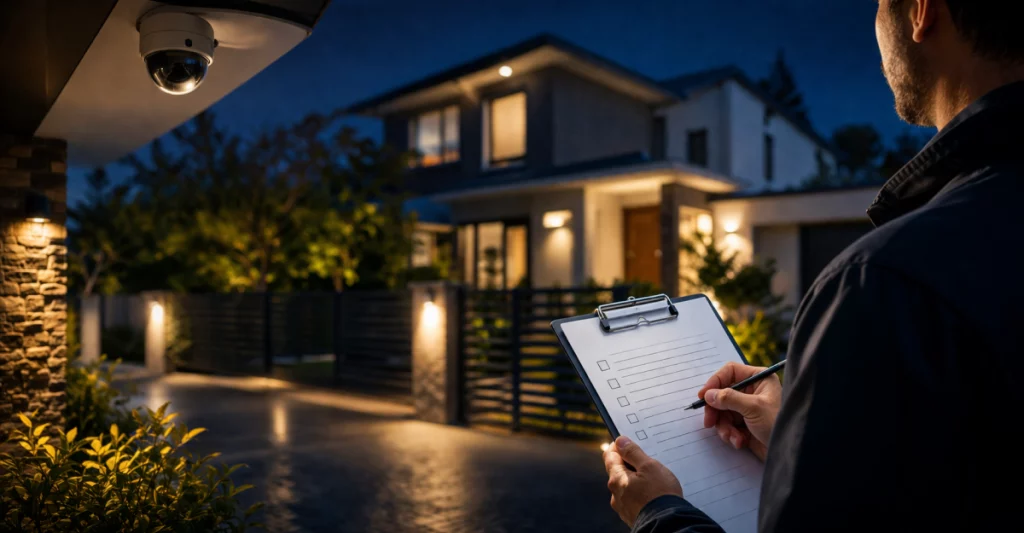
Is your home safe enough? Really? When you look past the locks and the cameras, a residential security risk assessment is the only honest way to answer that question and decide what to fix first, instead of guessing.
In the US, this is more important than ever. Around 61% of households now have at least one security camera, and about 48% use a video doorbell, which shows how normal smart security has become. At the same time, traditional alarm systems sit at roughly 30% of households. Burglary rates are falling overall, but homes still remain a major target, so it is not the time to relax.
Below is a simple, practical framework you can follow step by step.
Why a residential security risk assessment matters today?
Before we jump into the steps, let us anchor this in current numbers so you see why this is worth your time.
- About 61% of US households now have at least one security camera at home, up sharply from just a few years ago.
- Roughly 48% of homes have a video doorbell, which works out to almost 59 million households.
- Traditional home alarm systems are used by about 30% of households and have stayed in that range recently.
- National burglary rates have dropped about 9.5% in the last year and are roughly 40% lower than in the late 1990s, but the country still sees around one break in every 26 seconds.
- About 52% of all burglaries target homes or residential properties, not businesses.
- Homes without a security system are often described as being about 300% more likely to be broken into than homes that have one.
- Only around 11% of burglary cases are cleared by police, which means you cannot rely only on catching the offender after the fact.
So yes, cameras and alarms are now common, but homes are still hit often and most burglars get away. A structured security risk assessment helps you use these tools wisely, close the biggest gaps and avoid being part of those statistics.
Step 1: Define your goals and scope
Start by deciding what you are protecting and from what. This sounds simple, but most people skip it.
Ask yourself:
- Who and what are you most worried about losing or harming: family members, pets, jewellery, cash, documents, data, vehicles.
- Which threats matter most in your area: burglary, package theft, vandalism, fire, or even natural hazards.
- Which parts of the property are in scope: main house, garage, basement, garden, shed, rooftop.
Write this down in a short document. The goal is to make sure every later decision, from hardware to habits, traces back to these priorities instead of random fears.
Step 2: Understand your local risk
Next, zoom out and look at your neighbourhood. Well, this is a crucial part where you need to act like Sherlock Holmes for residential security risk assessment.
- First, just get a sense of what’s been going on around you lately. Check local news or even neighborhood WhatsApp groups if you have them. Things like break-ins, car theft, or random vandalism usually follow patterns. If something has happened nearby, it’s worth knowing how and where it happened so you’re not caught off guard.
- How your home compares to others on your street. Does it look well lit, lived in and cared for, or dark and isolated.
- Environmental details like alleyways, vacant lots, dead ends, thick trees or poorly lit paths that make it easy to approach unseen.
Criminals often choose the easiest target on a block, not the absolute richest one. If your place looks like the least protected home on the street, you are sending the wrong message without realising it.
Step 3: Walk the perimeter like an intruder
Now it is time to get outside and see your property with fresh eyes. Walk around your place once, slowly, like you’re seeing it for the first time.
- You might notice things you usually ignore—like a fence that’s slightly broken, a wall that’s easy to climb, or even something as simple as a dustbin placed in the wrong spot that could help someone get over.
- Also, pay attention to lighting. Any area that feels a bit too dark at night—especially near doors, windows, or side paths—is something you shouldn’t ignore.
- Overgrown bushes, tall hedges or features that create hiding spots close to your house.
Ask yourself: “If I wanted to get close to this home without being seen, how would I do it.” This simple mental switch will reveal flaws that daily routine hides.
Quick wins at this stage often include trimming shrubs, adding motion lights to side paths and securing garden tools and ladders that could help someone climb.
Step 4:Inspect doors, windows, and physical hardware
Most people assume break-ins are high-tech, but honestly, they’re not. It’s usually just someone finding an easy way in.
Check every entry point with a critical eye:
- Look at your main door—does it actually feel strong and secure? A solid door with a good lock makes a difference. And don’t just look at the lock—check the hinges and frame too. Sometimes that’s where the real weakness is.
- Hollow, lightweight doors and flimsy frames are easy to kick in.
- Side and back doors are often weaker, even though they are more likely to be attacked. Treat them with the same seriousness as the front door.
- Sliding doors should have secondary locks, bars or anti lift devices so they cannot be forced or lifted off the track.
- Ground floor windows should close fully and have working locks. Pay special attention to windows hidden by landscaping or at the back of the house.
Physical security is the foundation. Smart locks and alarms will not help much if someone can simply force a rotten frame or slide an unlocked window open.
Step 5: Review electronic security and monitoring
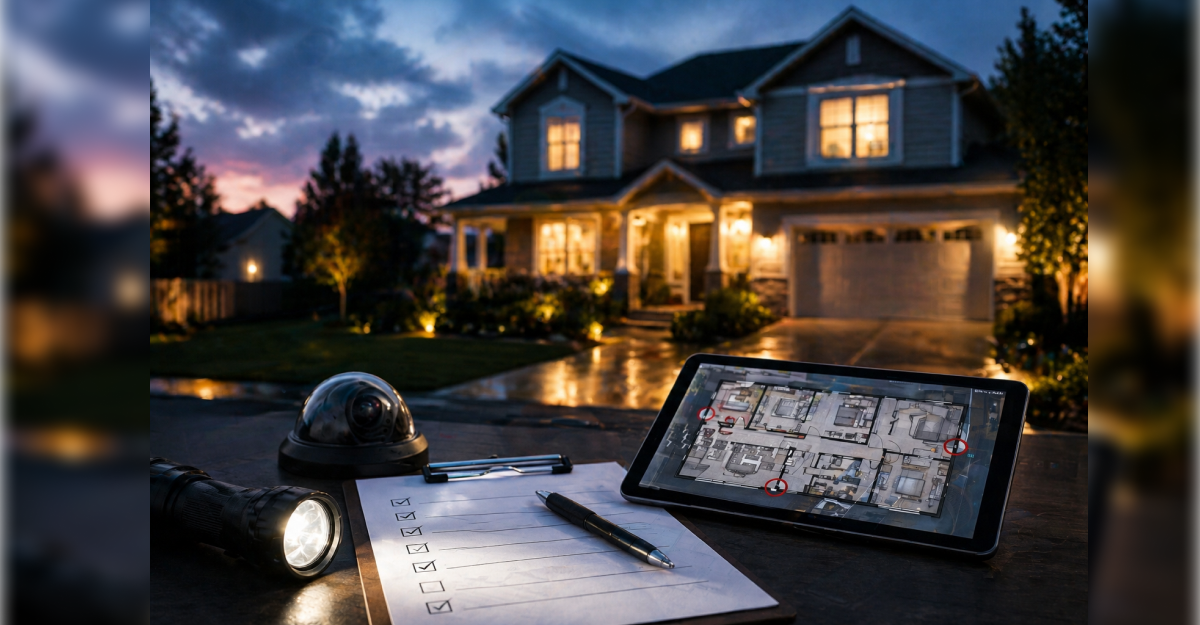
Once the basics look fine, think about your electronic security.
If you have an alarm system or cameras, don’t just assume they’re doing their job. Take a moment to think—are they really covering the important spots, or just the obvious ones like the front door?
A lot of setups look good on paper but miss the areas that actually matter.
When you’re thinking about your security setup, it helps to look at how it actually works in real life—not just how it’s supposed to work.
Start with your alarms. Are sensors placed on all the important doors and the windows that could be easy to access, or is everything focused only on the front door? It’s also worth checking if you have motion sensors inside the house in areas where someone would likely pass through.
Then think about monitoring. Is your system connected to a professional service, or are you handling it yourself? More importantly, if you get an alert, do you actually notice it and respond quickly, or does it sometimes get ignored?
Take a look at your cameras too. Do they cover all the main entry points—front, back, and sides—or are there gaps? And when they record, can you clearly see faces or vehicle details, or is the footage not that useful? Blind spots are more common than people think.
If you’re using a video doorbell, check how well it actually works. Does it give you a clear view of who’s there? And are you making use of features like motion alerts or two-way audio, or is it just sitting there doing the basics?
Finally, think about access. With smart locks or digital entry, it’s easy to forget who still has access. Have you shared codes with guests, tenants, or workers at some point? And if yes, did you change those codes after they no longer needed them?
Many US households now layer these devices. With 61% using cameras and nearly half using video doorbells, it makes sense to treat them as part of a system, not as isolated gadgets.
If you’re not sure whether your setup is good enough, this is usually where people start looking at professional home security companies. They can help you figure out proper sensor placement, monitoring, and coverage instead of relying on guesswork.
Let me share some famous names holding expertise in this field- ADT, Vivint, SimpliSafe, Brinks Home, Ring, and Cove, etc.
Step 6: Examine daily habits and routines
Even the best hardware fails if daily behaviour is weak.
Ask some honest questions for residential security risk assessment:
- Do you lock all doors and windows every time you leave, even for a quick errand.
- Are spare keys hidden outside in obvious places like under mats or in plant pots.
- Do you leave windows open at night or when you are in another part of the house.
- Are valuables and car keys visible through windows or near the door.
- Do you announce travel plans publicly on social media.
Most burglars prefer easy wins. If they see open windows, overflowing mail, dark houses or predictable routines, they will not need advanced tools. Changing small habits often reduces your risk more than adding one more gadget.
Step 7: Score your risks and set priorities
Now you have a long list of issues. To avoid overwhelm, score each one by likelihood and impact, then assign a priority.
You can use a simple table like this.
| Area | Common issue | Risk level | Suggested action |
| Front and yard | Poor lighting, tall shrubs near paths | Medium | Add motion lights, trim shrubs |
| Main door | Hollow door, basic latch only | High | Upgrade to solid door with deadbolt |
| Windows | Ground floor windows without locks | High | Install and use window locks |
| Garage | Automatic door with no extra lock | Medium | Add manual lock or interior bar |
| Cameras and alarms | No coverage on back entrance | Medium | Add or reposition cameras and sensors |
| Daily habits | Spare key outside, windows left open at night | High | Remove spare key, lock up every evening |
You can score risk as:
- Likelihood: How easy is this weakness to exploit.
- Impact: How serious would it be if someone used it.
Focus first on items that are both likely and serious. For most homes, that means back doors, dark side approaches and poor daily locking habits.
Step 8: Build a simple action plan for residential security risk assessment
Finally, turn your assessment into a clear plan with dates. Otherwise, nothing changes.
Instead of trying to fix everything at once, break it down so it’s easier to handle.
In the next few days:
Start small. Remove any spare keys lying around outside, fix locks that aren’t working properly, and get into the habit of checking everything before going to bed.
Over the next couple of months:
This is where you improve things—better locks, stronger doors, more lighting outside, and maybe adjusting your cameras so they’re actually useful.
Over the longer term:
If you’re thinking seriously about security, you can invest in a better system or even make changes around your home so there are fewer hidden spots in the first place.
Review this plan at least once a year or after big changes in your life, such as moving, renovating or seeing new crime patterns in your area.
Note: When it comes to security, we can’t overlook the rising risks faced by VIPs. Even the latest shooting on Trump’s administration has raised concerns over security. Similar is the situation in India. Hence, we have covered the following types of securities-
- Top 10 Z+ Security holders in India
- Most powerful Y+ Security holders in India
- Crucial Features of Cyber Security One Should Know
Wrapping Up Residential Security Risk Assessment
Modern statistics show a clear trend. More than half of US homes now use cameras and video doorbells, and yet homes still account for more than half of all burglaries, with an attempted or successful break in happening roughly every half a minute. The clearance rate is low, so you cannot rely on “after the crime” solutions.
The most effective path for residential security risk assessment is simple but disciplined. Understand your local risk, walk your property like an intruder, strengthen physical barriers, use electronic tools wisely and tighten daily habits.
With that kind of structured residential security risk assessment, your cameras and alarms stop being random gadgets and become part of a deliberate, layered defence that fits the real risks you face.
