
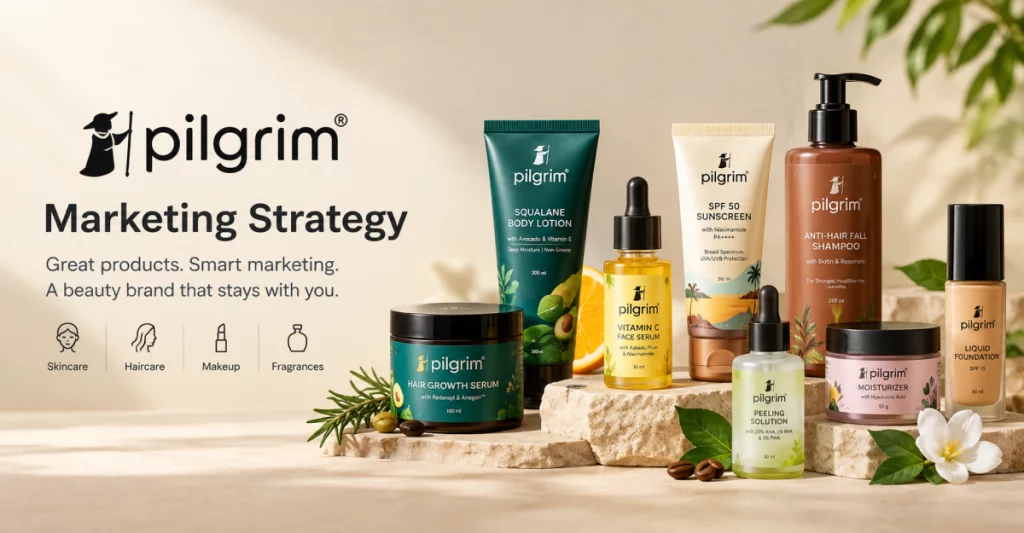
You have probably seen Pilgrim somewhere before. Maybe it was a creator applying a serum on Instagram, a skincare recommendation on YouTube, a product listing on Nykaa, or a discount popping up while you were browsing online.
That is the interesting part.
In a beauty market packed with D2C startups, celebrity-backed brands, global companies, and traditional FMCG players, simply launching another serum is not enough. The real challenge is getting people to notice the product, remember the brand, and eventually click “Buy Now.”
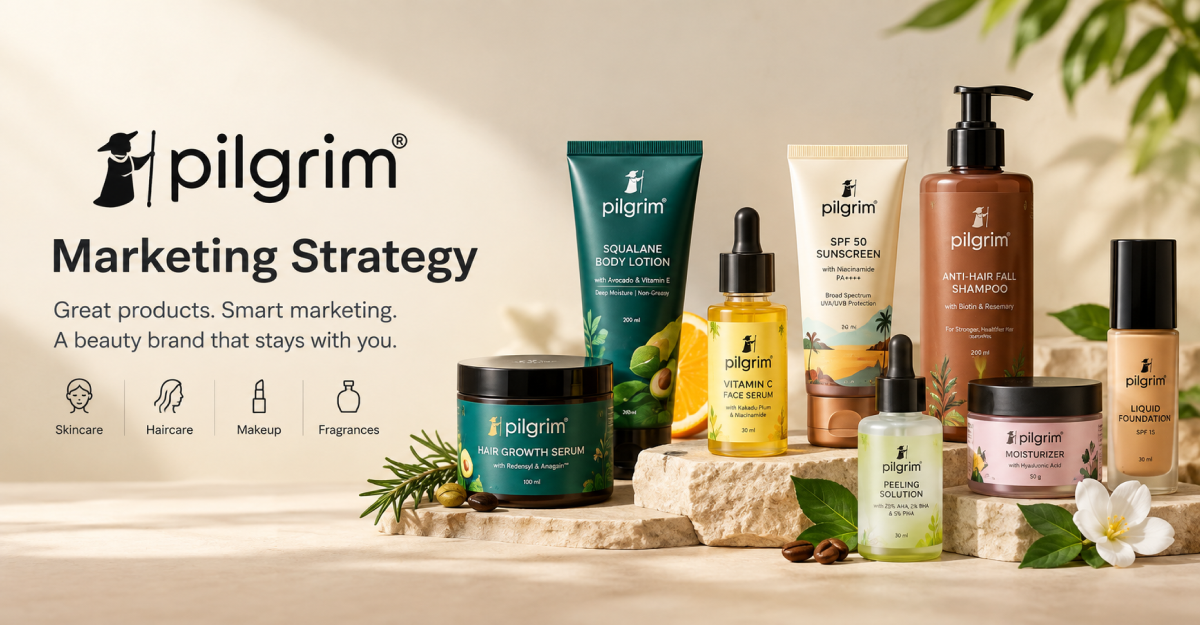
That is where the Pilgrim marketing strategy gets interesting. The brand has built its presence around product storytelling, creator-led content, search-friendly education, promotional offers, and increasingly, offline distribution. Founded in 2019 by Anurag Kedia and Gagandeep Makker, Pilgrim has expanded from its early skincare and haircare portfolio into makeup and fragrances, with more than 250 products reported in 2025.
So, what is Pilgrim doing differently? Let’s break it down.
What Is Pilgrim?
Pilgrim is an Indian beauty and personal care brand selling products across skincare, haircare, makeup, and fragrances. Its early ranges were inspired by beauty traditions from places including Korea and France, while its current portfolio includes products such as Pilgrim shampoo, Pilgrim Vitamin C serum, Pilgrim hair growth serum, Pilgrim face serum, Pilgrim sunscreen, and Pilgrim moisturizer.
The company started as a D2C brand, but its distribution has expanded significantly. Pilgrim says consumers can buy its products through its website, while its FAQ also lists Amazon, Flipkart, Myntra and Nykaa. Business reporting in 2025 additionally identified Zepto, Blinkit, and Swiggy Instamart among its online channels.
That expansion matters because marketing only works as a growth engine when consumers can actually find and buy the product.
What Is The Pilgrim Marketing Strategy?
The simplest way to understand the strategy is to look at the consumer journey:
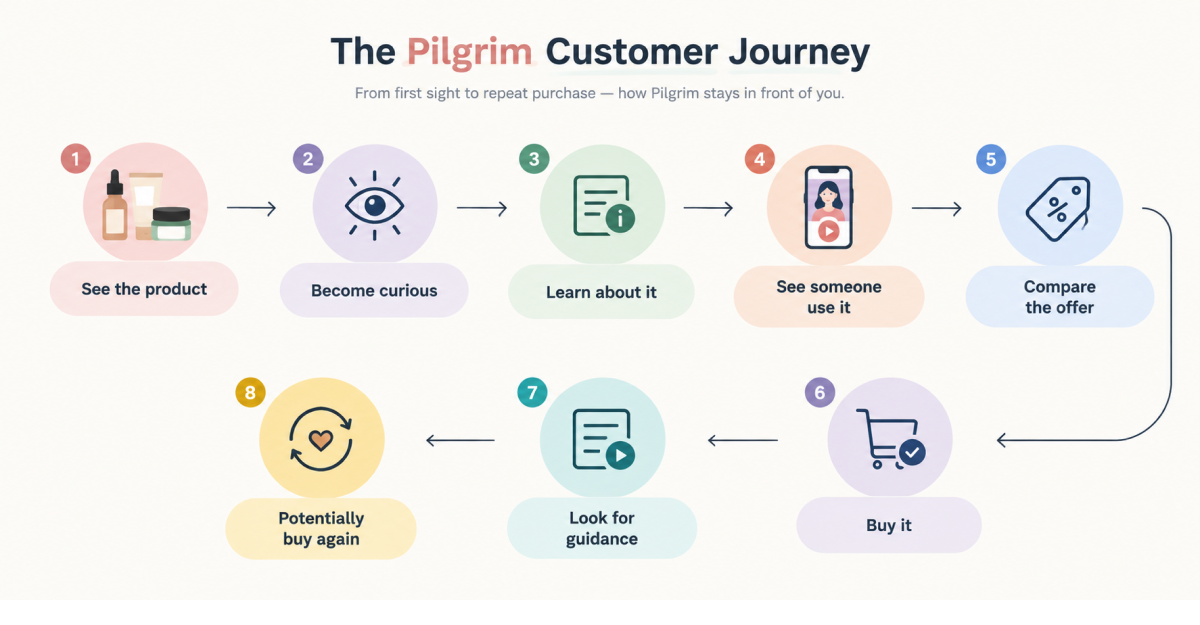
Pilgrim’s marketing activity touches several of these stages.
1. Product-Led Storytelling
Pilgrim does not market its products only by putting a bottle against a plain background.
The brand frequently connects products with ingredients, beauty concerns and routines. Its own brand history highlights Korean beauty, French red-vine formulations and Spanish squalane as part of its product storytelling.
This gives the consumer a mental shortcut.
Instead of remembering a complicated formulation, they might remember a particular concern, ingredient, or routine associated with a product.
Take the Pilgrim Vitamin C serum. The current product page connects the serum with Vitamin C, niacinamide, Kakadu plum, and brightening-related concerns. It also provides usage information and product combinations.
That is product information, but it is also marketing content.
2. Influencer And Creator Marketing
Beauty products have one major advantage: they are easy to demonstrate.
A creator can show the texture of a serum, apply it during a morning routine, discuss the product and direct viewers towards the listing. That makes influencer marketing particularly useful for beauty brands.
Pilgrim has also used celebrity-led marketing. Its official brand communication says Rashmika Mandanna became its hair brand ambassador in 2024, while Manisha Koirala became the face of the brand. In 2026, Pilgrim and Rashmika returned with the “Nani Ka Secret” campaign around its Advanced Hair Growth Serum.
The important point is not simply celebrity visibility. It is how the celebrity campaign gives an existing product a new story that creators and consumers can talk about.
3. Social Media That Shows The Product
Think about beauty content on Instagram. Routines, tutorials, product demonstrations, ingredient explainers and “get ready with me” videos all give brands an opportunity to appear without relying entirely on conventional advertising.
Pilgrim’s product portfolio fits naturally into these formats.
A Pilgrim serum for face can become part of a morning routine. A hair product can become part of a haircare routine. A sunscreen can appear in a “daily essentials” video. A foundation can be demonstrated through application and shade content.
That makes the product itself a content asset.
4. SEO And Search-Driven Discovery
This is one of the less obvious parts of the strategy.
Consumers do not always search for a brand first. Sometimes they search for an answer.
Queries such as “Pilgrim peeling solution how to use,” “How to use Pilgrim peeling solution” and “Pilgrim hair growth serum how to use” show a different kind of intent from a person casually scrolling Instagram.
Pilgrim itself publishes educational content around product usage. Its peeling solution page, for example, provides application, timing, patch-testing and aftercare instructions.
That creates a useful path:
Question → Search → Educational content → Product → Purchase
It also helps existing customers after purchase, which makes educational SEO more than just a traffic strategy.
5. Discounts, Bundles And Buy 1 Get 1 Offers
Now comes the part almost every online shopper notices: the offer.
Pilgrim’s current website displays B1G1FREE offers across several categories. Its Vitamin C serum page, for example, currently lists Buy 1 Get 1 Free, Buy 2 Get 2 Free and Buy 3 Get 3 Free offers.
The same promotional approach appears across products including sunscreens, moisturizers and makeup.
From a marketing perspective, offers can lower the barrier to trying an unfamiliar product. Bundles can also encourage shoppers to test multiple products in one order.
That does not automatically mean every discount is a sign of strong marketing. The strategic value comes from where the offer sits in the purchase journey and whether it encourages trial, basket expansion or repeat buying.
6. Product Education As A Marketing Tool
Search behaviour around beauty products can continue even after someone discovers a brand.
A consumer may search “Pilgrim hair growth serum how to use” because they are considering buying it. Another may search for instructions after purchasing it.
Pilgrim provides detailed usage information on its product pages. For example, its hair growth serum instructions tell users to apply the product directly to the scalp, massage it in, and leave it overnight.
Similarly, the brand provides detailed instructions for its peeling solution, including a patch test and specified application time.
That turns product education into another customer touchpoint.
7. Omnichannel Distribution
Pilgrim’s story is no longer purely D2C.
In 2025, ET reported that the company had more than 10,000 retail stores, 10 exclusive brand outlets and a presence across 150 cities, with online channels accounting for around 80% of revenue at the time. The company said it planned further offline expansion.
The shift is significant.
A consumer can discover Pilgrim on social media, search for reviews or usage information, see it on a marketplace and eventually encounter it in a physical store.
Marketing and distribution start reinforcing each other.
Is Pilgrim A Good Brand?
The question “Is Pilgrim a good brand?” is ultimately a consumer decision rather than something advertising alone can answer.
A sensible evaluation would involve looking at product ingredients, substantiated claims, customer reviews, pricing, return policies and available evidence around product performance.
Pilgrim’s current website provides ingredient information and product-specific usage details, while its product pages also display customer reviews.
It is also worth separating product quality from marketing effectiveness. A brand can have strong marketing without every product being right for every consumer.
The same applies to searches such as “How to sue Pilgrim face serum.” That phrase should not be interpreted as evidence of a legal dispute. Without credible evidence of a specific case, there is no basis for suggesting that Pilgrim or a particular serum has been involved in one.
Pilgrim Marketing Strategy At A Glance
| Marketing Strategy | How It Works |
| Product-led marketing | Turns individual products into searchable and shareable hero products |
| Influencer marketing | Builds awareness through creators, demonstrations and reviews |
| Social media | Shows products through routines and short-form visual content |
| SEO | Captures consumers searching for beauty questions and solutions |
| Offers | Encourages product trial and conversion |
| Bundles | Gives consumers a reason to purchase multiple products |
| Product education | Helps consumers understand how to use products |
| Omnichannel distribution | Makes products available across websites, marketplaces and retail |
What Other D2C Brands Can Learn From Pilgrim?
There are several practical lessons here.
Make products searchable: A product should answer a real consumer question, not simply have an attractive name.
Give creators something to demonstrate: Beauty products work particularly well when consumers can see them being applied and used.
Turn education into marketing: A “how to use” search can bring a consumer closer to a purchase while also helping an existing customer.
Use offers strategically: Discounts and bundles can encourage trial, but they should have a clear role in the funnel.
Build a recognisable identity: A consumer should be able to encounter the same brand language across social media, product pages and marketplaces.
And perhaps most importantly, do not depend on one channel. Pilgrim’s journey shows how social content, search, creators, marketplaces and offline retail can work together rather than operating as separate marketing activities.
Note: We have also covered “10 Lessons To Learn From Apple’s New CEO John Ternus Before Your Next Career Move”. Go through it for more info.
Wrap-Up
So, what is the Pilgrim marketing strategy really about?
It is less about one viral campaign and more about connecting several small moments.
A consumer sees a product in a creator’s video. They search for it. They read about the ingredients. They look for reviews. An offer makes the first purchase easier. Later, they search for how to use the product. And when the brand expands across marketplaces and stores, finding it becomes even simpler.
That creates a connected path:
Product → Content → Creator → Search → Offer → Purchase → Education
And that may be the most useful lesson from Pilgrim’s marketing playbook. In a crowded beauty market, getting noticed once is only the beginning. The bigger challenge is staying visible wherever the consumer happens to look next.
