
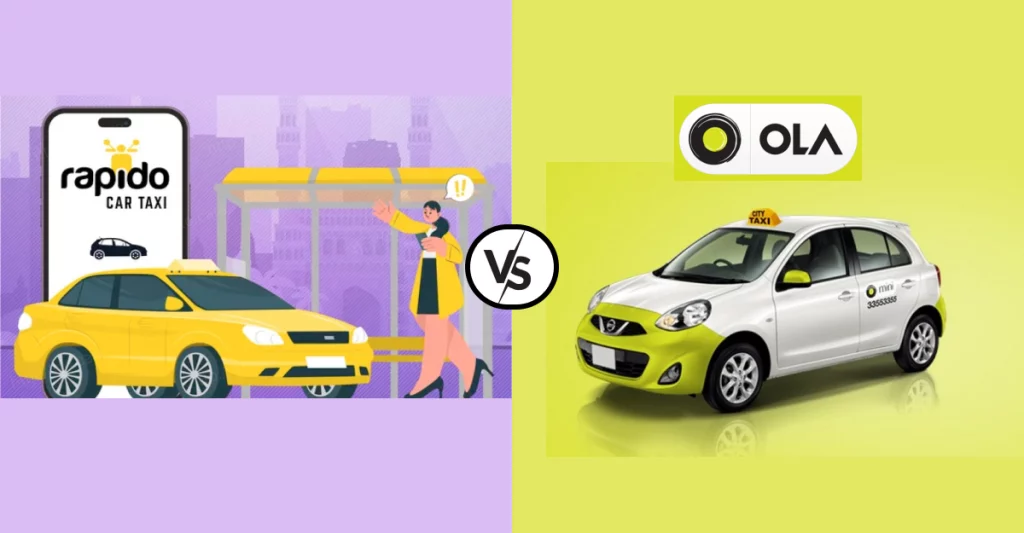
If you’re stuck choosing between Rapido vs Ola, you’re not alone. Whether you’re late to class, rushing to work, or just trying to beat traffic, we all crave speed, safety, and savings.
But with so many ride-hailing apps out there, Rapido vs Ola has become the real rivalry worth watching. One is dominating India’s streets with bikes and autos, while the other leads in cabs and convenience.
Now the question is- Who really offers you the best value in 2025?
Buckle up, because this comparison is going to surprise you—and maybe even save you time and money!
Profile Comparison: Rapido vs Ola
Let’s start by looking at where both companies come from. Even though both Rapido and Ola were born in Bengaluru, their paths have been very different.
Rapido, launched in 2015, took the bike-taxi-first route. Today, they offer not just bikes, but autos, parcel delivery, and rentals. Ola, on the other hand, started back in 2010 and quickly scaled with a focus on cabs—mini, micro, SUVs, and outstations. It even tried food delivery and financial services at one point!
| Aspects | Rapido | Ola |
| Founded | 2015 | 2010 |
| Headquarters | Bengaluru (Karnataka, India) | Bengaluru (Karnataka, India) |
| Founders | Aravind Sanka, Rishikesh SR, Pavan Guntupalli. | Bhavish Aggarwal, Ankit Bhati |
| Core Products | Known for offering diversified services (including food delivery and financial services) and a market leader in India in ride-hailing market | Mobile app, website |
| Brand Reputation | Known for reliability and lower cancellation rates in bike taxis. | Known for offering diversified services (including food delivery and financial services) and a market leader in India in the ride-hailing market |
| Recent Innovations | Introduced a subscription model for drivers; expanded into cab services and logistics. | Zero-Commission (Flat Fee) Model; E-bike Ride-Hailing expansion, Premiumization of Mobility, New Regulatory Adaptation, Auxiliary Services. etc. |
| Sustainability Initiatives | Focus on reducing the carbon footprint through bike taxis and efficient logistics. | Promotion of Electric Mobility, Real-Time Emissions Reduction Campaigns, etc. |
After checking the profile data, here’s what’s clear: Rapido vs Ola isn’t just about vehicles—it’s about vision. Rapido stays lean and bike-focused, while Ola’s wide reach makes it a full-fledged urban transport platform.
Despite Ola being older and larger in scale, Rapido is catching up fast by focusing on the middle-class commuter who wants quick and affordable rides.
Features Comparison: Rapido vs Ola
When it comes to actual ride features, this is where the battle gets interesting. You’re probably wondering: “Which app will give me a cheaper, faster, and safer ride?”
Let’s break it down-
| Feature | Rapido | Ola Consumer (Ola Cabs) |
| Service Type | Mainly bike taxis, including auto-rickshaws, cabs, buses, and parcel services. | Four-wheeler cabs, auto-rickshaws, and also some bike taxis in select cities |
| Market Presence | Tier II and III cities; Prefers shorter distances (ideal for trips under 3 km) | Strong presence across tier I, II, and III cities; traditionally focused more on urban and longer distances |
| Pricing Strategy | Base fare of ₹20 + ₹3/km; Price doubles in peak hours | Dynamic pricing (surge pricing) during high-demand periods; fares vary based on category and demand |
| Cancellation Rate | Lower cancellation rates compared to Ola | Higher cancellation rates; has been a point of user criticism |
| Driver Model | Subscription-based model for drivers, offers predictable income and flexibility | Recently shifted to a zero-commission/flat fee model (as of June 2025), letting drivers keep full fares |
| Funding | Raised $300 million; operates independently without deep pockets like Uber or Ola | No major round after Feb 2022; focus on Ola Electric’s funding |
| Safety Measures | Helmet compulsory for riders and captains; GPS tracking; verified captains | In-app SOS, trip sharing, 24×7 support, driver background checks; safety kit in vehicles |
| Ride Options | Bike taxis, autos, and parcel delivery (RapidoBox) | Cabs (mini, micro, sedan, SUVs), auto-rickshaws, some bike taxis, rentals, outstation |
| Payment Options | Digital wallets, UPI, credit/debit cards, and cash payments | Digital wallets, UPI, cards, and cash; broad payment acceptance |
| Technology Integration | Real-time tracking, instant booking feature | Real-time tracking; predictive pricing and supply tools using AI; app is mature but updates less rapid than Rapido |
| Promotions & Loyalty | Regular promotions- “Power Pass” for discounts on frequent rides | Promotions run periodically; lacks a unified pass like Rapido’s “Power Pass” |
| Accessibility Features | Special features for visually impaired users with voice-to-text commands | Standard accessibility options; not as focused as Rapido for special-needs users |
Rapido vs Ola shows very distinct strengths here. Rapido’s pricing starts at a flat ₹20 + ₹3/km—ideal for short trips under 3 km. Ola, on the other hand, uses dynamic pricing that often leads to higher fares during peak hours.
Cancellation rates? Rapido wins there too. Users have long complained about Ola’s unpredictable cancellations. In contrast, Rapido’s drivers follow a subscription model, giving them more income predictability and fewer reasons to cancel.
While Ola boasts a wider vehicle range and deeper city penetration, Rapido’s customer-first focus is shining through, especially in smaller cities and for budget-friendly users like you.
So, in the daily grind of Rapido vs Ola, Rapido seems to be building trust while Ola banks on its size!
Business Comparison of Rapido vs Ola
Let’s talk business, because the strength of a company determines the service you receive in the long run. Here’s where the Rapido vs Ola financial story flips expectations-
| Business Aspects | Rapido | Ola |
| Market Valuation in India | $1.1 billion | $1.25 billion |
| Market Share in India | Dominates bike taxi segment with 56% share; 33% in auto-rickshaws; 14-18% in cars. | 34% in cab segment; 26% in auto segment |
| Revenue Earned | Revenue surged to ₹648 crore in FY24; expected to reach ₹600 crore by the end of FY24. | ₹2,012 crore (FY24), ₹2,128 crore (FY23) |
| Expenses | Losses reduced by 45% to ₹371 crore in FY24. | ₹2,017 crore (FY24), ₹2,517 crore (FY23) |
| Profits/Loss | Not profitable yet; nearing profitability. | Uber, Rapido Cabs, Lyft, DiDi, Careem, etc. |
| Competitors | Ola, Uber, InDrive | Uber, Rapido Cabs, Lyft, DiDi Careem, etc. |
| Employee Benefits | Offers a subscription-based model for drivers, providing predictable income. | Health insurance, transport facilities, work-from-home options, education assistance, tax-saving options, maternity/paternity leaves. |
| Funding & Capitalization | Recently raised $30 million from Prosus; previously raised $200 million in Series E round. | Latest funding round (Series J) occurred in 2022 securing $20 million |
| Daily Rides | Completes over 2.5 million rides daily across various services. | 1.5 million rides per day. |
| User Base | 31.8 million monthly active users. | 28 million monthly active users |
You might think Ola, being older, would crush the competition financially—but the data paints a different picture.
Ola’s revenue in FY24 reached ₹2,012 crore. Impressive, yes. But they also posted a massive ₹2,017 crore in expenses, leading to losses of ₹10 crore. In FY23, the losses were an even bigger ₹623 crore.
Now, look at Rapido. They earned ₹648 crore in FY24 and cut their losses by 45%, bringing them down to ₹371 crore. They’re not profitable yet, but they’re closer to it than Ola is.
Also, Rapido handles 2.5 million rides daily—that’s 1 million more than Ola’s 1.5 million rides.
In terms of user base, Rapido clocks 31.8 million monthly users vs Ola’s 28 million. That’s a big win in a country where every ride counts.
When comparing Rapido vs Ola in 2025, the underdog might just be turning into the next big shark.
Latest News on Rapido and Ola
Now, let’s look at the recent updates of both the companies that will help us to understand their current status.
Rapido

As of July 2025, Rapido is celebrating a major breakthrough with the Motor Vehicle Aggregator Guidelines 2025, which finally legalize bike taxis using private vehicles. This regulatory clarity means states can no longer outright ban these services.
Rapido called it a milestone for mobility, job creation, and reducing traffic. They’re now working closely with state governments—especially in Karnataka, where services had previously faced disruptions.
India has around 9 million bike taxi riders, and this move helps formalize one of the country’s biggest gig economy segments. Meanwhile, in Pune, Rapido (alongside Ola and Uber) is being asked to clarify its fare structure amid complaints about pricing fairness.
On the business front, Rapido just teamed up with HPCL to support over 380,000 drivers in Hyderabad. They’ve also jumped into food delivery, launching a zero-commission platform aimed at undercutting big players.
Ola
While Ola Cabs adjusts to new fare rules, Ola Electric is facing setbacks. Sales dropped 45% year-on-year in June 2025, with quality issues plaguing their Roadster X Plus. Market share has fallen to just 19–20%, and Q1 FY26 losses hit ₹428 crore. The company is now betting on next-gen models to recover lost ground.
Who Is the Winner? Rapido vs Ola in 2025
Alright, let’s settle it. You’re looking for the best app for your daily rides—so who wins in Rapido vs Ola?
If you’re someone who travels short distances, prefers quick pickups, hates cancellations, and wants to spend less, Rapido is your go-to. Its growing popularity in Tier II and III cities makes it especially good for students, office-goers, and everyday riders.
On the flip side, if you’re looking for outstation cabs, variety in vehicle types, and a more established infrastructure, Ola still holds its ground.
But here’s the twist: Rapido is winning in the one place that matters most—your experience. Lower fares, more reliability, and a driver-friendly model! That’s the kind of innovation India needs.
So, in the race of Rapido vs Ola, the winner really depends on your lifestyle. But if current trends continue, Rapido might take the crown in the long haul.
Conclusion: What Should You Choose?
Now that you’ve seen the full picture of Rapido vs Ola, it’s time to choose. Both offer something unique. Ola has the history, capital, and reach. But Rapido has the heart, hustle, and flexibility that younger, smarter, price-conscious users are loving.
In a world where traffic doesn’t wait, prices keep surging, and rides often cancel last minute, your daily experience matters. And right now, Rapido seems more committed to making that better.
So, next time you open your ride-hailing app, think smart: for fast, affordable, and friendly rides—Rapido might just be your new favorite.
FAQs About Rapido vs Ola
Here are some of the frequently asked questions of our readers-
1. Which one is better, Ola or Rapido?
If you need affordable and quick short-distance rides, Rapido is better. For long-distance or outstation rides, Ola still has the upper hand. Your needs decide the winner.
2. How is Rapido beating Ola and Uber?
Rapido is focusing on Tier II and III cities, offering lower fares, fewer cancellations, and better driver support. It’s dominating the bike-taxi market with 56% share—a segment Ola and Uber don’t focus heavily on.
3. Why is Rapido shutting down?
It’s not. There are no confirmed reports of Rapido shutting down. It continues to grow in user base and funding, with 2.5 million rides per day.
4. Is Rapido safe at night?
Yes. Rapido includes helmet requirements, GPS tracking, and verified captains, making it safe for nighttime rides. However, personal vigilance is always recommended.
5. Why is Ola so expensive?
Ola uses a dynamic pricing model, where fares increase during high-demand periods. This surge pricing can make rides significantly more expensive.
6. Who is the CEO of Rapido?
Rapido’s CEO and Co-founder is Aravind Sanka.
7. Is Ola cab in loss?
Yes. Ola posted a ₹10 crore loss in FY24, though this is a significant improvement from its ₹623 crore loss in FY23.
8. Is Rapido in profit or loss?
Rapido is currently operating at a loss of ₹371 crore (FY24) but is rapidly moving toward profitability.
9. Can I get Rapido at 4 am?
Availability depends on your city, but in most metros and larger Tier II cities, yes, you can book a ride even at 4 am.
10. Is driving Rapido illegal?
No, Rapido is legal in most Indian states. However, some cities have placed temporary restrictions, mostly around licensing rules.
11. Why is Ola in the loss?
Ola faces high operational costs, fleet maintenance, regulatory hurdles, and stiff competition, especially from Uber and newer players like Rapido.
12. Why did Rapido prices increase?
Rapido introduced peak-hour charges to support driver earnings. Still, its base fare remains lower than Ola’s.
13. Can Rapido drivers cancel?
Yes, but the cancellation rate is much lower than Ola. Rapido’s subscription model discourages frequent cancellations.
14. Do Rapido drivers get a salary?
Not exactly a salary. Rapido offers a subscription model, where drivers pay a fixed fee and keep all their earnings, giving them more predictability.
15. Why did Bengaluru ban Rapido?
The city temporarily restricted bike taxis over licensing issues, but Rapido is working with regulators to adapt and continue legally.
If you found this Rapido vs Ola breakdown helpful, bookmark it and share it with your friends who always ask, “Which one should I book?”
Because now, you know the answer. If you found the article helpful, then feel free to visit the following articles on cab economy-
- Rapido Captain vs Uber Driver: Who earns more in 2025?
- Rapido vs Uber Bike: Which bike taxi is best for you in 2025?
- How much does a Rapido Captain earn per km? Full Breakdown
- How does Rapido make money? Rapido Business Model
- Ola vs Uber: Which one is doing better business in India?
- Ola vs Ather: Which Company is leading the EV race?
Thanks for reading 🙂
