
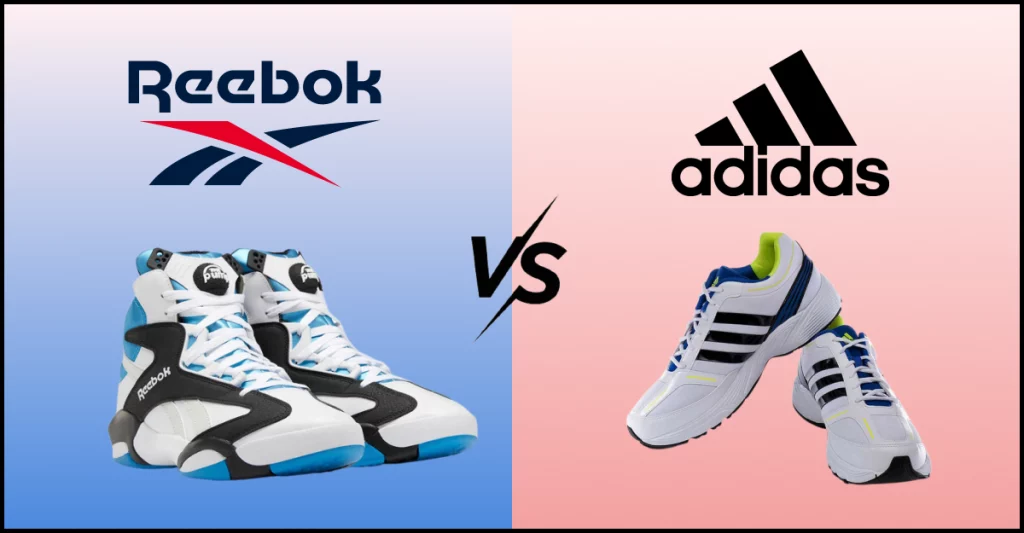
When you’re standing in the store (or scrolling online) trying to choose between two of the biggest names in sportswear, it’s easy to get stuck. Reebok vs Adidas is more than just a product comparison—it’s a decision between two different legacies, two identities, and two visions of performance.
Sounds hyped?
Well, there’s a long story behind this! Go through this article and you’ll find out!
Profile Comparison: Reebok vs Adidas
Adidas is the older sibling here, founded way back in 1924 in Germany, officially becoming Adidas in 1949. It has deep roots in performance sports and is now a global fashion icon. You’ve seen it on football fields, running tracks, fashion runways, and even music videos.
Reebok, though younger—founded in 1958 in the UK—has a legacy of its own. Once under Adidas’s ownership, Reebok now operates independently under Authentic Brands Group. Its home base is Boston, and while it may not be as massive as Adidas, it holds a strong identity in the fitness world—especially in functional training, gyms, and CrossFit.
Let’s briefly go through the profile of Reebok vs Adidas-
| Particulars | Reebok | Adidas |
| Operating Industry | Textile, Sports Equipment | Textile, Footwear |
| Founded | 1958 | 1924 as Gebrüder Dassler Schuhfabrik; 1949 as Adidas |
| Founders | Jeff and Joe Foster | Adolf Dassler |
| Headquarters | Boston, Massachusetts (since 2016) | Herzogenaurach, Bavaria, Germany |
| Number of Locations | Approx. 400 (freestanding stores globally) | Approx. (1,933 retail stores globally) |
| Area Served | Worldwide | Worldwide |
| Key People | Todd Krinsky (CEO) | Thomas Rabe (Chairman); Bjørn Gulden (CEO) |
| Products | Sportswear, footwear | Apparel, footwear, sportswear, sports equipment, toiletries |
| Launched in India | 2006 | 1995 |
| Parent Company | Adidas (2005-2021); Authentic Brands Group (2021- Present) | Adidas AG |
| Competitors | Nike, Adidas, Puma, Under Armour, New Balance, Asics, Fila, etc. | Nike, Puma, Under Armous, Reebok, Asics, Skechers, Converse, Fila, Lululemon, Columbia Sportswear, etc. |
While Adidas runs over 1,900 retail stores worldwide, Reebok holds around 400. But don’t let those numbers fool you. In the Reebok vs Adidas story, Reebok doesn’t try to be everything. Instead, it sticks to what it does best—supporting people like you who train hard and want gear that can keep up.
Both brands serve a global market, and both are available across India, with Adidas entering first in 1995 and Reebok arriving in 2006. Whether you’re looking at products, people, or reach, this comparison is already shaping up to be a true face-off.
Note: Do you know how Adidas became famous? We have uncovered it here- Adidas Marketing Strategy.
Reebok vs Adidas: Features Comparison
Let’s be real: what really matters when you’re spending your hard-earned money on footwear or sportswear? It’s the features. Comfort. Fit. Durability. Design. And here, Reebok vs Adidas gets interesting.
| Aspect | Reebok | Adidas |
| Target Audience | Fitness enthusiasts, training, casual wear; traditionally strong in gyms, CrossFit, and functional fitness | Wide spectrum: running, performance sports, casual/lifestyle, streetwear, football, basketball, and more |
| Key Technologies | Pump Technology (customizable fit), Floatride Energy Foam, DMX cushioning, Nano (cross-trainer) platform | Boost (energy return), Lightstrike Pro, Dreamstrike+, EnergyRod carbon rods, Primeknit upper, Terrex (trail tech), Adizero racers |
| Comfort | Prioritizes ankle support, cushioned rides, adequate breathability, and protection, especially in training shoes | Known for plush step-in comfort (UltraBoost), stretchy/upgraded uppers, soft and responsive (Boost/Lightstrike Pro) foams |
| Performance Running | Reebok Floatride (distance, daily) and Nano X1 (cross-training, versatile) | Adizero Adios Pro 4: elite racer; Evo SL: light, versatile super-trainer; Supernova Rise/Prima: plush daily, Terrex: advanced trail tech |
| Weight (Flagship) | Nano X1: ~272g (Men’s US 9); Floatride Energy 5: ~235g | Adizero Evo SL: 224g; Adios Pro 4: 201g (Men’s US 9) |
| Cushioning Feel | Responsive yet stable, supportive for physical training; mildly less plush than top rivals | Very plush (UltraBoost), responsive spring (Lightstrike Pro); Evo SL/Adios Pro 4 provide energetic ride |
| Stability & Support | Pump and Nano lines focus on lockdown fit and lateral stability for dynamic workouts | Neutral shoes well-cushioned but sometimes less stable (Evo SL). Supernova/Adizero lines and trails offer both neutral and stability options |
| Beathability | Sufficient for most trainers; tech mesh/synthetic combos, but not always as airy as some rivals | Upper ventilation is a major focus (Pegasus-like mesh, Primeknit, mesh overlays) |
| Durability | Reebok Nanos and Floatrides rated for above-average durability in cross-training and all-round use | UltraBoost and Adizero lines are durable in uppers/soles; Adios Pro Evo shows more wear in aggressive, elite-use scenarios |
| Style & Design | Classic training, retro ‘90s, performance-inspired, bold logos | Modern sporty, sleek (Adizero), streetwear icons, collaborations (Yeezy, Pharrell), vibrant trend-focused colorways |
| Trail Running | Not a core focus; some all-terrain and retro trail-style options | Terrex series: high-performance trail shoes with substantial cushioning, technical outsoles, and protective uppers |
| Price Range (India) | Moderate: ₹3,000–₹10,000 for trainers and running shoes | Mid-premium: ₹5,000–₹25,000; Adizero/UltraBoost/Adios Pro 4 command higher end |
| Fit | True-to-size, adaptive fit (Pump series), accommodates wider feet in some models | Generally true-to-size; some high-performance shoes run narrow (Adios Pro 4 toe box) |
| Sustainability | Growing focus on recycled materials, especially since ABFRL acquisition in India | Strong push: Primegreen/Primeblue recycled uppers, sustainability partnerships, eco-packaging |
| Heritage/Brand Appeal | Legacy in sports and fitness, especially ‘80s-‘90s and as a training-first brand | Global sportswear powerhouse, strong current momentum in running, football, fashion, and global collaborations |
| Most Recommended 2025 | Nano X1 (cross-training, gym), Floatride Energy 5 (running), Breeze Glide (budget running) | Adizero Adios Pro 4 (marathon racing), Evo SL (super-trainer), Supernova Rise 2 (daily), UltraBoost 5 (lifestyle/running) |
| Customer Feedback | Praised for value, versatility, fit, and training support; less “plush” than rivals in some categories | Praised for energy return, step-in comfort, upper quality; occasional feedback on high price and narrow fit for racers |
Reebok’s strength is in focus. It speaks to fitness lovers like you—people who lift, sprint, jump, and grind it out in the gym. Its Nano line is famous in the CrossFit world, while Floatride Energy shoes cater to runners who want value without compromising performance.
Adidas, on the other hand, goes big. It doesn’t stop at running or gym shoes—it covers everything from lifestyle sneakers to elite racing shoes. Whether you need the bouncy, luxurious feel of Boost foam or want the cutting-edge speed of Adizero racers, Adidas is ready.
In short, in Reebok vs Adidas, you’re choosing between focused performance and broad innovation. And that decision depends on what you want your shoes to do for you.
Business Comparison: Reebok vs Adidas
Behind the products you wear lies a massive business machine. And in this part of the Reebok vs Adidas face-off, the numbers speak loud and clear.
| Business Aspect | Reebok | Adidas |
| Market Capitalization | $20 billion | $43.31 billion |
| Market Share (India) | 47% (in India);1.1% (Global) | 19% (Global) |
| Revenue Earned (2024) | $713 million | €23.68 billion (≈ $25.82 billion) |
| Expenses (2024) | N/A | €22.25 billion ($24.183 billion) |
| Profits (2024) | $163.5 million | €1.34 billion ($1.46 billion) |
| Employee Benefits | Health Insurance, Retirement Plans, Time Off, Employee discounts of products. | Life Insurance, On-site clinic, On-site mother’s room, Sabbaticals, Gym on site with discounted rate of $300; On-site fitness classes, ESPP, Free food; 44% discount on Adidas products. |
| Cash Flow (2024) | N/A | €2,750 million/ $3.20 billion (Positive Cash Flow) |
Adidas is the heavyweight. In 2024, it earned nearly $25.82 billion in revenue. Its global market share is a strong 19%, and it’s still growing. Reebok, in comparison, made $713 million, and its global share sits at just 1.1%. On paper, that’s not even close.
But here’s a twist: in India, Reebok actually owns a whopping 47% of the market share. That shows how deeply the brand connects with the Indian audience. Its pricing, product focus, and distribution hit the sweet spot for Indian customers like you.
Adidas, however, still dominates worldwide in profits and cash flow—reporting $1.46 billion in profits and a very healthy $3.2 billion in positive cash flow last year.
So yes, if you want to back the bigger player in Reebok vs Adidas, Adidas has the clear edge in global business performance. But Reebok is strong in the regions and spaces it chooses to play in. It’s a case of quality over quantity.
Final Words: Who is the Winner?
Okay, you’ve seen the stats, the features, the money talk. But who really wins the Reebok vs Adidas battle?
Here’s the truth: you win, if you choose based on what matters most to you.
If your world revolves around the gym, functional training, or high-intensity workouts,
Choose Reebok if-
- You prioritize performance training and gym workouts.
- You want durability & support.
- You love retro style and solid value.
Choose Adidas if-
- You want versatility—performance, streetwear, and everything in between.
- You crave comfort, tech, and style in one package.
- You’re willing to invest a bit more for the latest innovation.
So, next time you’re deciding between Reebok vs Adidas, don’t just ask which brand is bigger. Ask which brand is right for you.
Choose the one who fits your story!
