
If you’ve ever downloaded a stock trading app and paused for a second thinking, “Is this actually safe?”, you’re not alone.
That hesitation is real. And honestly, it’s justified.
Because while India’s investing culture is booming, there’s another side growing just as fast. Fake trading apps that look real, act real, and then quietly wipe out your money.
Now, something significant has happened.
SEBI partners with Google to introduce verified badges on the Play Store. It may sound like a small update, but it could fundamentally change how millions of Indians invest online.
Let’s break this down properly, because this is bigger than it looks.
Stay tuned!
The Problem No One Talks About Enough
India has over 140 million investors in the securities market today. That number has exploded in the last few years.
More people are investing through apps than ever before. For many, the entire investing journey begins and ends on a smartphone.
But here’s the problem.
Most first-time investors cannot tell the difference between:
- A genuine broker app
- A cloned or fake app
And fraudsters know this.
They create apps that:-
- Copy the interface of real platforms
- Use similar logos and names
- Promise guaranteed returns to lure users
At first, everything looks normal. The app shows profits, balances increase, and confidence builds.
Then suddenly:
- Withdrawals fail
- Accounts get blocked
- Support disappears
And the money is gone.
This is not rare. It is happening at scale.
The Enforcement Directorate has flagged ₹35,925.6 crore in proceeds from cyber fraud cases. That number alone tells you how serious the issue has become.
SEBI Partners with Google: What Has Changed?
To tackle this growing threat, the Securities and Exchange Board of India partners with Google to introduce a system that helps users instantly identify genuine apps.
This initiative is called the Verified App Label Initiative.
Here’s what it does in simple terms:
- Apps from SEBI-registered brokers get a “Verified” badge on the Google Play Store
- Users can visually confirm authenticity before downloading
- Fake or impersonating apps become easier to spot
Think of it like a trust signal built directly into the app store.
You no longer need to depend only on reviews or guesswork.
Why This Move Feels Different?
Let’s be honest. Regulators have issued warnings before.
“Don’t trust unknown apps.”
“Verify before investing.”
But those messages rely on user awareness.
This time, the system itself is changing.
Instead of expecting users to be experts, the platform is doing the verification for them.
That’s the key difference.
As SEBI Chairman Tuhin Kanta Pandey said during the launch, this is not just about labeling apps. It is about building trust and safety into the ecosystem.
And that matters, especially for first-time investors.
How the Verified Badge Actually Works?
The process behind this system is quite structured.
- SEBI identifies all registered stock brokers
- This data is shared with Google
- Google verifies these apps on the Play Store
- A visible “Verified” badge is added to approved apps
Currently, over 600 apps have already been verified.
This is just the starting point.
The plan is to expand this system to:
- Depositories
- Mutual fund platforms
- Other SEBI-regulated intermediaries
Over time, almost every legitimate financial app could carry this badge.
| Aspect | Details |
| Initiative Name | Verified App Label Initiative |
| Partners | SEBI and Google (Google Play Store) |
| Current Coverage | Apps of SEBI-registered stock brokers; 600+ apps already verified |
| Future Expansion | Other SEBI-regulated intermediaries (e.g., depositories, mutual funds) |
| Content Takedowns | 1.3 lakh+ pages of misleading content across platforms; 66 fake apps removed |
| Investor Base | 140 million+ unique investors in India’s securities market |
| Cyber Fraud Scale | ED identified ₹35,925.6 crore in proceeds from 257 cases |
| Other SEBI Tools | Sebi Check platform; @valid UPI handles for verified payments |
| Ad Framework | API-based: Only verified intermediaries can advertise on Google/Meta |
| Launch Date | March 25, 2026 |
These numbers show how large both the opportunity and the risk are.
Real Scams That Triggered This Action
It is easy to think these scams happen to “other people”.
But the reality is very different.
- A senior citizen in Delhi lost ₹22.67 lakh through a deepfake-based investment scam
- A property dealer in Faridabad lost ₹17 crore
- A distributor in Maharashtra lost ₹6.7 crore
In all these cases, the apps looked legitimate.
That is what makes them dangerous.
They don’t look like scams. They look like opportunities.
And by the time users realise the truth, it is too late.
Beyond Badges: The Bigger Crackdown
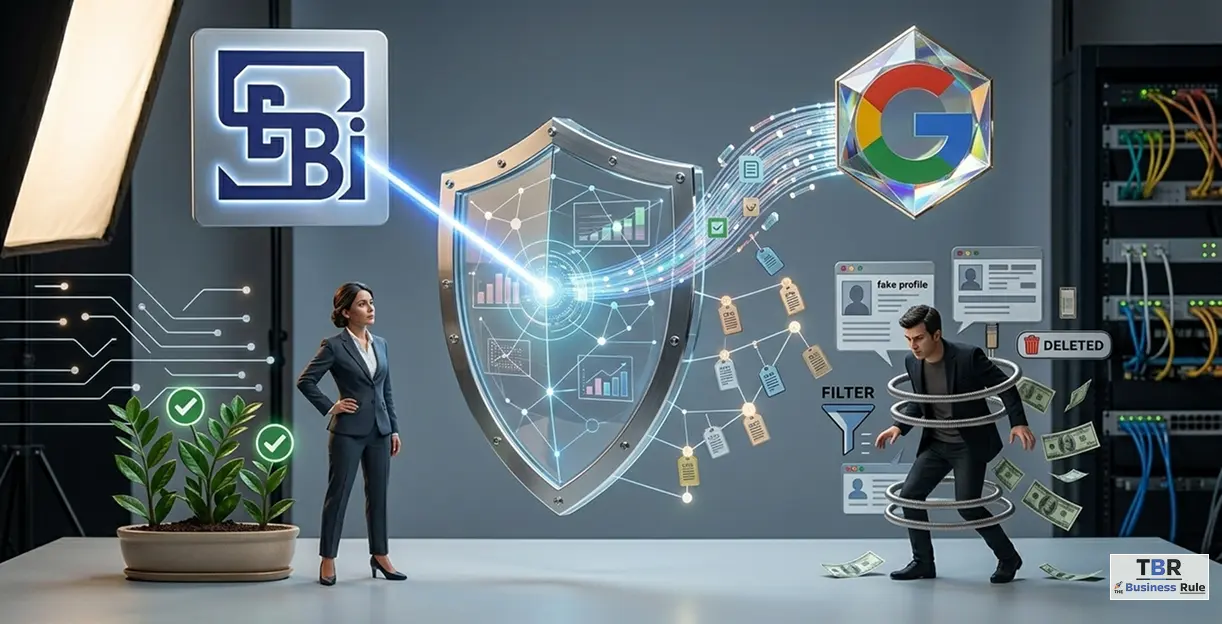
The fact that SEBI partners with Google is only one part of a larger strategy.
The regulator is building multiple layers of protection.
1. AI Monitoring of Finfluencers
SEBI has asked Google to strengthen AI systems that can:
- Track influencers giving unauthorised financial advice
- Identify misleading investment content
- Flag suspicious patterns across platforms
This is important because many scams today start on social media, not app stores.
2. Advertising Restrictions
A new API-based framework ensures:
- Only verified financial entities can run ads on platforms like Google and Meta
- Fraudulent apps cannot easily promote themselves
This directly reduces visibility for scam platforms.
3. Massive Content Cleanup
SEBI has already taken strong action:
- Over 1 lakh misleading links flagged
- 66 fake apps removed
- 1.3 lakh+ pages of harmful content taken down
This shows a shift from reactive to proactive enforcement.
Existing Safety Tools You Should Know
Even before this partnership, SEBI had introduced tools to protect investors.
Sebi Check
Allows users to verify UPI handles linked to registered intermediaries.
@Valid UPI System
Ensures payments go only to authorised entities.
Now, with the verified badge system, these tools become part of a stronger ecosystem.
What This Means for First-Time Investors?
If you are new to investing, this changes your experience completely.
Earlier, you had to rely on:
- Reviews
- Word of mouth
- Trial and error
Now, you have a clear signal built into the platform itself.
The new approach becomes simple:
- Open Play Store
- Search for the app
- Check for the verified badge
- Download only if it is present
This removes a lot of confusion.
And more importantly, it reduces risk.
Why Trust Is Everything in Markets?
Financial markets don’t just run on money. They run on trust.
If people believe:
- Platforms are unsafe
- Apps can be fake
- Money is at risk
They stop participating.
That affects:
- Market growth
- Liquidity
- Overall economic momentum
This is why initiatives like this matter.
When SEBI partners with Google, it is not just solving a tech problem. It is protecting the foundation of market growth.
The Bigger Picture: Where This Could Lead?
This partnership could have long-term implications.
1. Safer App Ecosystems
App stores could become far more secure for financial services.
2. Global Benchmark
India could set an example for how regulators and tech platforms collaborate.
3. Smarter Fraud Detection
AI-driven monitoring could catch scams before they spread.
4. Stronger Policy Integration
Future collaborations with government bodies like MeitY and DoT could tighten cyber security further.
Final Thoughts
At first glance, “SEBI partners with Google” sounds like just another announcement.
But if you look closely, it changes something fundamental.
It shifts responsibility from the user to the system.
You no longer have to be an expert to stay safe.
A simple visual check can protect you from a costly mistake.
In a world where investing starts with a download button, that one small badge can make a huge difference.
So next time you install a trading app, don’t rush.
Pause.
Check the badge.
Because in today’s digital market, safety begins before you even log in.
Thanks for sticking to the end!
We have also covered- Top 7 Fintech Startups of Europe in 2026: Why Are They Successful? Go through this article to have insights on finance ecosystem in Europe. Feel free to share your thoughts in the comments section 🙂
