

Ethanol fuel has long been framed as a practical bridge between fossil fuels and cleaner energy systems. It is not an abstract laboratory concept. It is alcohol distilled from crops such as corn and sugar, blended into petrol, and poured into ordinary fuel tanks across the country. In chemical terms, ethanol is straightforward.

Its boiling point of ethanol is lower than that of water, and it burns cleaner than conventional petrol. In policy terms, however, it has become far more layered.
What is ethanol fuel used for in India? Primarily for blending with petrol to reduce crude oil imports, support farmers, and cut tailpipe emissions. Bio ethanol fuel, or bioethanol, is produced from agricultural feedstock rather than fossil sources. Governments across the world have promoted it as a form of renewable energy that connects rural incomes with national energy security. The ambition makes sense.
But ambition alone does not guarantee balance. In India today, ethanol fuel production capacity has expanded faster than actual demand. The result is not a collapse, but a pause.
A moment where the roadmap looks slightly out of sync with ground realities…
Ethanol Capacity Outpaces Demand
India’s ethanol infrastructure has expanded at remarkable speed. Driven by a target of 20 percent blending with petrol, known as E20, distilleries multiplied, investments flowed in, and capacity rose to nearly 20 billion litres. Another 4 billion litres is expected to come online soon.
Against that backdrop, annual demand for the current ethanol year stands at roughly 11 billion litres. The imbalance is difficult to ignore. Installed capacity now significantly exceeds practical requirement, leaving a substantial portion underutilized. Utilization rates of 25 to 30 percent reflect that gap clearly.
| Metric | Current Value (Billion Litres) | E20 Requirement | Excess Capacity |
| Installed Capacity | 20 | 11 | 9 (82%) |
| Upcoming Additions | 4 | – | – |
| Utilization Rate | 25-30% | 100% | – |
None of this happened by accident. Policy signals were strong. Farmers were encouraged to divert more corn and sugar output toward ethanol production. Mills invested in new distillation lines. Financial institutions backed expansion on the assumption that blending mandates would steadily rise.
Now, approvals for new plants are on hold. When supply grows faster than procurement, momentum naturally slows. The original goals remain intact on paper: lower crude oil imports, reduced emissions, and stable incomes for rural producers.
The question is whether demand can catch up in time to justify the scale of expansion.
Ripple Effects Across the Value Chain
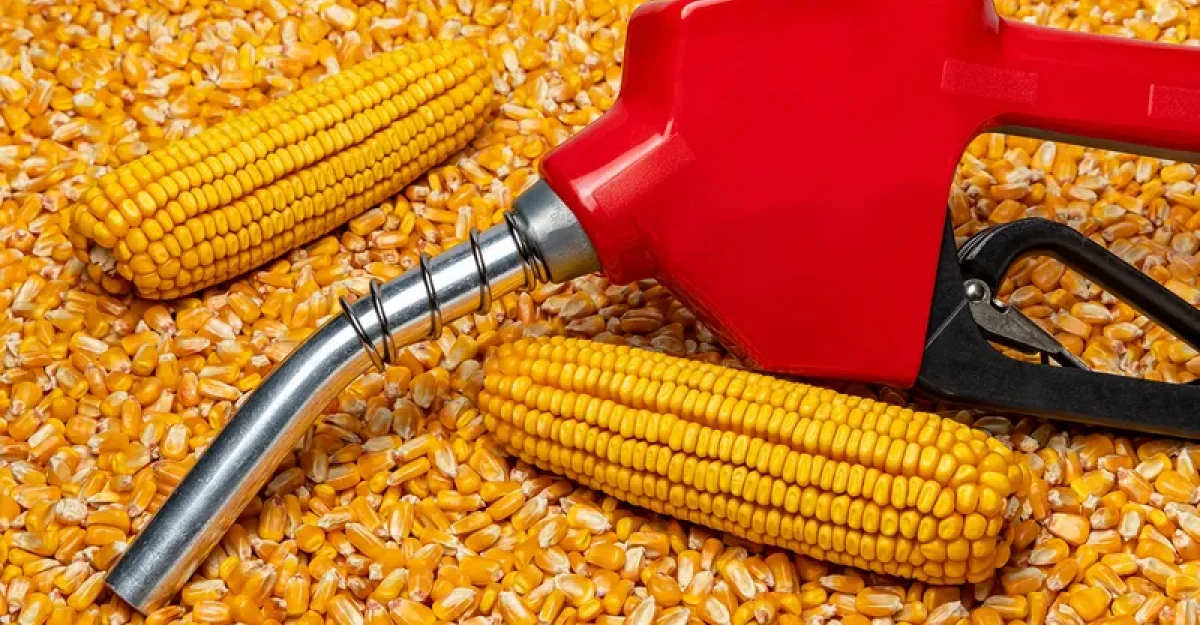
When ethanol fuel supply moves ahead of demand, the impact spreads quickly.
Sugar mills and distilleries that expanded over the past few years are now in an uncomfortable position. Many built new capacity assuming blending would steadily climb and procurement would follow.
Instead, a sizable share of that infrastructure is running well below potential. Storage tanks are fuller than expected. Payment cycles are stretching. Nearly 100 distilleries were commissioned in 2024 to 2025 alone, each counting on gradual absorption of output. That confidence has softened.
| Stakeholder Group | Key Impacts |
| Sugar Mills & Distilleries | 25-30% utilization; rising inventories; paused expansions |
| Farmers | Lost stable revenue stream; dependency risks |
| Investors | Questioned ROI amid uncertainty |
| OMCs | Slow procurement straining relations |
Farmers are watching closely. Ethanol fuel was meant to smooth the volatility of sugar cycles. For many growers, especially those dependent on sugarcane, bio ethanol fuel offered a predictable outlet. When procurement slows, that stability feels less certain.
Investors have also shifted tone. Renewable energy ventures depend on steady utilization. When plants operate at roughly 30 percent of capacity, financial projections drawn up during expansion look optimistic in hindsight. Conversations are no longer just about growth, but about sustainability and timing.
Consumers, meanwhile, approach the issue from a practical standpoint. Ethanol contains less energy per litre than petrol. At E20 levels, mileage can dip slightly. For daily commuters and transport operators, even small differences matter.
Some motorists question pricing when blended fuel does not appear cheaper. The oil ministry maintains that ethanol procurement costs remain high. The debate reflects a familiar tension between environmental goals and everyday economics.
Charting the Path Forward: Diesel Blending Challenges

If petrol blending is nearing its practical ceiling for now, attention shifts to diesel. Diesel powers freight, agriculture, and public transport. Even modest blending here could significantly increase ethanol fuel demand.
Yet the chemistry presents complications. Petrol and ethanol mix relatively easily. Diesel and ethanol do not. Left on their own, they tend to separate, creating storage and engine concerns. Oil companies such as Indian Oil Corporation and Bharat Petroleum Corporation are testing additive-based solutions to maintain stability. But real-world performance still needs validation, especially around cold starts, long-term durability, and maintenance cycles.
| Blending Type | Petrol (E20) Status | Diesel Prospects | Technical Hurdles |
| Feasibility | Achieved; plateauing | Under testing | Coupler chemicals needed; layer separation |
| Market Size | Smaller share | Freight/agri dominant | Stability, cold-start, durability |
| Progress | Policy-driven | IOCL/BPCL pilots | Engine compatibility studies ongoing |
Other countries provide useful context. Brazil, for example, has decades of experience with very high blends and even 100% ethanol fuel in compatible vehicles. But that system evolved gradually, with engine design, fuel infrastructure, and consumer habits adapting together.
Replicating that model requires alignment across the value chain. Even the best bio ethanol fuel cannot compensate for engines not built to handle high alcohol content.
The diesel pathway could unlock substantial demand. It could also introduce new complications if accelerated without careful testing.
Flex-Fuel Vehicles: Promise vs. Policy Vacuum
Flex-fuel vehicles are often presented as the next logical step. These vehicles are engineered to operate on a wide range of blends, from standard petrol to E85 and in some cases nearly 100% ethanol fuel.
From a technical perspective, automakers suggest adaptation is manageable. The hesitation lies in policy clarity. Without firm timelines, incentives, or infrastructure commitments, large-scale rollout remains uncertain.
| Automaker | FFV Status | Potential Models |
| Maruti Suzuki | Prototypes; rollout likely | Wagon R, Fronx |
| Tata Motors | Prototypes showcased | – |
| Toyota Kirloskar | Prototypes | – |
| Mahindra & Mahindra | Prototypes | – |
Flex-fuel vehicles could give consumers flexibility in how to use ethanol as fuel. Drivers might choose blends based on availability or price. Yet infrastructure remains uneven. Higher-blend pumps are limited, and many motorists still struggle to locate them consistently.
Note: You can visit our article on “Flex Fuel” for more details.
At the same time, some vehicle owners search for where to buy non ethanol fuel near me, particularly for older engines. What is non ethanol fuel in this context? Simply petrol without ethanol blending. The coexistence of these preferences highlights a transitional phase rather than a settled market.
Policy Pivots and Industry Recommendations
Industry bodies have called for raising blending targets beyond E20, mandating flex-fuel vehicles, and offering fiscal incentives similar to those granted to electric vehicles. Oil marketing companies advocate for faster diesel pilot programs. The objective is clear: create demand that matches installed ethanol fuel capacity.
| Recommendation | Proponent | Expected Impact |
| Raise blending beyond E20 | AIDA | Absorb excess capacity |
| Mandate FFVs | Automakers | Expand high-blend use |
| GST cuts on FFVs | Industry | Boost adoption |
| Fast-track diesel pilots | OMCs | Unlock larger market |
Farmers who redirected acreage toward sugar and corn for ethanol are watching procurement trends carefully. Distilleries that borrowed to expand seek clearer long-term visibility. Investors are not abandoning renewable energy, but they are asking for steadier alignment between supply and demand.
Balancing Green Ambitions with Economic Realities
Ethanol fuel remains central to India’s broader renewable energy strategy. It supports rural incomes, reduces import dependence, and contributes to lower emissions. On a chemical level, what is ethanol is simple. On a policy level, it represents a balancing act between agriculture, transport, and energy security.
The current surplus does not invalidate the long-term case. It does, however, underline the importance of pacing. Supply expansion, vehicle readiness, infrastructure, and consumer acceptance must move together.
India’s ethanol story is still unfolding. If production and demand realign thoughtfully, ethanol fuel can remain a meaningful part of the energy mix. If not, this phase may serve as a reminder that even well-intended green transitions work best when ambition and market reality evolve side by side.
