
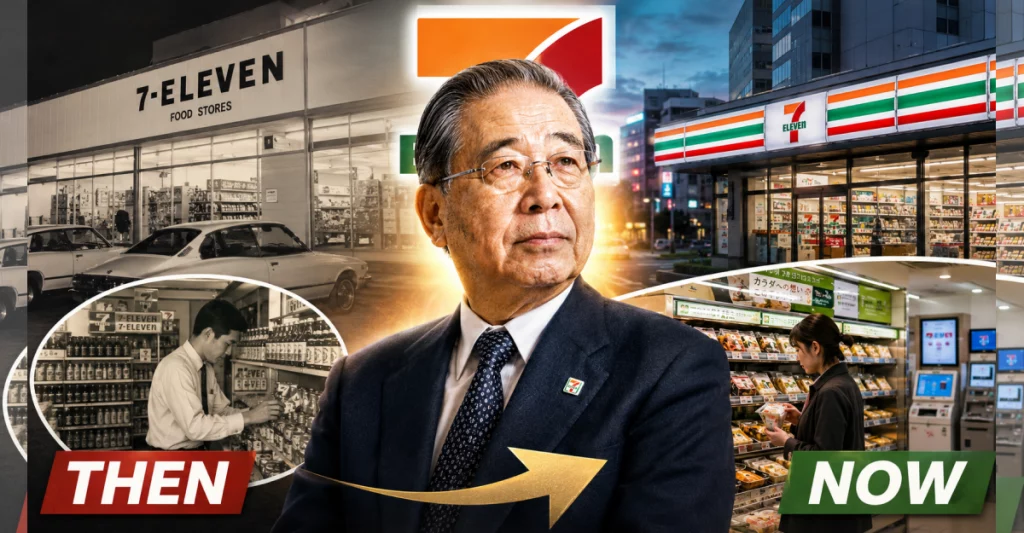
Most people walk into a convenience store without thinking about it.
You grab a drink. Maybe a sandwich. Maybe tissues because you forgot to buy them earlier. Two minutes later, you’re gone.
But in Japan, convenience stores feel strangely different.
The food tastes fresher. The shelves somehow seem smarter. The products change constantly. Even the lighting, the packaging, and the store layout feel carefully designed for tired commuters rushing home at 11 PM.
And that raises an interesting question.
How did Japan become better at convenience stores than the country that invented them?
That story begins in America. But the real transformation happened thousands of miles away, under a businessman named Toshifumi Suzuki.
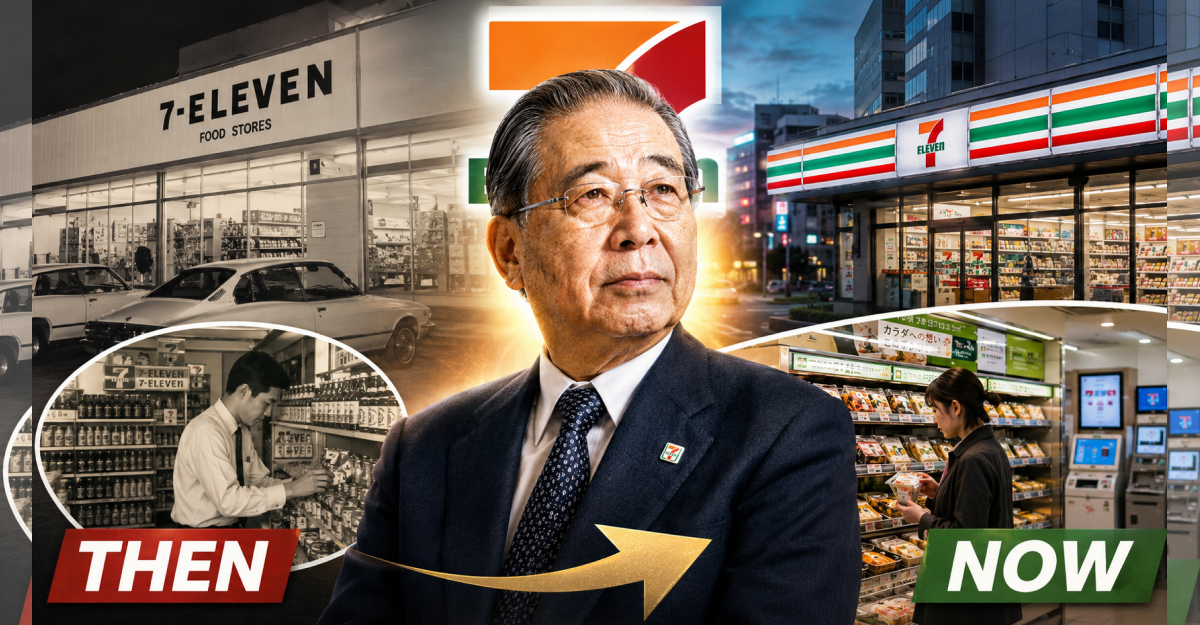
His version of the 7 Eleven Japan retail strategy didn’t just improve stores. It quietly changed how modern retail thinks about customers, data, inventory, and even human behavior.
Ironically, it also led to a bizarre moment in business history where the Japanese company eventually rescued the struggling American parent that created 7-Eleven in the first place.
And honestly, that twist says everything.
7-Eleven: The Convenience Store Was Never Supposed To Become This Big
Long before Japan perfected the convenience store industry, 7-Eleven started as something far less glamorous.
An ice business.
Back in 1927, a man named John Jefferson Green worked at Southland Ice Company in Dallas, Texas. Refrigerators were still uncommon in homes, so people regularly visited ice docks to buy giant blocks of ice.
Green noticed something simple.
If customers were already coming there anyway, why not also sell milk, bread, and eggs?
That tiny observation changed retail history.
Over time, the stores became known for staying open longer than traditional shops. By 1946, many locations operated from 7 AM to 11 PM.
That’s where the name came from.
For decades, America dominated the convenience store idea. The model spread rapidly because it matched post-war suburban life perfectly. Cars increased. Cities expanded outward. People wanted quick purchases without walking through giant department stores.
Then Japan entered the story.
In 1974, Japanese retailer Ito-Yokado opened the country’s first 7-Eleven franchise through a licensing deal with Southland Corporation.
At the center of that expansion was Toshifumi Suzuki.
At the time, few people realized Japan wasn’t just importing an American retail concept.
It was about to reinvent it entirely…
Why America Lost The Business It Invented?
This is where the story becomes fascinating. By the 1980s, the American parent company behind 7-Eleven had started drifting in too many directions.
Southland Corporation expanded into unrelated businesses, including oil, dairy operations, and video rentals. The company became larger, but also slower and less focused.
Meanwhile, Japan was moving in the opposite direction.
Instead of treating convenience stores as small grocery outlets, Suzuki treated them almost like living laboratories of customer psychology.
That difference changed everything.
While American stores often focused on scale, Japan focused on precision.
While others tried to sell more products, Suzuki became obsessed with selling the right products.
And that obsession became the foundation of the 7 Eleven Japan retail strategy.
By 1990, Southland Corporation filed for bankruptcy.
A year later came one of the most ironic moments in retail history:
Japanese retailer Ito-Yokado acquired 70% of Southland for roughly $430 million.
The student had effectively taken over the teacher.
Toshifumi Suzuki Saw A Problem Others Missed
To understand why Suzuki succeeded, you first need to understand what changed in Japan after the 1960s.
Earlier generations lived in what economists call a “seller’s market.”
People bought what was available.
Any rice.
Any beer.
Any soap.
But rising incomes changed consumer behavior.
Suddenly, customers became selective.
A shopper no longer wanted just coffee. They wanted a specific coffee. If the store didn’t have it, they simply walked elsewhere.
This sounds obvious today.
Back then, it was revolutionary.
Most retailers were still using old inventory systems built around past sales data. If something sold well last month, stores ordered more of it.
But Suzuki believed that approach was already outdated.
Because shelves were no longer reflecting the future.
They were reflecting the past.
And that’s when the real insight emerged.
The Shelf Was Actually Predicting The Future
Suzuki introduced a retail philosophy called Tanpinkanri, which roughly translates to “control of every single item.”
It sounds technical.
But the idea was surprisingly human.
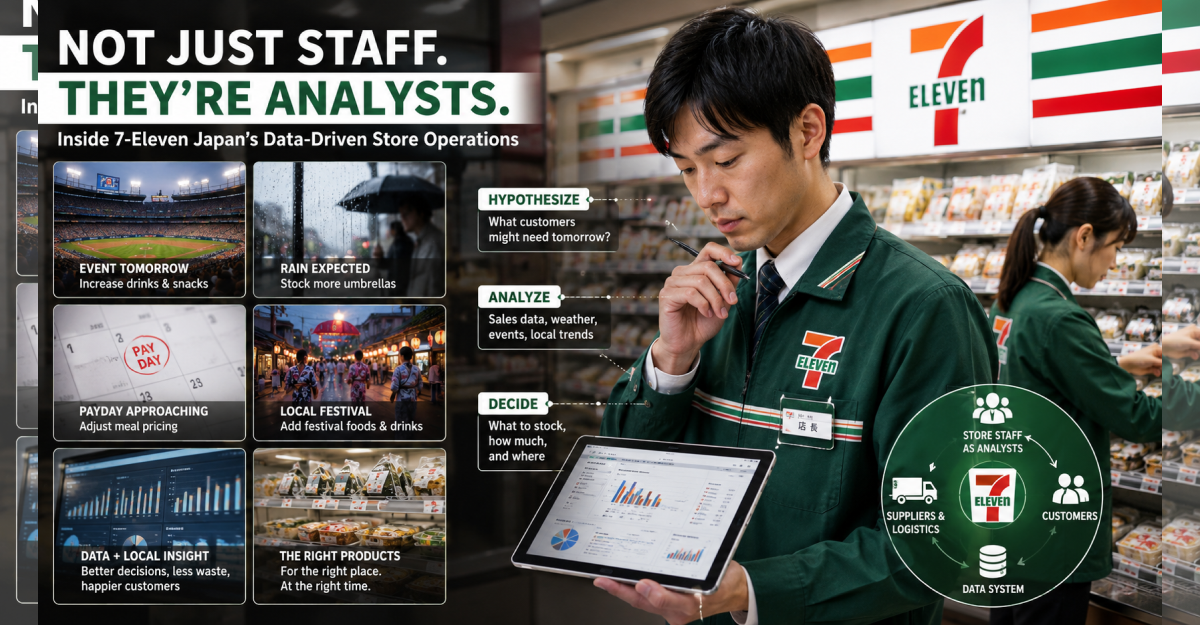
Instead of blindly restocking products based on historical sales reports, store employees were encouraged to think like local analysts.
Their job was to observe life happening around them.
That meant asking questions constantly:-
- What are people likely to need tomorrow?
- What changed in this neighborhood today?
- What products suddenly became irrelevant?
- What mood are customers in this week?
This became one of the defining features of the 7 Eleven Japan retail strategy.
Here’s what that looked like in practice.
| Situation | What A Typical Store Might Do? | What did 7-Eleven Japan do? |
| Stadium event nearby | Keep normal inventory | Increase energy drinks, snacks, and quick meals |
| Rain expected later | No major changes | Stock umbrellas near entrance |
| Payday approaching | Maintain prices | Adjust meal pricing strategically |
| Summer festival weekend | Generic ordering | Add festival snacks and cold beverages |
| Office-heavy neighborhood | Same products all day | Shift inventory for lunch and evening commuters |
The system depended heavily on human observation.
A store manager near a train station understood commuters differently from someone operating near a university campus.
That local intelligence mattered more than generic national trends.
And Suzuki trusted frontline workers to make those calls.
That part is important.
Many companies say employees matter. Suzuki actually designed systems that treated them like decision-makers.
In most retail chains, workers simply fill shelves.
In 7-Eleven Japan, workers studied behavior.
Why Suzuki Became Ruthless About Removing Products?
Most retailers get emotionally attached to products that still sell “reasonably well.”
Suzuki hated that mindset.
He believed average products quietly damage stores.
Because every slow-moving item occupies shelf space that could be used for something customers actually want right now.
Inside many traditional stores, shelves become museums of outdated demand.
Suzuki refused to let that happen.
This is why the 7 Eleven Japan retail strategy became famous for rapid product turnover.
By the early 2000s, nearly 70% of products inside 7-Eleven Japan stores were replaced every year.
That number sounds insane until you understand the logic behind it.
Japanese convenience stores operate in tiny spaces. Every inch matters.
If one rice ball stops exciting customers, another replaces it quickly.
If a dessert trend emerges on social media, stores react fast.
If customers suddenly prefer lighter meals during humid weather, menus shift accordingly.
The shelves stay alive.
And customers notice that energy subconsciously.
A stale store signals that nobody is paying attention anymore.
Suzuki understood this at a psychological level long before “customer experience” became corporate buzzword language.
The Logistics System Was Quietly Brilliant
Of course, none of this would work without logistics.
And this is where 7-Eleven Japan became extraordinarily sophisticated.
Traditional retail distribution often creates chaos.
Different suppliers send separate trucks. Deliveries arrive constantly. Inventory piles up in back rooms. Staff waste time sorting products.
Suzuki streamlined the entire process.
Instead of multiple suppliers flooding stores independently, products from different vendors were consolidated into fewer deliveries.
That sounds small.
It wasn’t.
It allowed stores to order smaller quantities more frequently without dramatically increasing costs.
Fresh food became easier to manage.
Waste decreased.
Shelves adapted faster.
This mattered especially in Japan, where customers expect freshness almost obsessively.
A sandwich sitting too long simply wouldn’t survive.
The system also helped Japanese convenience stores become deeply integrated into daily urban life.
Today, many konbini function almost like neighborhood infrastructure.
People use them to:
- Pay utility bills
- Withdraw cash
- Send parcels
- Print documents
- Buy concert tickets
- Collect online shopping orders
- Grab late-night meals
That evolution didn’t happen accidentally.
It emerged from years of obsessively studying customer behavior at a microscopic level.
Note: Did you know, the SmartNews app also belongs to Japan? We have covered the SmartNews Case Study in detail. Go through the information, and you’ll find out its effective strategies.
Why Suzuki Rejected Endless Consensus?
Japanese corporate culture traditionally values harmony and consensus.
There’s even a well-known practice called nemawashi, where executives informally gather agreement from stakeholders before major decisions move forward.
Suzuki respected collaboration.
But he also believed consensus could become dangerous.
Because businesses sometimes move too slowly when everybody needs to agree first.
That belief became critical after Japan took control of the Southland in the United States.
Suzuki pushed aggressive reforms.
| Problem Inside Southland | Suzuki’s Response |
| Underperforming stores | Shut down around 1,200 locations |
| Weak product selection | Improve local relevance |
| Fragmented distribution | Build integrated logistics systems |
| Inefficient pricing | Standardize and optimize pricing |
| Poor inventory systems | Introduce Japanese-style information systems |
Many franchise owners hated the changes.
Some resisted losing freedom over suppliers and product decisions.
But Suzuki pushed ahead anyway.
By 1994, the American business returned to profitability.
And that tells you something important about leadership.
Suzuki listened carefully to data, workers, neighborhoods, and customers.
But he didn’t believe every bold decision required universal approval.
Sometimes, customers themselves don’t fully understand what they want until they experience it.
That philosophy shaped modern retail far beyond Japan.
The Real Genius Of The 7 Eleven Japan Retail Strategy
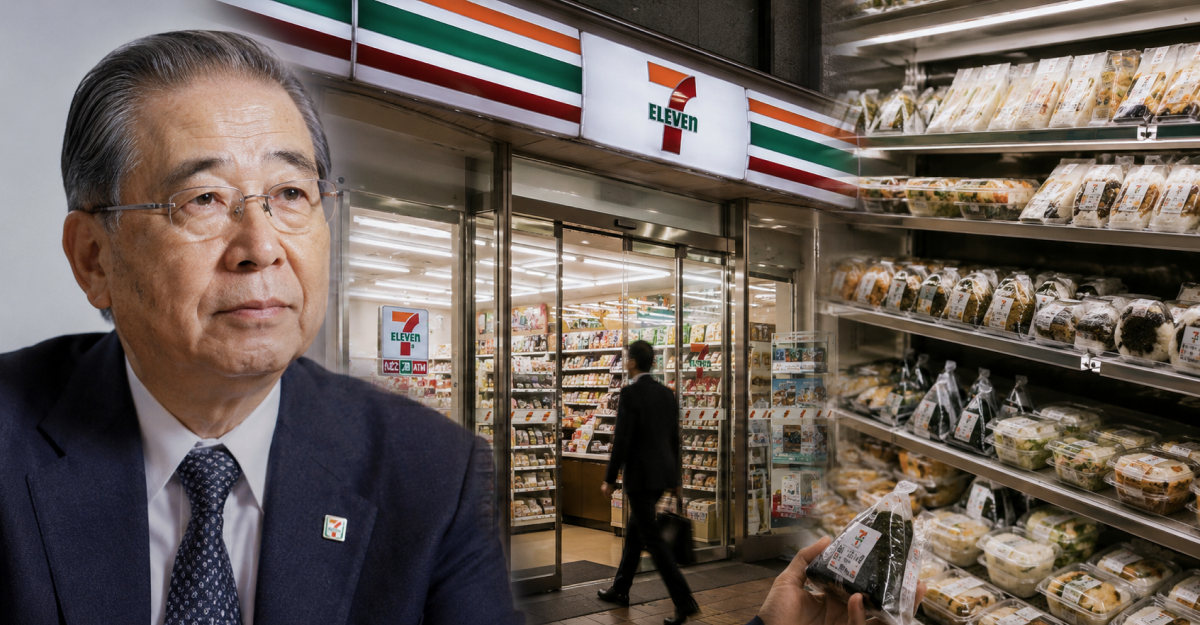
People often assume the success of 7-Eleven Japan came from technology.
That’s only partially true.
The real genius was understanding human routines.
Suzuki recognized that convenience is emotional.
A tired office worker rushing home at midnight behaves differently from a weekend tourist.
A rainy day changes purchasing behavior.
A local baseball game changes snack demand.
Seasonal humidity changes food preferences.
The stores constantly adapted to those tiny emotional shifts.
That’s why Japanese convenience stores rarely feel random.
They feel strangely synchronized with everyday life.
And that synchronization became a competitive weapon.
Today, many global retailers study the 7 Eleven Japan retail strategy because it solved a problem modern businesses still struggle with:
How do you make large systems feel personal?
Suzuki’s answer was surprisingly simple. Pay obsessive attention to small details.
Why This Story Still Matters Today?
Walk into a modern 7-Eleven Japan store today and you’ll still see Suzuki’s fingerprints everywhere.
The constantly changing shelves.
The fresh meals.
The precise inventory.
The almost eerie understanding of customer habits.
Most people see a convenience store.
Suzuki saw a daily behavioral map of society.
That’s what made his retail strategy so powerful.
And maybe that’s the bigger lesson here.
Businesses often fail when they become obsessed with expansion, scale, and efficiency while slowly losing touch with ordinary human behavior.
Suzuki went the other way.
He zoomed in closer.
Closer to neighborhoods.
Closer to routines.
Closer to weather patterns.
Closer to customer moods.
Closer to tiny signals everyone else ignored.
That attention transformed a simple American convenience store into one of Japan’s most admired retail systems.
Which is why the 7 Eleven Japan retail strategy still feels so relevant today.
Not because it was technologically futuristic.
But because it understood something timeless:
People rarely remember businesses that simply sell products. They remember businesses that seem to understand their lives.
That’s all for today! Hope you enjoyed the write-up. Feel free to share your thoughts in the comments section.
