
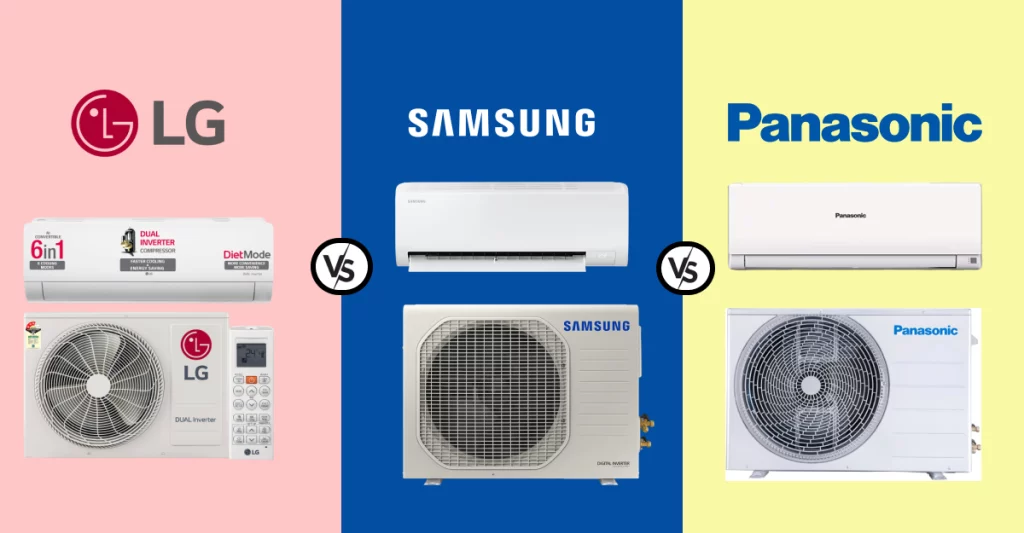
When it comes to choosing an air conditioner, you want a brand that not only cools effectively but also offers smart features, energy efficiency, and durability. Among the top contenders, LG, Samsung, and Panasonic stand out as leading brands with advanced cooling technology.

But which one truly offers the best smart cooling?
To help you decide, we’ll compare these brands LG vs Samsung vs Panasonic AC based on their profile, features, business performance, and smart cooling capabilities. By the end of this guide, you’ll have a clear idea of which brand suits your needs best.
Keep reading!
Profile Comparison: LG vs Samsung vs Panasonic
Understanding the background of each brand gives you insight into their expertise in air conditioning. Here’s how LG, Samsung, and Panasonic compare:-
| Aspect | LG | Samsung | Panasonic |
| Founded | 1958 | 1938 | 1918 |
| Headquarters | Seoul, South Korea | Suwon, South Korea | Osaka, Japan |
| Core Products | Home appliances, TVs, air conditioners, electronics | Home appliances, TVs, smartphones, electronics | TVs, home appliances, cameras, batteries |
| Market Presence | Strong global presence, especially in North America | Significant global presence, especially in Europe and Asia | Strong in Japan and parts of Europe; limited in North America |
| Brand Reputation | Known for innovation in OLED technology and reliability | Recognized for QLED technology and smart features | Respected for high-quality products but less market share |
| Employee Satisfaction | CEO rating: 47% promoters; 36% detractors | CEO rating: Not specified | CEO rating: Not specified |
| Recent Innovations | Advanced AI features in products | Wind-Free™ cooling technology in ACs | New OLED and Mini-LED TVs launched recently |
| Sustainability Initiatives | Focus on eco-friendly products and energy efficiency | Commitment to sustainability in manufacturing | Emphasis on eco-friendly technologies |
Let me summarize it for you!
- LG (founded in 1958, and headquartered in Seoul, South Korea) is known for its innovation in home appliances and reliability. It has a strong global presence, especially in North America.
- Samsung (founded in 1938, and headquartered in Suwon, South Korea) is recognized for its smart technology and Wind-Free™ cooling. It has a strong presence in Europe and Asia.
- Panasonic (founded in 1918, and headquartered in Osaka, Japan) has a reputation for quality but a more limited market share compared to the other two, with strength in Japan and parts of Europe.
All three brands focus on sustainability, with LG emphasizing energy-efficient products, Samsung prioritizing eco-friendly manufacturing, and Panasonic integrating eco-friendly technologies.
Features Comparison: LG vs Samsung vs Panasonic AC
Now, let’s compare the key features that affect cooling performance, energy efficiency, and smart capabilities.
| Feature | LG AC | Samsung AC | Panasonic AC |
| Cooling Technology | Dual Inverter Compressor with Himalayan Cooling | Digital Inverter with Wind-Free™ technology | Twin Rotary Compressor with iAUTO-X |
| Cooling Performance | Quick cooling in 20 mins, effective in high temps | Fast cooling, suitable for hot climates | Powerful cooling with ECONAVI sensors |
| Energy Efficiency | ISEER rating of 5.2 for 1.5-ton models | ISEER rating of 5.16 for 1.5-ton models | High energy efficiency with ECONAVI |
| Smart Features | Mobile app control, Wi-Fi, Alexa & Google Home support | SmartThings app for remote control | Advanced app features including air quality index |
| Filtration System | PM 1 filter, antibacterial filters | Tri-Care filter system | PM 0.1 filter for superior air quality |
| Air Throw Range | 15 meters | Comparable range (specifics N/A) | 13.7 meters |
| Convertible Modes | 6-in-1 convertible mode | Features vary by model | 7-in-1 convertible mode |
| Build Quality | Good plastic build, ocean black coating | Solid build quality | Attractive design with eco-tough coating |
Other Aspects
| Aspect | LG AC | Samsung AC | Panasonic AC |
| Price Range | Rs.32,000 to Rs.59,000 | Rs.28,000 to Rs.71,000 | Rs.37,000 to Rs. 67,000 |
| Durability | Long-lasting with ocean-black protection | Durable with anti-corrosion coating | High durability with an eco-tough outdoor coating |
| Ease of Maintenance | Easy-to-clean filters and durable components | Self-cleaning features in some models | Nanoe-G filter reduces maintenance effort |
| Warranty Coverage | Comprehensive, including 10 years on the compressor | Similar warranty coverage | 5 years on outdoor unit coating |
| Design & Aesthetics | Sleek and modern design | Stylish with a focus on compactness | Elegant design with premium finish |
| Noise Levels | Very quiet operation (as low as 31 dB) | Quiet due to Wind-Free™ technology | Slightly higher noise levels compared to LG |
| AI Features | AI-powered cooling modes for energy savings | AI Auto Cooling for efficient temperature control | AI-based ECONAVI sensors for optimized cooling |
| Room Coverage | Effective cooling up to 15 meters | Comparable range | Slightly less coverage (up to 13.7 meters) |
| Power Consumption | Low annual energy consumption | Energy-efficient models with Wind-Free™ technology | Highly efficient with ECONAVI technology |
| Convertible Modes | 6-in-1 convertible cooling | Flexible modes depending on the model | Advanced 7-in-1 convertible cooling |
Business Comparison of LG vs Samsung vs Panasonic AC
Looking at business performance gives an idea of each brand’s market strength and reliability.
| Business Aspects | LG | Samsung | Panasonic |
| AC Units Sold in India (2024) | 2 million units | 500,000 units | 1.5 million |
| Revenue from ACs (2024) | Rs.3,136.2 Crore ($378 million) | $5.5 billion ($1.37 billion) | Revenue from AC not disclosed. However, overall revenue was ₹11,300 to ₹11,400 crore (around $1.37 to $1.38 billion) |
| Expenses | N/A | N/A | N/A |
| Profit | Specific profit attributable to air conditioner sales was not detailed separately (Net Profit was ₹1,511 crore around $182 million) | Profit related to AC Sales not available; Net profit was ₹8,188.7 crore (around $1 billion) | N/A |
| Retail Stores | Over 10,000 global retail outlets | Over 12,000 global retail outlets | 6,000 retail outlets in India |
| Market Valuation (2024) | $13 billion | Rs.23.558 Trillion | Rs.258 Crore |
| Market Share (ACs in India) | 19.8% | 5% | 7.5%-8% |
In other words-
- LG dominates the Indian AC market with a 19.8% market share and 2 million units sold in 2024, generating Rs.3,136.2 crore ($378 million) in revenue.
- Samsung has a smaller share of 5%, selling 500,000 units in India, though its global AC revenue is $1.37 billion.
- Panasonic holds a 7.5%-8% market share, selling 1.5 million units in India, but does not disclose AC-specific revenue.
In terms of retail presence, Samsung leads with over 12,000 outlets, followed by LG (10,000+), and Panasonic (6,000 in India).
Note: We have also explained “OnePlus vs Samsung: Who Is Winning The Premium Android Market?” Go through the article for more information.
Which Offers the Best Smart Cooling?
To determine which brand delivers the best smart cooling, we need to evaluate the combination of cooling performance, energy efficiency, smart features, and filtration.
LG: Best for Fast Cooling & AI-Powered Efficiency
LG’s Dual Inverter technology, Himalayan Cooling, and AI-powered energy-saving features make it a great choice if you want quick cooling with intelligent automation. It also supports Google Home and Alexa for voice control.
Samsung: Best for Silent & Smart Cooling
Samsung’s Wind-Free™ technology ensures cool air without uncomfortable drafts, and its SmartThings app makes remote control seamless. If you prioritize quiet, smart cooling, Samsung is a strong option.
Panasonic: Best for Air Quality & Customization
Panasonic’s PM 0.1 filter and ECONAVI sensors provide excellent air purification, and its 7-in-1 convertible mode gives more flexibility in cooling. If you need customizable smart cooling with top-tier air quality, Panasonic stands out.
Final Words on LG vs Samsung vs Panasonic AC
Each brand has its strengths, so your choice depends on your priorities:-
- Choose LG if you want fast cooling, energy efficiency, and AI-powered smart features.
- Go for Samsung if you prefer silent, Wind-Free™ cooling with smart app control.
- Pick Panasonic if air quality and customizable cooling modes are your top concerns.
Ultimately, LG offers the best balance of smart cooling, energy efficiency, and fast cooling performance, making it the top choice for most users. However, if silent cooling or advanced air filtration matters more to you, Samsung and Panasonic are excellent alternatives.
By the way, which one is best among LG vs Samsung vs Panasonic as per your understanding? Don’t forget to share your thoughts in the comments!
Thanks for reading 🙂
