
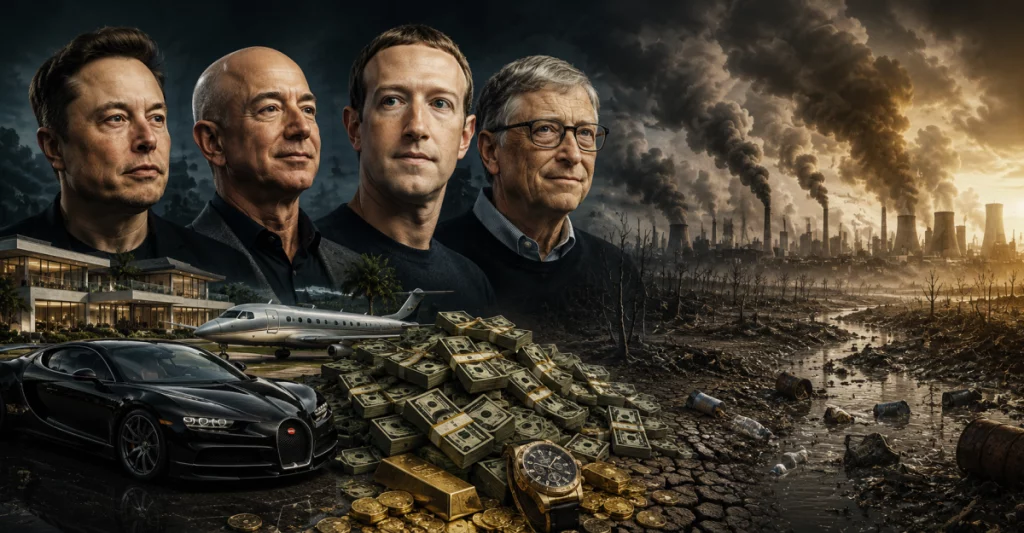
What if you received a bill worth trillions of dollars for environmental destruction?
Not because of an entire country. Not because of a multinational corporation. But because a relatively small segment of humanity was responsible for a disproportionate share of the damage.
According to a new study published in Communications Sustainability by researchers from the Oxford Martin School at the University of Oxford and Leiden University, the world’s highest-consuming 10% of people are responsible for between $1.7 trillion and $5.7 trillion in environmental damage every year.
That number is staggering for one reason. It exceeds current global commitments for climate and biodiversity funding and sits in the same range as what experts estimate is needed to address some of the world’s biggest environmental crises.
The study shines a spotlight on a difficult question: if environmental destruction creates real economic costs, who should ultimately pay for them?
The Hidden Environmental Bill Nobody Sees
Most environmental damage never arrives as an invoice.
When someone takes multiple long-haul flights every year, lives in a large home that consumes vast amounts of energy, owns several vehicles, or relies heavily on resource-intensive digital services, there is no direct bill showing the environmental consequences of those choices.
Yet those costs exist.
To make them visible, researchers combined consumption data with environmental pricing models from the Environmental Prices Handbook 2024. They calculated the economic cost of damage across four planetary boundaries:
- Climate change
- Biodiversity loss
- Nutrient pollution
- Freshwater use
Their findings reveal just how concentrated environmental impacts can be among the world’s highest consumers.
Key Findings From The Study
| Metric | Finding |
| Annual environmental damage | $1.7T – $5.7T |
| Group responsible | Top 10% consumers globally |
| US per-person damage bill | $19,000 – $63,000 |
| Global top 10% living in US & EU | Over 60% |
| Largest source of damage | Biodiversity loss |
| Climate damage contribution | 36-45% |
| Biodiversity contribution | 47-56% |
On an individual basis, the average annual environmental damage attributed to someone in the global top 10% ranges from $2,300 to $7,500. In the United States, the figure rises dramatically to $19,000 to $63,000 per person annually.
Researchers note that more than 60% of the global top 10% live in the United States and the European Union.
Why Biodiversity Loss Is A Bigger Problem Than Climate Change?
Most environmental debates revolve around carbon emissions.
The surprise finding from this study is that biodiversity loss creates a larger economic burden than climate change.
Globally, biodiversity-related damage accounts for 47% to 56% of total environmental costs. Climate change contributes 36% to 45%.
Breakdown Of Environmental Damage
| Environmental Boundary | Share Of Total Damage |
| Biodiversity Loss | 47-56% |
| Climate Change | 36-45% |
| Nutrient Pollution | Smaller Share |
| Freshwater Use | Smaller Share |
Why does biodiversity carry such a high price tag?
Because ecosystems quietly support nearly every part of the global economy.
Pollinators help produce crops. Forests regulate rainfall. Wetlands filter water. Oceans support fisheries that feed billions of people.
When species disappear and habitats degrade, these natural systems become less productive and less resilient.
Unlike carbon emissions, which can theoretically be reduced through cleaner technologies, extinct species cannot be brought back. Destroyed ecosystems often take decades, centuries, or longer to recover.
That makes biodiversity loss not only expensive but, in many cases, irreversible.
Why Wars Are Making The Problem Worse?
The study focuses on consumer-driven environmental damage. However, another growing factor is receiving increasing attention from environmental researchers: war.
Modern conflicts leave enormous ecological footprints.
The ongoing Russia-Ukraine war, the Israel-Gaza conflict, and numerous military operations worldwide have generated emissions through fuel consumption, weapons production, transportation, and reconstruction efforts.
The environmental impacts extend far beyond carbon.
Wars can destroy forests, contaminate water supplies, damage farmland, and fragment wildlife habitats. Explosions release pollutants into soil and waterways. Infrastructure destruction often creates environmental consequences that last for decades.
Despite this, military emissions remain underrepresented in many climate discussions.
The broader lesson is that environmental damage is not driven solely by consumers. Governments, military activity, and geopolitical conflicts can significantly amplify ecological pressures already affecting the planet.
The AI Boom Nobody Talks About
Another emerging environmental challenge is unfolding inside data centres.
Artificial intelligence has rapidly become one of the world’s fastest-growing technologies. But behind every chatbot response, image generation request, and AI-powered search lies a vast network of servers consuming electricity and water.
Technology companies such as Google, Microsoft, OpenAI, and Amazon are investing billions into AI infrastructure.
That growth comes with environmental trade-offs.
Environmental Pressures From The AI Boom
| Factor | Environmental Impact |
| Data centres | High electricity use |
| AI training models | Massive compute demand |
| Cooling systems | Large water consumption |
| Chip manufacturing | Resource intensive |
| Cloud infrastructure | Rising carbon footprint |
AI can certainly improve efficiency and accelerate scientific breakthroughs. But it is also driving unprecedented demand for computing power.
As governments and companies race to build more AI capacity, the environmental footprint of data centres is becoming an increasingly important part of the sustainability conversation.
It is worth noting that AI-related impacts are not included in the Oxford-Leiden study’s core findings. However, they represent an emerging multiplier that could increase future environmental pressures.
Why The Richest Consumers Have The Largest Footprint?
At its core, the study highlights a simple reality: higher consumption generally means higher environmental impact.
The world’s wealthiest consumers tend to travel more, own larger homes, consume more energy, purchase more goods, and maintain lifestyles that require significantly greater resource use.
But the researchers suggest the true environmental picture may be even larger.
The study measures only direct consumption.
For ultra-wealthy individuals, a substantial portion of emissions can come from investments in businesses, infrastructure, and financial assets. Some estimates suggest investment-linked emissions account for roughly half of total emissions among the highest-income groups.
Average Environmental Damage Per Person
| Group | Annual Environmental Damage |
| Global Top 10% | $2,300 – $7,500 |
| US Top Consumers | $19,000 – $63,000 |
| Lower-Income Countries | Significantly Lower |
That means the actual environmental damage associated with the wealthiest individuals may be considerably higher than the figures reported.
Could The Polluter-Pays Principle Work?
One of the study’s most interesting implications involves the “polluter pays” principle.
The idea is straightforward.
If environmental damage imposes costs on society, then those responsible for creating the greatest damage should contribute more toward solving it.
Potential approaches include:
- Carbon taxes
- Luxury consumption taxes
- Private jet taxes
- High-emission lifestyle taxes
Supporters argue these measures could generate significant funding for climate adaptation, conservation, and environmental restoration.
Critics point out that implementing such policies globally would be difficult. Wealthy individuals and corporations often have access to tax planning strategies that can reduce the effectiveness of national policies.
The researchers themselves stress that pricing mechanisms alone are not enough. Regulation, technological innovation, and behavioral changes are also necessary.
What The Study Doesn’t Capture?
Importantly, the authors emphasize that their estimates are conservative.
The research covers only four of the nine planetary boundaries used by scientists to assess Earth’s environmental limits.
It also excludes:
- Investment-linked emissions
- Several forms of environmental degradation
- Long-term ecological impacts that are difficult to monetize
Lead author Inge Schrijver of Leiden University notes that putting a monetary value on nature is uncomfortable because ecosystems possess value far beyond economics.
The purpose of the exercise is not to commodify nature, but to reveal the scale of environmental harm that often remains hidden.
In other words, the real environmental bill is almost certainly larger than the headline figures suggest.
Note: We have also explained- 10 Effective Strategies of Elon Musk That Made Him a Trillionaire . Go through the article for more information.
The Real Question Isn’t About Money
At first glance, this study appears to be about trillions of dollars.
In reality, it is about responsibility.
The researchers from Oxford Martin School and Leiden University are not claiming nature can be reduced to a price tag. Instead, they are attempting to make invisible costs visible.
Environmental damage affects ecosystems, communities, and future generations whether or not anyone pays for it directly.
The study’s central finding is difficult to ignore: a relatively small group of the world’s highest consumers is responsible for environmental damage worth up to $5.7 trillion every year, a figure comparable to what the world needs to address climate and biodiversity challenges.
If a small fraction of humanity is generating trillions of dollars in environmental damage every year, the debate is no longer whether the cost exists. The real debate is who ultimately pays for it.
Thanks for sticking with us 🙂 The numbers are staggering, but the conversation around responsibility is only just beginning!
