
One company owns some of the biggest money-making games on the planet. Yet despite billions of dollars in acquisitions, millions of daily players, and a growing global footprint, its future depends heavily on just three titles.
That’s the surprising reality of the Scopely mobile empire in 2026.
If you’ve played Monopoly GO, caught Pokémon in a local park, or seen ads for mobile games across social media, you’ve already witnessed the business Scopely has spent years building. What began as a mobile game publisher has evolved into one of the most powerful companies in the industry, backed by billions of dollars from Saudi Arabia’s Savvy Games Group.
But behind the headlines and acquisitions lies a fascinating question: how does a company generating enormous revenue still rely so heavily on a handful of games?
The answer reveals a lot about how the modern mobile gaming business really works.
The Quiet Rise of Scopely
Most people have never heard of Scopely, even though millions play its games every day.
Unlike Nintendo, Sony, or Microsoft, Scopely isn’t known for making gaming hardware or blockbuster console titles. Instead, it focuses on something far less visible but incredibly lucrative: running mobile games that keep players engaged for years.
Its strategy is surprisingly simple.
Find a game that people already love or build one that can become a hit. Then keep improving it through constant updates, events, rewards, and collaborations.
Think of it like running an amusement park.
If visitors see the exact same attractions every day, many will eventually stop coming. But if new rides, seasonal events, and special experiences keep appearing, people have a reason to return.
That’s essentially how Scopely approaches mobile gaming.
And in recent years, the company gained something even more valuable: scale.
In 2023, Saudi-backed Savvy Games Group acquired Scopely for $4.9 billion. Two years later, Scopely spent another $3.5 billion acquiring Niantic’s games business, including Pokémon GO.
The deals transformed Scopely from a successful publisher into a global gaming powerhouse.
The Three Games Carrying the Scopely Mobile Empire
Despite its large portfolio, three games generate nearly all of Scopely’s mobile revenue.
| Game | Role in Scopely’s Business | Main Challenge |
| Monopoly GO | Biggest revenue driver | Slowing growth |
| Pokémon GO | Stable long-term asset | Aging player base |
| Pixel Flow | Future growth bet | Proving it can last |
Together, these games account for roughly 95% of Scopely’s monthly in-app purchase revenue.
That level of concentration is both impressive and risky.
Imagine a restaurant chain where almost all profits come from just three menu items. As long as customers keep ordering them, the business looks fantastic. But if one item suddenly falls out of favor, the impact can be significant.
Scopely faces a similar challenge.
Monopoly GO: The Hit That Changed Everything
Few mobile games have exploded as quickly as Monopoly GO.
Launched in 2023, it became one of the fastest-growing games in mobile gaming history. Players loved rolling dice, building cities, stealing resources from friends, and collecting rewards.
The game generated more than $1 billion in revenue within seven months.
For a while, it looked unstoppable.
But success creates new problems.
As the initial excitement faded, growth naturally slowed. Monopoly GO still generates enormous amounts of money, but its monthly revenue is well below the record levels it reached in 2024.
That doesn’t mean the game is failing.
In fact, most publishers would dream of having a title that still earns over a billion dollars annually.
The challenge is that keeping players interested becomes harder every year.
Why Monopoly GO Changed Mobile Gaming?
To understand Monopoly GO’s success, you need to understand one of the gaming industry’s favorite buzzwords: live ops.
The concept sounds complicated, but it’s actually very simple.
Imagine opening your favorite app every day and finding something new waiting for you:
- A special tournament
- A limited-time challenge
- Exclusive rewards
- A collaboration with a famous brand
- New goals to chase
That’s live ops.
Rather than releasing a game and leaving it alone, companies constantly refresh the experience.
Monopoly GO became famous because it did this exceptionally well.
The game always seemed to have another event, another reward, or another reason to keep playing. Competitors quickly noticed and began copying the formula.
And that’s where the problem begins.
Once everyone starts using similar strategies, standing out becomes much harder.
The Growing Cost of Finding Players
Meanwhile, another challenge was quietly emerging.
Getting people to download mobile games has become increasingly expensive.
Think of online advertising like an auction.
Every gaming company wants attention. They all bid for the same ad space on social media, YouTube, search engines, and mobile apps.
The more competitors enter the market, the higher prices rise.
When Monopoly GO launched, Scopely reportedly spent huge sums attracting players. Today, newer games are competing for the same audience, making growth harder and more expensive.
As a result, Monopoly GO relies more heavily on keeping existing players engaged rather than constantly finding new ones.
Pokémon GO: A Different Kind of Asset
If Monopoly GO represents explosive growth, Pokémon GO represents something else entirely: stability.
When Scopely acquired Pokémon GO through its Niantic deal, some observers questioned the price.
After all, the game launched back in 2016.
Why spend billions on a ten-year-old title?
Because Scopely wasn’t buying a game.
It was buying a community.
Millions of people still play Pokémon GO. More importantly, Pokémon remains one of the most popular entertainment franchises in the world.
Fans don’t just engage with Pokémon through mobile games. They buy trading cards, watch shows, collect merchandise, and play console games.
That constant stream of activity helps keep the brand relevant.
Unlike Monopoly, Pokémon regularly creates new characters, stories, products, and experiences that pull fans back into its ecosystem.
That’s incredibly valuable.
The Revenue Most Players Never See
Another reason Pokémon GO remains attractive is that much of its business happens outside the app itself.
Most players assume game companies only make money from in-app purchases.
But modern mobile publishers have found other revenue streams.
One example is web stores.
Normally, purchases inside apps go through Apple or Google, which take a share of every transaction. Web stores allow publishers to sell directly to players through websites, keeping more of the revenue.
Pokémon GO also benefits from something few games can offer: real-world sponsorships.
Companies can pay to have their locations featured inside the game, turning stores, restaurants, and venues into destinations for players.
For Scopely, Pokémon GO isn’t about rapid growth.
It’s about dependable cash flow.
Pixel Flow: Betting on the Next Big Thing
The newest pillar of the Scopely mobile empire is Pixel Flow.
Unlike Monopoly GO and Pokémon GO, Pixel Flow doesn’t have a famous brand behind it.
It’s a puzzle game created by Loom Games, a small team of industry veterans.
Yet within months of launch, it became one of the fastest-growing games in its category.
Scopely moved quickly.
In early 2026, it acquired a majority stake in Loom Games in a deal that reportedly valued the company at more than $1 billion.
The acquisition reveals something important about Scopely’s strategy.
The company isn’t only interested in giant established franchises.
It also wants to identify breakout hits before they become obvious to everyone else.
The big question now is whether Pixel Flow can remain successful for years rather than months.
If Scopely can apply the same engagement techniques that powered Monopoly GO, the game could become another long-term winner.
The Risk Hidden Behind the Success
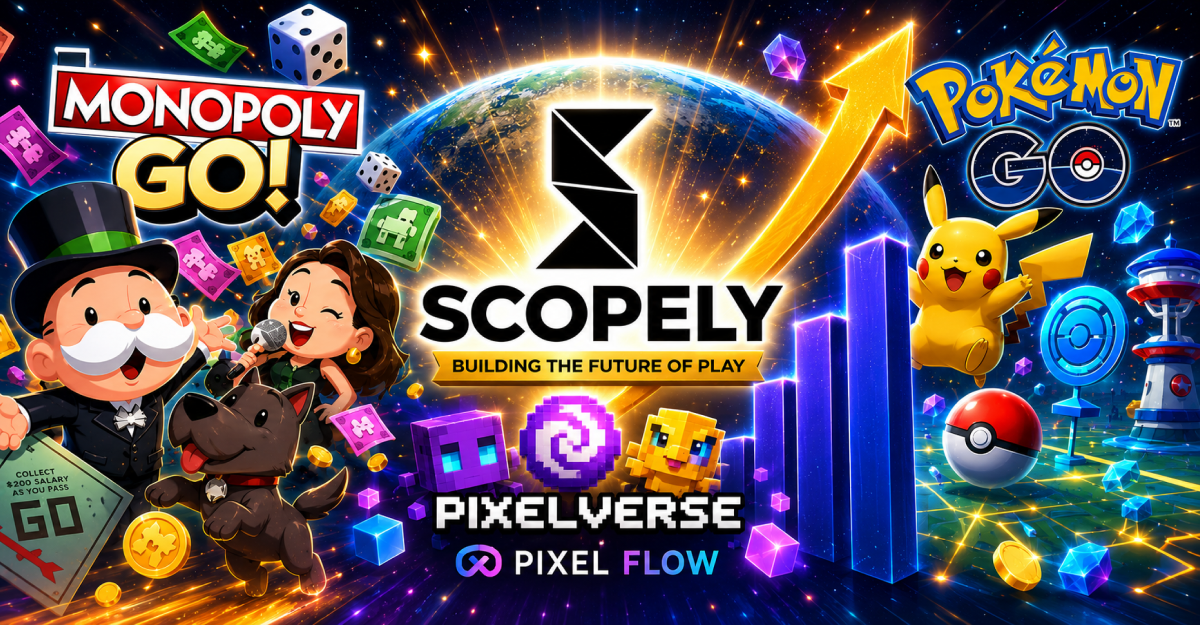
For all its strengths, the Scopely mobile empire faces a challenge that investors, developers, and competitors are watching closely.
It depends heavily on three games.
Monopoly GO is still huge but slowing.
Pokémon GO remains strong but is nearly a decade old.
Pixel Flow is growing rapidly, but is still unproven.
Outside those titles, Scopely owns dozens of other games, including Stumble Guys, MARVEL Strike Force, Star Trek Fleet Command, Scrabble GO, and Bingo Bash.
Together, they create a diversified portfolio.
Yet none currently carry the same weight as the top three.
Note: Do you know that AI has entered the segment of game creation, too? We have covered it here- Astrocade: The Free AI Game Maker Turning Ordinary People Into Game Creators. You can go through the article for more info.
What Happens Next?
The future of the Scopely mobile empire may not depend solely on its existing games.
It may depend on its ability to find the next one.
Scopely has built a reputation for acquiring successful studios, identifying promising franchises, and operating games for the long term. The company’s backing from Savvy Games Group gives it resources that many competitors simply cannot match.
But even the best operators cannot escape a basic reality of entertainment.
Every hit eventually ages.
Every audience eventually changes.
The challenge is finding the next winner before the current one slows down.
That’s why the story of Scopely in 2026 isn’t really about Monopoly GO, Pokémon GO, or Pixel Flow individually.
It’s about whether a company that mastered the art of running blockbuster games can continue discovering the next generation of them.
For now, the Scopely mobile empire remains one of the most powerful forces in mobile gaming.
The question is whether three games are enough to keep it that way.
