

ISRO has made India proud with achievements like Chandrayaan-3, Aditya-L1, and the upcoming Gaganyaan mission. So, reports of over 100 scientists leaving the organisation have naturally raised eyebrows across the country.
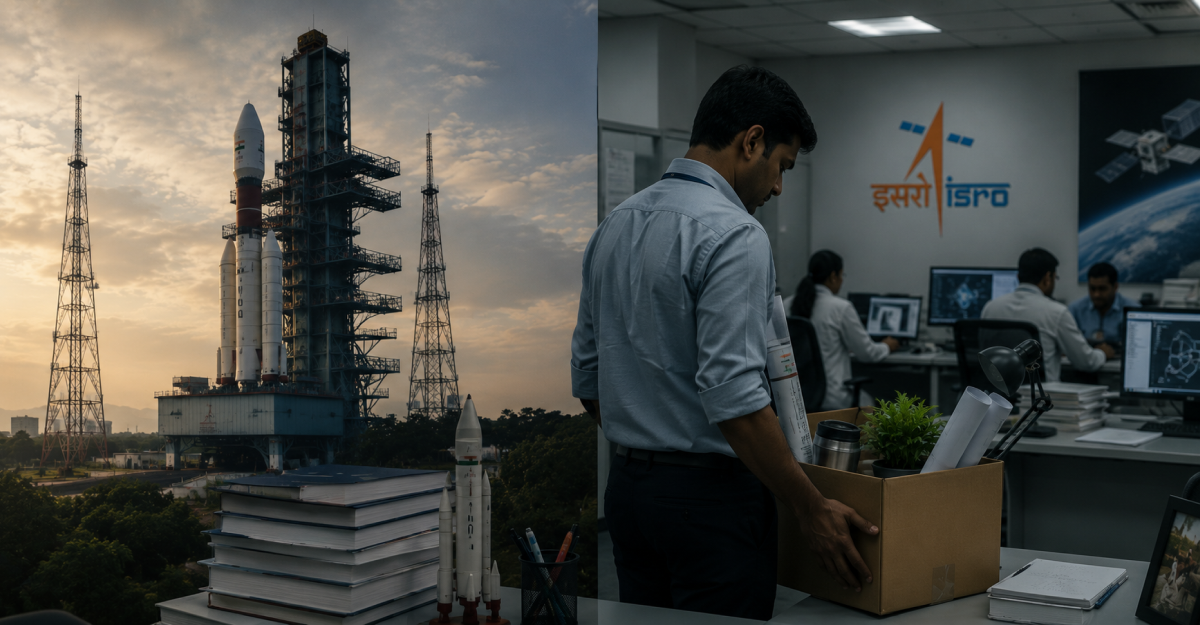
The reported ISRO scientist resignations have prompted the Government of India to tighten resignation and voluntary retirement rules for scientists working on critical space missions.
But why are experienced researchers leaving one of the world’s most respected space agencies, and could these departures affect India’s future in space?
Let’s break down what the reports say and why this development matters!
What Do the Reports Say About ISRO Scientist Resignations?
According to multiple media reports citing official communications and ISRO sources, around 100 to 120 scientists have reportedly resigned or sought voluntary retirement in recent months. Reports mention an internal memorandum dated July 14 that instructed ISRO centres not to process resignation or voluntary retirement requests from certain Group A scientific and technical employees without prior approval from the Department of Space.
The reported directive is aimed at scientists working on critical national missions where the loss of experienced personnel could affect long-term projects. While ISRO has not released an official count of resignations, the reported figures have been widely covered by credible news organisations. The Department of Space is expected to review such requests before any final decision is taken.
| ISRO Centre | Location | Reported Resignations* | Primary Work |
| UR Rao Satellite Centre (URSC) | Bengaluru | Around 60 | Satellite design and development |
| Vikram Sarabhai Space Centre (VSSC) | Thiruvananthapuram | Around 40 | Launch vehicle and rocket development |
(*Figures are based on media reports and sources cited by news organisations. ISRO has not officially confirmed a centre-wise breakup.)
Why Has the Government Tightened Exit Rules?
Building a space mission takes years of planning, testing, and teamwork. Scientists often spend a significant part of their careers working on a single project before it reaches launch. When experienced experts leave suddenly, replacing them is not as simple as hiring new employees.
Many ISRO scientists possess specialised knowledge that has been developed through years of research and practical experience. They understand complex spacecraft systems, launch procedures, satellite integration, and mission planning. Much of this expertise is gained through hands-on work rather than textbooks alone.
The government’s reported decision reflects the strategic importance of India’s space programme. Missions such as Gaganyaan, future Chandrayaan projects, advanced satellites, and launch vehicle development depend on stable teams.
By introducing additional approval requirements, the Department of Space aims to reduce sudden manpower shortages while ensuring knowledge remains within ongoing projects.
What Is Gaganyaan and Why Is It So Important?
Gaganyaan is India’s first planned human spaceflight mission. Its objective is to send Indian astronauts into low Earth orbit aboard an indigenous spacecraft before bringing them safely back to Earth. The mission represents a major technological milestone for the country and requires years of careful preparation.
Unlike many satellite launches, human spaceflight demands extremely high safety standards. Every spacecraft system, rocket component, life-support mechanism, and emergency procedure must work flawlessly. Experienced ISRO scientists play an essential role in designing, testing, and validating these technologies.
Beyond Gaganyaan, ISRO is also working on future Chandrayaan missions, navigation satellites, Earth observation satellites, PSLV and GSLV launch vehicles, and scientific programmes that support weather forecasting, communication, and national development. Retaining skilled personnel helps ensure continuity across these long-term projects.
Why Might Scientists Be Leaving ISRO?

ISRO has not officially disclosed the individual reasons behind the reported resignations. As a result, any explanation should be treated carefully and should not be presented as a confirmed fact.
However, the broader space industry has changed rapidly in recent years. India’s growing private space sector, along with increasing global demand for aerospace engineers and researchers, has created new career opportunities. Private companies often offer higher salaries, faster career progression, flexible work environments, or opportunities to work on commercial space technologies.
Some scientists may also leave for personal reasons, higher education, international research opportunities, or family considerations. These factors are common across many scientific organisations and are not unique to ISRO.
At present, there is no official evidence suggesting that all reported ISRO scientist resignations were driven by a single reason. Instead, the reported departures appear to reflect a combination of individual career decisions and wider industry trends.
Thanks for reading! If you found this article helpful, explore our latest explainers on science, technology, and business.
