
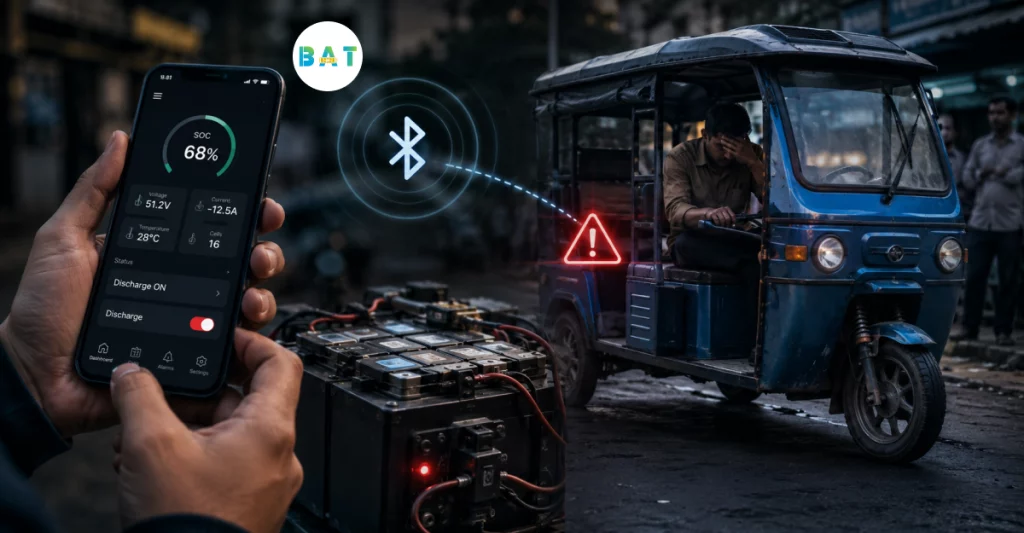
Nowadays, social media is flooded with videos of distressed e-rickshaw drivers after some mischief-makers allegedly switch off their vehicles remotely, causing them to lose customers and income. If this sounds like a minor prank, imagine driving through a busy street when, without any warning, your e-rickshaw suddenly comes to a halt.
The battery isn’t empty. The motor hasn’t failed. Instead, someone nearby may have tapped a few buttons on their smartphone.
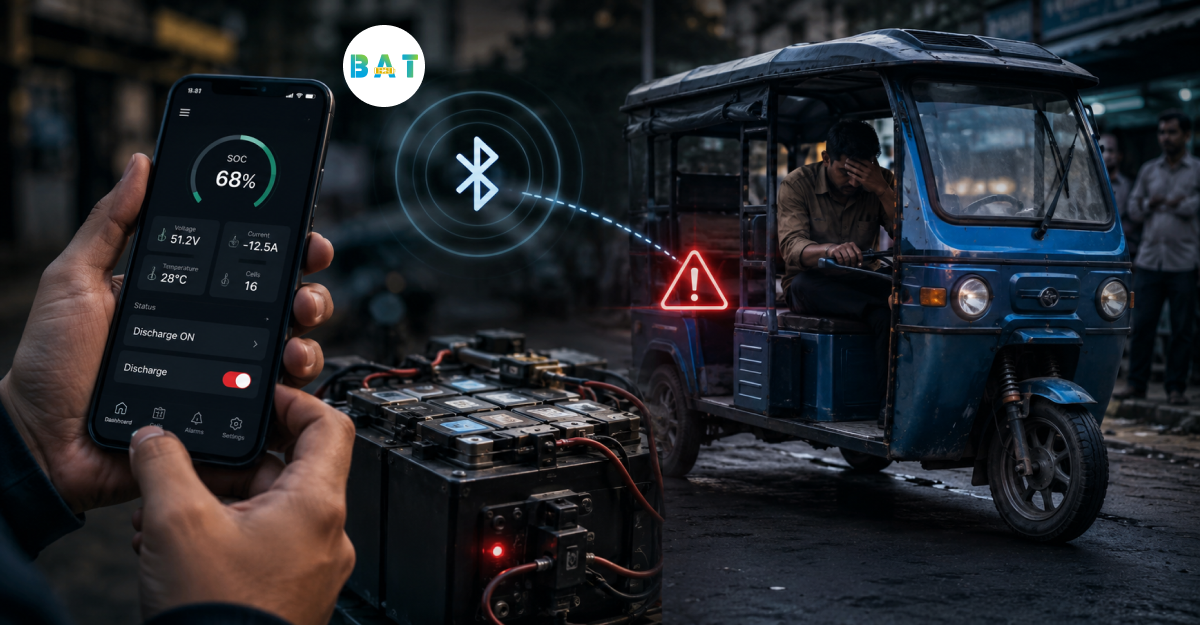
That unsettling scenario has fueled the viral BAT BMS Tirri Control App trend across Instagram, YouTube, Reddit, and X. Videos showing people remotely stopping e-rickshaws have attracted millions of views, leaving many wondering whether any electric vehicle can be controlled from a phone.
The truth is both reassuring and concerning.
The BAT BMS Tirri Control App is not a hacking tool designed to attack electric vehicles. It is a legitimate battery management application. However, some people are misusing it to exploit poorly secured battery systems. The controversy has exposed a much bigger issue: weak cybersecurity in certain low-cost lithium battery setups.
Let’s separate social media myths from verified facts!
What Is the BAT BMS Tirri Control App?
The BAT BMS Tirri Control App is a genuine battery monitoring application developed by Shenzhen Grenergy Technology. It is designed to communicate with compatible Bluetooth-enabled lithium batteries through their Battery Management System (BMS).
Think of a Battery Management System as the brain of a battery. Just as your phone’s operating system keeps its battery healthy, a BMS constantly monitors how an EV battery charges, discharges, and operates safely.
The BAT BMS app allows battery owners to monitor information such as:
- Battery voltage
- Current flow
- Temperature
- Individual cell health
- Remaining battery capacity
- Charge and discharge status
- Charge cycles
For businesses using solar storage, boats, backup power systems, or lithium battery packs, these features are extremely useful. The app was never intended to hack vehicles. The problem begins only when compatible batteries are left unsecured.
How Does the Viral “Tirri Control” Prank Actually Work?
Contrary to many viral claims, the prank is not a sophisticated cyberattack. It depends on a battery system that has weak Bluetooth security.
Some inexpensive lithium battery packs used in e-rickshaws and electric scooters include a Bluetooth-enabled Battery Management System. If manufacturers or dealers leave Bluetooth access open without authentication, anyone nearby with the BAT BMS app may be able to connect.
Once connected, the app allows users to disable battery discharge. Since the motor depends on battery discharge for power, the vehicle immediately stops moving.
| Steps | What Happens |
| 1 | Phone detects a nearby Bluetooth-enabled battery |
| 2 | BAT BMS connects to an unsecured Battery Management System |
| 3 | User disables battery discharge |
| 4 | The battery stops supplying power |
| 5 | The vehicle comes to a halt |
The videos look dramatic because the shutdown appears instant. However, the app is not magically taking over every EV. It is simply communicating with an already vulnerable battery system.
Why Doesn’t It Affect Every EV?
This is the most misunderstood part of the controversy.
The BAT BMS Tirri Control App works only if all of the following conditions are true:
- The vehicle uses a Bluetooth-enabled lithium battery.
- The Battery Management System allows Bluetooth access.
- No password or authentication protects the connection.
- The person is within Bluetooth range, usually around 10 to 15 metres.
If even one of these conditions is missing, the prank is unlikely to work.
| Vehicle Type | Vulnerable? | Why |
| Lead-acid e-rickshaw | No | No Bluetooth-enabled BMS |
| Password-protected lithium battery | Very unlikely | Authentication blocks access |
| Bluetooth lithium battery without a password | Yes | Open Bluetooth access |
| Premium EV brands | Usually no | Better cybersecurity and secure architecture |
Many older e-rickshaws still rely on lead-acid batteries, making them immune to this specific issue. Likewise, most well-designed EVs include stronger security measures that prevent unauthorized Bluetooth connections.
Why Has This Trend Gone Viral?
The internet rewards surprising content, and few things are more surprising than watching a moving vehicle suddenly stop because of a smartphone.
The “Tirri Control” videos combine entertainment with shock value. Many creators present the prank as revenge against reckless drivers or as a social experiment. That emotional angle encourages people to share the clips, helping social media algorithms spread them even further.
Unfortunately, many viewers assume the videos prove that every electric vehicle can be remotely controlled. That simply is not true.
The Real Problem Isn’t the App
Blaming the BAT BMS app for this issue is a bit like blaming a house key because someone forgot to lock the front door.
The application is performing exactly the functions it was designed to perform. The real weakness lies in battery systems that leave Bluetooth access open without passwords or proper authentication.
Poor manufacturing practices, weak security settings, and inadequate quality control create the conditions that make these pranks possible.
Without those security gaps, the BAT BMS Tirri Control App cannot randomly stop nearby vehicles.
Why This Is a Bigger Cybersecurity Problem?
The controversy highlights an issue that extends well beyond e-rickshaws.
Modern vehicles increasingly rely on connected technologies, wireless communication, smart batteries, and software updates. Every connected feature creates another potential digital entry point if manufacturers fail to secure it properly.
Today’s concern involves unauthorized battery shutdowns. Tomorrow’s risks could include:
- Firmware manipulation
- Battery data theft
- Unauthorized system access
- Service disruption
- More sophisticated attacks on connected vehicle components
As India’s EV ecosystem grows, cybersecurity is becoming just as important as mechanical reliability.
| Feature | Lead-acid Battery | Bluetooth Lithium Battery |
| Bluetooth connectivity | No | Yes |
| Battery monitoring app | Not required | Supported |
| Remote monitoring | No | Yes |
| Remote misuse possibility | No | Possible if unsecured |
What Drivers Should Do?
Most EV owners do not need to panic, but they should understand how their battery system works.
| Action | Why It Helps |
| Enable a BMS password | Blocks unauthorized Bluetooth access |
| Ask the dealer about Bluetooth security | Ensures proper configuration |
| Update battery firmware | Fixes known vulnerabilities |
| Avoid unknown Bluetooth pairing | Reduces security risks |
| Verify battery type | Helps determine whether the issue applies |
Drivers should also ask whether their battery broadcasts Bluetooth signals continuously and whether authentication has been enabled before purchasing a vehicle.
Who Is Responsible?
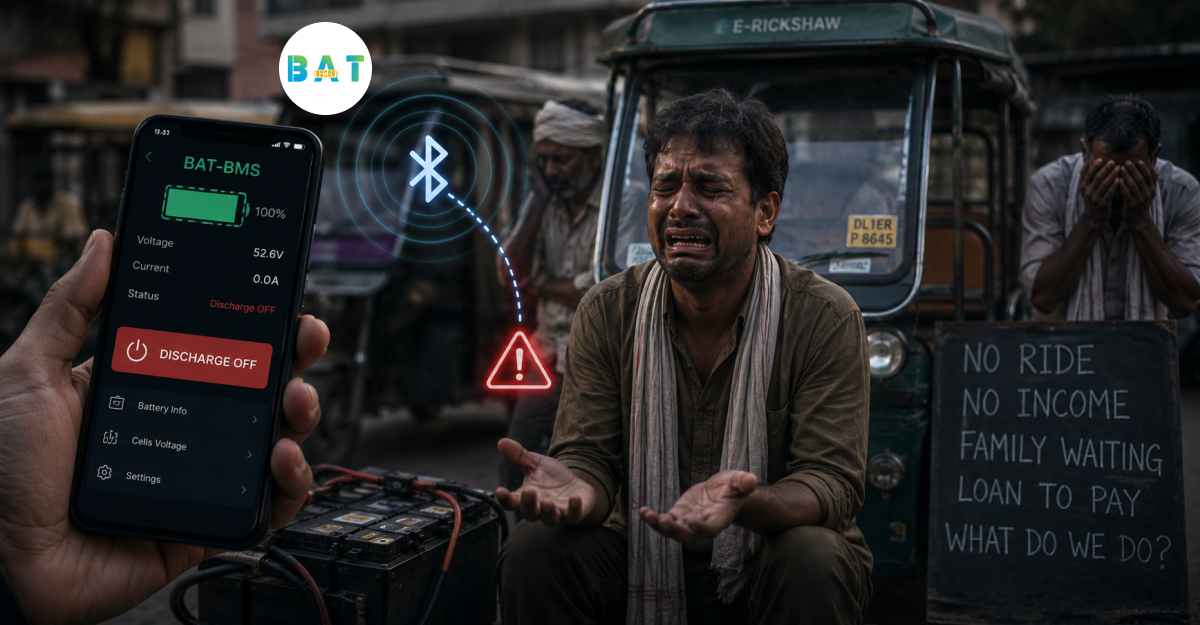
Responsibility does not fall on one party alone.
Battery manufacturers should build secure Battery Management Systems with password protection enabled by default.
Vehicle manufacturers should verify that every battery installed meets basic cybersecurity standards.
Dealers should configure batteries correctly before handing vehicles to customers.
Consumers should understand what type of battery their vehicle uses and request secure Bluetooth settings when buying a new EV.
Security works best when everyone in the supply chain treats it as a priority.
Is BAT BMS a Dangerous App?
No.
The BAT BMS Tirri Control App is a legitimate battery management application used for monitoring compatible lithium batteries. Similar battery management apps are common across the energy and electric mobility industries.
The app has been available on the Google Play Store for legitimate battery monitoring purposes. Reports indicate that it is no longer available on Apple’s App Store, although the company has not publicly detailed the reason. The app itself is not malware, nor is it designed to attack vehicles.
Problems arise only when poorly secured Battery Management Systems allow unauthorized access.
| Myth | Reality |
| BAT BMS can stop any EV | It works only with certain unsecured Bluetooth-enabled battery systems |
| Every electric scooter is vulnerable | Only specific battery configurations are affected |
| BAT BMS is malware | It is a legitimate battery monitoring application |
| The app hacks vehicles | It communicates only with compatible Battery Management Systems |
What This Means for India’s EV Industry?
India is one of the world’s fastest-growing electric vehicle markets. As more vehicles become software-driven and connected, digital security must become part of standard vehicle safety.
Battery cybersecurity can no longer be treated as an optional feature reserved for premium vehicles. Basic protections such as password authentication, secure Bluetooth pairing, and regular firmware updates should become industry norms.
The BAT BMS Tirri Control App controversy has not revealed a dangerous app. It has revealed a gap in how some connected battery systems are secured.
The viral prank will eventually disappear from social media. The lesson it leaves behind should last much longer. In the next generation of electric vehicles, cybersecurity will be just as essential as brakes, tyres, and seatbelts!
